Introduction
For over 90 years, archaeologists in eastern North America have used the Archaic to denote a time period that preceded the Woodland period. The Archaic is the kind of term that archaeologists love, because it has become a shorthand for a whole lot of things, not just chronologically. It is also one of those words that could give offense. So it is worth our time to take a deep dive into its meaning, its origins, and whether it is defensible as a concept or a word choice.
As archaeologists, we try to use terms in precise ways. It allows us to use them economically, as a signal of greater underlying meaning. In the moment, we rarely think about why we pick one term over another to indicate an archaeological idea. As archaeology has evolved as a discipline and as society has changed, some terms lose their meaning. Some become offensive. So we adapt.
Finally, it is very likely that little of what is presented below is new or original. Numerous authors have plowed this ground over the last 30 years, and I weighed whether or not raising these points again are worthwhile. Ultimately, I decided that since there seems to be no current conversation over the Archaic and one is worthwhile, here it is.
Archaic, what?
Some years ago, I was confronted at a Tribal Summit with the fact that archaeologists routinely refer to the period of North American archaeology that existed before European contact as “prehistoric.” It was considered offensive insofar as it suggested indigenous peoples in North America did not have a history. Duly noted. Since then, I’ve been more careful in using that particular term, preferring pre-contact, which is descriptive and flexible in that it doesn’t set a specific date to start the subsequent proto-historic or historic time periods.
More recently, I came across a Guide for Referencing Indigenous Communities put out by the New York Archaeological Council suggesting more respectful terminology. Among the critiqued terms were “Archaic” and “Woodland” as well as “prehistoric.”
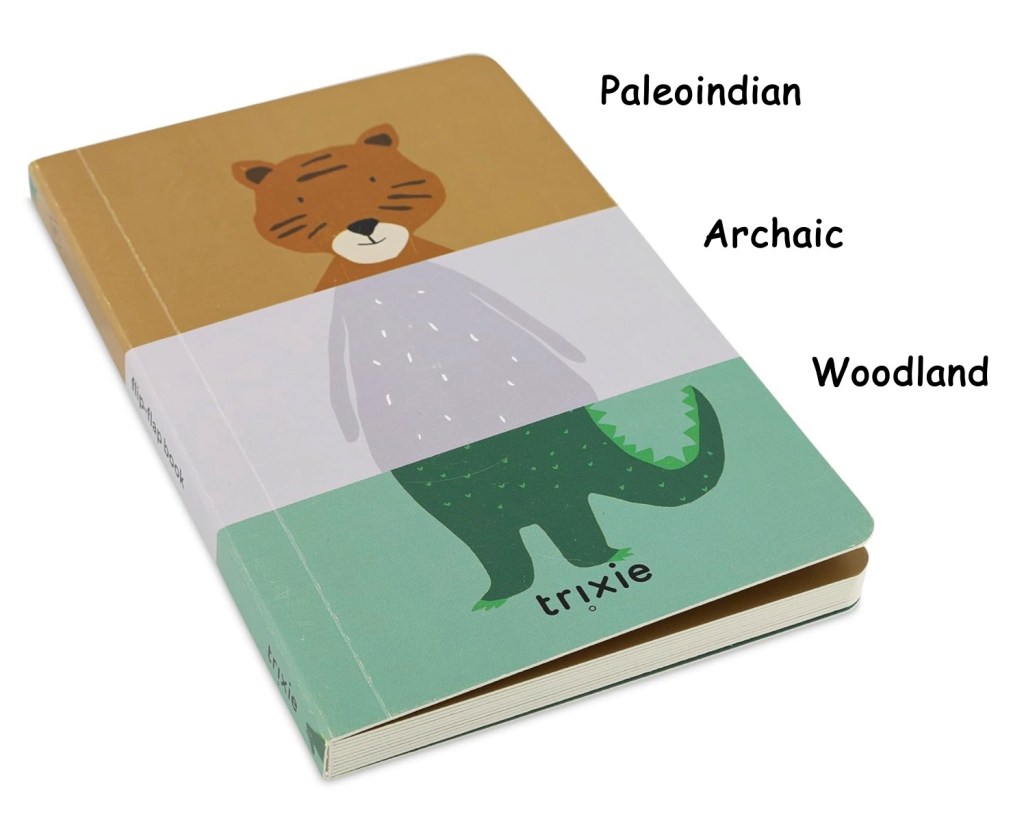
It got me wondering. Why do we call the time period after Paleo-Indian and before Woodland “Archaic.” What are we actually describing here? And as an aside, why do we go from “Paleo-Indian” to “Archaic” to “Woodland?” It reminds me of the flip flap books, where the top is a penguin, the middle is a bear and the bottom is a rabbit.
I had spent my entire professional career happily oblivious to these and other questions. The current moment seems to call for other thinking.
Archaic With a Small “a”
Where does the term “Archaic” come from? And more importantly, when we say something is “Archaic,” what are we suggesting? Should we start at the beginning? During the last quarter of the 18th century and first quarter of the 19th, Scandinavian historians and archaeologists developed the Three-Age System, a sequence of three stages in the prehistoric past: Stone, Bronze, and Iron (Daniel 1967:79). Christian Jurgensen Thomson, in 1816 the curator of the newly established National Museum in Copenhagen, organized the vast collections from the peat bogs, burial chambers, and kitchen middens of Denmark into three successive ages of Stone, Bronze, and Iron, as much to get his arms around the collections as to interpret them. The Three-Age system has been properly described as the “cornerstone of modern archaeology.” (Macalister in Daniel 1967).
Following the publication of Origin of Species in 1859, there was a flurry of scientific and archaeological discoveries. By the late 19th century, anthropologists and archaeologists had landed on a theory of unilineal evolution, going from savagery through barbarism to civilization. While the Three-Age system was found to be unworkable in the new thinking – the Three-Age System being mainly about artifactual materials – the developed evolutionary stages incorporated technology, social organization, alphabets, speech, and writing and the presence or lack thereof (see Morgan 1877)
In the first decades of the 20th century, unilineal evolution had been discredited. Each new archaeological or ethnological discovery seemed to poke holes in the cultural progressions so carefully worked out 30 years earlier. Replacing it was a school of anthropology, led by Franz Boaz and others, that played a much smaller theoretical game and focused on description and specific artifacts and behaviors. What we describe as culture change was subsumed under the study of culture processes.
By processes of culture we mean those factors which operate either toward the stabilization and preservation of cultures and their parts, or toward growth and change. Changes, in turn may consist either of increments, such as new developments, inventions, and learned traits acquired from outside; or of losses and displacements. Beyond these, there are minor alterations or fluctuations that are neither particularly additive nor deductive, as when the wheel base of automobiles is shortened, or the floor is lowered, or the engine is placed behind. (p. 344) (Kroeber 1948).
For anthropology, the work was now devoted to finding and explaining invention versus diffusion. Archaeology soon followed, explaining cultural change as a product of independent invention or of cultural contact with another society, adopting the new whatever. The culmination of an archaeological methodology to address this historical approach is the Midwestern (or McKern) Taxonomic System, introduced in the early 1930’s. But we are ahead of ourselves.
In North America, the use of the term “archaic” to describe either a stratigraphic level or culture can be traced to 1910 with the description of the lowest level of human remains in the Valley of Mexico and also used by Spinden to describe an archaic people of Nahua stock (Byers 1959:229). In eastern North America, the term appears as early as 1919, but each example is in lower case and used somewhat generically as an adjective to describe the earliest stage of Algonkian occupation (of New York):
The first or archaic occupation yields crude implements, such as large and clumsy arrow points, but occasionally very fine spear heads, many net sinkers… (Parker 1923:50)
Archaic could more innocently be ascribed as simply old. Emerson and McElrath (2009) noted the neo-evolutionary roots of the term archaic, “the Archaic pattern is a reflection of a primitive stage in a cultural-neo-evolutionary sequence. As noted above, the common meaning of the archaic label itself was inherent in the archaeological definition – to be archaic was to be technologically and socially primitive.” (p.26) I agree that archaeologists in the 19th century thought of ancient societies as being technologically and socially primitive. I also agree that archaeologists in the last half of the 20th century through today likely associate the Archaic with a less technologically and socially advanced society. During this early 20th century period, I believe that archaeologists and their anthropological theoreticians applied the term more as being really old, but not carrying the bulk of unilineal evolutionary baggage. For me, the tipoff is the small “a” use of the term as an adjective, not a noun.
Archaic with a Capital “A”
This all changes in 1932. William Ritchie described his excavations at Lamoka Lake, ascribing to its inhabitants,
“an early level of culture based on hunting, fishing and gathering of wild foods, and lacking pottery, the smoking pipe and agriculture.” (Ritchie 1932b; 1980)
He labelled the traits associated with this culture as the Archaic, Archaic Algonkian, and Archaic Algonkian Period (Ritchie 1932a).
In his formulation of a Midwestern Taxonomic System, W. C. McKern more formally established a pattern named Archaic within the five-level taxonomy – focus, aspect, phase, pattern, and base (McKern 1939). It is important to emphasize that in the McKern system, the focus was on “hierarchically ordered categories of morphologically similar associated component assemblages” (Schwartz 1996). McKern notes specifically the focus on cultural traits rather than time or space in using the taxonomic system:
In brief, the archaeologist requires a classification based upon the cultural factor alone; temporal and distributional treatments will follow as accumulating data shall warrant. Moreover, the archaeological classification necessarily must be based upon criteria available to the archaeologist.” (p. 303).
The close scrutiny of cultural traits, especially those discoverable archaeologically, fits well into the anthropological theory of the time, that of invention and diffusion, and of core area. The goal was to figure out, based on traits, where the component in an archaeological site fit in time and space, but more importantly, whether these traits found at this particular site were the result of invention (meaning part of the core area) or a result of diffusion.
As noted by numerous authors (Willey and Phillips 1958, Byers, 1959, Stoltman 1992, Emerson and McElrath 2009), by the 1940’s archaeologists had found that the concept of archaic was too useful to be left to mere taxonomic usage.
Because it now appears that this nonagricultural, nonpottery, hunter-fisher-collector pattern of culture may have been widespread in the eastern United States in early aboriginal times, the term “Archaic” is here adopted to designate this patter manifestation in Kentucky and Alabama.” (Webb and DeJarnette 1942:319)
Ford and Willey applied Archaic to the earliest known cultural horizon in the East.
The cultures of this period were “archaic” in the true sense; horticulture was lacking, pottery is either absent or makes it appearance later in the stage, and the abundance, variety and qualities of artifacts do not compare with the more complex later developments. On the other hand, the archaic cultures established a complex containing many elements which lasted on into later periods. This stage appears to provide a sort of foundation cultural pattern for the East into which new traits and complexes were intruded to form the later cultural stages. (Ford and Willey 1941:332)
Some archaeologists, Sears (1948) among them, found the Archaic concept difficult to fit into either the Midwestern Taxonomic System or into a cultural period. Ironically, most seemed perfectly satisfied to adopt it into a unilineal cultural evolutionary stage, whether it was the earliest known culture in North America, or as a subsequent cultural period following Paleoindian inhabitants (see also Krieger 1953). Prior to effective chronological dating, there was even some disagreement as to whether the cultures so described as archaic were in fact old enough to warrant that moniker (Emerson and McElrath 2009:25). In the scrum over just what was the archaic, the contemporary anthropological goals of explaining culture change seemed to have been left aside.
The Periods They are a Changin’
A confession. I am a product of the New Archaeology. Where we trace our origins vary. Some put it with Walter Taylor’s 1948 A Study of Archaeology. Others with Leslie White’s 1959 The Evolution of Culture. The shot across the bow may have come in Willey and Phillip’s 1958 Method and Theory in American Archaeology, particularly the oft-cited statement that “American archaeology is anthropology or it is nothing” (p. 2). As unkindly, but not unfairly described by Emerson and McElrath (2009), this led to a stampede of hunter-gatherer interest within Archaic period studies, with perhaps the neo-evolutionary or multi-lineal evolutionary theory running far ahead of the data. What was clear was the accepted narrative of the cultures living during the Archaic period having a post-megafauna but pre-agricultural hunter-gatherer adaptation to an evolving Holocene landscape.
Almost overnight, the conversation over the Archaic and it’s taxonomic problems were swept under the rug of adaptation, so much so that by the time I entered graduate school in 1976, the origin story of the “Archaic” was never spoken. The McKern Taxonomic System was relegated to a few paragraphs in the history of archaeology, and lumped with the Boazian particularistic historical approach. This little trick neatly severed the term Archaic and its time period utility, from any other context or cultural or trait-laden attributes.
Except for a few ne-er-do-wells and post-processualists, this terminological sleight-of-hand has stood unchallenged for 60 years. An early foray into the newer thinking comes from John Witthoft, who in a piece from 1961, diverges from Sears’ characterization of the Archaic as “a basic culture-complex subject to slight variation over huge times and regions”(1971:97). Instead, Witthoft sees a vast and infinitely variable series of simple technologies, with space and time units often as small as county and century.” He leans toward an anthropological definition, characterizing the Archaic as “the community of a single hunting territory- the band or horde, or the larger community of intermarrying family hunting bands – the tribe in the sense of Australian ethnology.” Later on, he contrasts Archaic with Paelo-Indian’s specialization on large game to Archaic man occupying “every sort of ecological niche available in our temperate regions”(p.101).
By 1985, the Archaic had largely been defined in cultural ecological terms.
With the end of the Pleistocene between 11,000 and 9,000 B.P. a newly diversified biome and moderate climate was established over most of North America. Milder temperatures and the retreat of the ice permitted a more heterogeneous vegetation and fauna to replace the subarctic biotic regime characteristic of the Pleistocene. Cultural adaptations to this environmental change are characteristic of the Archaic period.” (Raber 1985:11)
The general pattern suggested for the Archaic is, in summary, one of seasonal movement by small bands of hunter-gatherers through a series of base camps, hunting/butchering stations, and special-purpose camps adapted to a wide variety of animal and plant resources. The greater variety of subsistence pursuits is indicated in the archaeological record by a greater variety of site types, artifact types, and floral or faunal remains.” (p.12)
A decade later, archaeologists use the concept of the Archaic as a heuristic, encompassing a time period, a temperate forest hunting-fishing-gathering/collecting economy, and as a tool kit that includes ground stone tools, varied stemmed and notched projectile points, netsinkers, etc. (Raber et al. 1998:121-122). Also importantly (and we will get back to this later), they note two main problems with the Archaic, namely: 1) Archaic cultural patterns of a hunting-fishing-gathering economy persist well into the Woodland Period, and 2) Early Archaic patterns are “fundamentally indistinguishable from those of the late Paleoindian period” (p.121). Other than a chronological fence line, how would you know you were in one Period or another?
The characterization of the Archaic as an adaptation carries through to the current syntheses. In its popular iteration (Carr and Moeller 2015), the Archaic is defined as “an adaptation to a forest environment and involves a new set of tools” (p.74).
They begin to exploit a wide variety of upland environments along smaller bands. In contrast to the Paleoindian period, the bands are less mobile, they do not cover large territories, and populations increase dramatically by the end of the period. In addition, bands begin to regionalize…The Archaic period ends with the appearance of a new and very distinctive set of artifacts. These include broad-bladed spearpoints/knives aptly called broadspears.” (p.74)
The ”professional” version (Bergman et al 2020) is largely the same. However, they do provide some additional context. They note Ritchie is credited with introducing the term “Archaic” in 1932.
…it is the Archaic period for which archaeologists are able to define and describe specific settlement systems…In the Middle Atlantic region, at least until the 1970’s, a cultural/historical approach dominated the research of the Early and Middle Archaic periods.”(p.107)
In addition:
The Early and Middle Archaic periods mark the transition from the landscapes of the Late Pleistocene into the deciduous forests of the mid-Holocene…This is a time of increasing cultural regionalization, involving band-level societies participating in a foraging economy…The Early Archaic is characterized by a distinctive change in projectile point design associated with significant environmental changes beginning at about 10,000 BP.” (p.105)
the Early Archaic is frequently characterized as the first adaptation to a Holocene environment.”(p.107)
Not everyone was with the program. Nearly 30 years ago, Jay Custer (1996) chose to create a taxonomy of cultural periods that did not include the Archaic (nor Woodland for that matter) as a lifeway. While accepting the use of the Archaic strictly as a time period (8,000-1,500 BC), he notes:
The major complication in the use of the chronological system in Table 1 arises from the fact that the main period terms (Paleo-Indian, Archaic, and Woodland) have come to be associated not only with chronological periods, but with types of prehistoric lifeways as well. (p.19)
Custer’s solution for the taxonomy of cultural periods (p.21, Table 2) was :
Hunter-Gatherer I
Hunter-Gatherer II
Intensive Gathering-Formative
Village Life
Contact
This taxonomy was not widely adopted, but certainly begs the question, “Why not?”
When We Say Archaic, What Do We Mean Exactly?
Since its introduction over 90 years ago, archaeologists have used the term Archaic to denote a stage in unilineal evolution, a pattern in an asynchronous and spatially floating taxonomic system, a pejorative, a time period, and a cultural adaptation. If there is something like a consensus, archaeologists would agree that in the Eastern United States at least, “The Archaic” is pre-ceramic, pre-agricultural, post-Pleistocene, and post-Paleoindian. As a time period, “The Archaic” (in Pennsylvania) starts around 10,000 years ago and ends around 3,000 years ago in the Upper Ohio Valley and Susquehanna Drainage Basins and 2,800 years ago in the Delaware Drainage Basin (Carr et al 2020). Finally, “The Archaic” is associated with a hunter-gatherer-collector adaptation to a deciduous forest environment. While noting some difficulties pinning down the specifics of the Archaic, especially when it starts, when it ends, what changes from one period to the next, its use as a cultural adaptation has largely been uninterrupted for the last 60 years.
For argument’s sake, let’s drop the word choice “Archaic.” We’ll call this thing “Fred” instead. And my apology to all the Freds out there who might take offense. How well does Fred hold together as a time period, an adaptation, etc.? Let’s start with pottery. We now know the earliest pottery in the Eastern United States was produced during the Late Fred by the Stallings Culture in southeastern Georgia. In Pennsylvania, you see a continuum of hard vessel manufacturing from steatite to steatite-tempered during the Late Fred to Early Woodland time periods. This also does not take into account vessels not made from stone or clay, but which functionally served that purpose (Stewart 2003:8-9). Anderson and Sassaman bluntly state “The appearance of pottery…no longer marks the end of the Archaic (now Fred) and the beginning of the Woodland period as it once did (Anderson and Sassaman 2012:107).
OK, what about agriculture? Implicit in the adoption of an agricultural economy was the notion of moving away from a hunter-gatherer-collector economy. Unfortunately, the peoples of precontact Pennsylvania didn’t drop their spears, atlatls and collecting baskets on a Friday and pick up corn kernels and a hoe on a Monday. In Pennsylvania, the “Three Sisters-“ corn, beans, and squash did not appear in the diet at the same time. Squash seems to have come first, around 5,400 BP, and domesticated independently from Mesoamerica (Hart and Asch Sidell 1997). Maize followed around 2,000 BP, then Beans a thousand years later. Beyond the Three Sisters, sumpweed and chenopodum were domesticated during the Late Fred, and sunflower was introduced from the west also during the Late Fred. When pressed, I believe all archaeologists would concede the journey from wild plant collection to domestication was uneven and falling under a long trajectory, one which in Pennsylvania certainly started in the Fred.
The Fred serves as a time period, lasting approximately 7,000 years. It is twice as long as the subsequent Woodland period, and is probably longer than the earlier Paleoindian period, 16,000 BP to 9,900 BP (Carr et al 2020). 7,000 years is a long time, so archaeologists have subdivided the Fred into Early, Middle, and Late sub-periods. The distinctions between these sub-periods are largely heuristic (Bergman et al 2020:106) and as much rely on changes in projectile point typology as anything else. In Pennsylvania, we have the Transitional period, which either embeds within the Fred, or follows the Fred and precedes the Woodland, depending on who you are talking to.
As suggesting a really old time, Fred may have had some agency when first coined, but since then has been pushed aside by earlier and earlier periods, first Paleoindian, then pre-Paleoindian. We are now talking earlier and earlier dates for entry into North America. No one is really blanching anymore if someone throws out a date of 30,000 years ago. The Fred seems positively youthful in this context. Any adjective tag suggesting this period is very old seems to have lost its sting.
Lastly, we have the hunter-gatherer-collector adaptation. This brings our focus into cultural ecological questions of diet, hunting and gathering strategies, sedentism and settlement, and social organization. Yet all we know of the Fred is that people were pre-agricultural. The Kalahari Bushmen were pre-agricultural. So were the Northwest Coast Chiefdoms. Prior to 9000 years ago, all human societies were pre-agricultural. A hunting-gathering-collecting adaptation was common and highly varied in our ethnological past. If you looked at the entirety of the California Indian societies, you would see a lot of diversity, but all of it would be put into the hunter-gatherer-collector bucket. So what I am saying is that although the Fred adaptation could reasonably be categorized as hunter-gatherer-collector, I don’t find it all that helpful.
Michael Stewart (2003) believes that taxonomy matters. I concur.
Any discussion or synthesis must begin with a consideration of how we have segmented regional prehistory (periods like Early and Middle Woodland), what we want these segments to mean (or what we think they mean), and the archaeological systematics that we have employed in their definition (primarily, the methods that we use for “telling time” on archaeological sites, especially those exposed at the surface…What is the point of periodization? What do we want these periods to be? Are they to be defined as times during which cultures exhibit common themes in lifestyle, or are they simply a way to chronologically organize our discussions of archaeological data, a common language that makes communication between researchers easier? In any case, using the periods as they now stand presents some real problems in terms of how we tell time (one aspect of archaeological systematics) and how we gauge and explain cultural change through time. (p.4-5)
I do believe he was referring to the Fred, as well as the Woodland, and Paleoindian periods.
Is the Fred Still Worth Keeping?
When one of our terms are challenged, we naturally give a harrumph and expend great effort in defending it, both its utility and pedigree. This is not always wise. To the degree we see ourselves as scientists, we should welcome any and all challenges to our word choices, and put the terms to that ultimate test of whether it economically conveys what it intends. If it does, we should file that test in our memory banks. If it does not, we should sit down and rethink what it is we are trying to say so economically, but perhaps incorrectly. If the term is offensive to one group or another, we should sit down again and more carefully evaluate our choice of words. Sometimes a simple adjustment can suffice, e.g. pre-contact for prehistoric. However, even in this change, there is an implicit shift in thinking about what constitutes history. So there actually may be no simple adjustments in language. Words convey meaning, whether it is our intended meaning or not.
For argument’s sake, let’s keep the concept of a period that follows the Paleoindian and precedes the Woodland. To continue for argument’s sake, let’s no longer call it the Archaic if we are asked to no longer do that. Does a word swap, be it Fred or something possibly more descriptive (mid-Holocene?) solve our problem? I have my doubts.
This period doesn’t have a clear beginning nor a clear end. It continues to be characterized by what it is not (pre-ceramic) more than what it is characterized by. Even within the cultural ecological paradigm, the period remains too long, too vague, too non-descriptive to really propel effective archaeological research or theorizing.
Some have suggested dropping the idea of a period entirely and just refer to dates or date ranges when discussing archaeological sites and assemblages. While this certainly could be effective in many cases, it does not scratch my cultural ecological itch and seems like a step back into the Boazian world. Stewart is again correct insofar as the choice of a period and the terminology to describe that period should be tooled to the kinds of questions one is concerned with, and might actually vary depending on those questions. Whether you trot out the Transitional may well depend on whether your focus is on how cultures became the Woodland, rather than what people were doing some 2,000 years earlier.
For those of us still interested in cultural evolution and cultural ecological adaptations, dropping the old term could actually be liberating. If we took away the one-to-one hunter-gatherer-collector association, we might actually be forced to look at the data and try to figure out what people were actually doing. Perhaps we could start scratching away at the wide variety of adaptations and localized histories to either tell that story or build a more compelling multi-lineal evolutionary one. This might be the unintended missive from Emerson and McElrath (2009) and a gift from groups that find offense in the term.
Bibliography
Anderson, David G. and Kenneth E. Sassaman
2012 Recent Developments in Southeastern Archaeology. From Colonization to Complexity. SAA Press. Washington, DC.
Bergman, Christopher A., Kurt W. Carr, and J. M. Adovasio
2020 The Early and Middle Archaic Periods in Pennsylvania, In The Archaeology of Native Americans in Pennsylvania, edited by Carr et al, pp. 105-139. University of Pennsylvania Press, Philadelphia.
Byers, Douglas S.
1959 An Introduction to Five Papers on the Archaic State. American Antiquity 24(3):229-232.
Carr, Kurt W., Christopher A. Bergman, Christina B. Rieth, Bernard K. Means, and Roger W. Moeller (editors)
2020 The Archaeology of Native Americans in Pennsylvania. University of Pennsylvania Press, Philadelphia.
Carr, Kurt W. and Roger W. Moeller
2015 First Pennsylvanian: The Archaeology of Native Americans in Pennsylvania. Pennsylvania Historical and Museum Commission, Harrisburg.
Custer, Jay F.
1996 Prehistoric Cultures of Eastern Pennsylvania. Pennsylvania Historical and Museum Commission, Harrisburg.
Daniel, Glyn
1967 The Origins and Growth of Archaeology. Thomas Y Crowell Company, New York.
Emerson, Thomas E. and Dale L. McElrath
2009 The Eastern Woodland Archaic and the Tyranny of Theory. In Archaic Societies: Diversity and Complexity Across the Midcontinent, edited by Thomas E. Emerson, Dale L. McElrath, and Andrew C. Fortier, pp. 23-38. SUNY Press, Albany.
Ford, James A. and Gordon R. Willey
1941 An Interpretation of the Prehistory of the Eastern United States, American Anthropologist 43(3, Pt. 1):325-363
Hart, John P. and Nancy Asch Sidell
1997 Additional Evidence for Early Curcubit Use in the Northern Eastern Woodlands East of the Allegheny Front. American Antiquity 62(3):523-537.
Kent, Barry C., Ira F. Smith, III, and Catherine McCann
1971 Foundations of Pennsylvania Prehistory. Anthropological Series of the Pennsylvania Historical and Museum Commission Number 1. Harrisburg.
Krieger, Alex D.
1953 New World Culture History: Anglo-America. In Anthropology Today: An Encyclopedic Inventory, A.L. Kroeber (ed.) pp. 238-264. University of Chicago Press, Chicago.
Kroeber, Alfred Lewis
1948 Anthropology. Race, Language, Culture, Psychology, Prehistory. Harcourt, Brace and Company, New York.
McKern, W. C.
1939 The Midwestern Taxonomic Method as an Aid to Archaeological Culture Study. American Antiquity 4:301-313.
Morgan, Lewis Henry
1877 Ancient Society. MacMillan and Company, London.
Parker, A. C.
1923 Outline of the Algonkian Occupation of New York. In “The Algonkian Occupation of New York.” Researches and Transactions of the New York State Archaeological Association 4(2): 49-80. Rochester, New York.
Raber, Paul A. (preparer)
1985 A Comprehensive State Plan for the Conservation of Archaeological Resources, Volume II.Pennsylvania Historical and Museum Commission, Harrisburg.
Raber, Paul A. and Verna L. Cowin (editors)
2003 Foragers and Farmers of the Early and Middle Woodland Periods in Pennsylvania. Recent Research in Pennsylvania Archaeology Number 3. Pennsylvania Historical and Museum Commission, Harrisburg.
Raber, Paul A., Patricia E. Miller, and Sarah M. Neusius (editors)
1998a The Archaic Period in Pennsylvania: Hunter-gatherers of the Early and Middle Holocene. Recent Research in Pennsylvania Archaeology Number 1. Pennsylvania Historical and Museum Commission, Harrisburg.
1998b The Archaic Period in Pennsylvania: Current Models and Future Directions. In The Archaic Period in Pennsylvania: Hunter-gatherers of the Early and Middle Holocene. Edited by Raber et al., pp. 121-137. Pennsylvania Historical and Museum Commission, Harrisburg.
Ritchie, William A
1932a The Algonkian Sequence in New York. American Anthropologist 34:406-14. Menasha.
1932b The Lamoka Lake Site. Researches and Transactions of the New York State Archaeological Association 7(4). Rochester, NY.
1980 The Archaeology of New York State. 2nd Edition. Harbor Hills Books, Harrison, NY.
Schwartz, B. K.
1996 The McKern Taxonomic System and Archaeological Culture Classification in the Midwestern United States: A History and Evaluation. Bulletin of the History of Archaeology 6:1(3-9).
Sears, William H.
1948 What is the Archaic? American Antiquity 14:122-124.
Skinner, Alanson
1919 Exploration of Aboriginal Sites at Throgs Neck and Clasons Point, New York City. Contributions from the Museum of the American Indian, Heye Foundation 5:47-126. New York.
Stewart, R. Michael
2003 A Regional Perspective on Early and Middle Woodland Prehistory in Pennsylvania, In Foragers and Farmer of the Early and Middle Woodland Periods in Pennsylvania, edited by Paul A. Raber and Verna L. Cowin, pp. 1-33. Pennsylvania Historical and Museum Commission, Harrisburg.
Stoltman, James B.
1992 The Concept of Archaic in Eastern North America Prehistory. Revista de Arqueología Americana5:101–118.
Taylor, Walter W.
1948 A Study of Archaeology. American Anthropologist 50(2, Pt. 2) Memoir 69.
Webb, William S. and David L. DeJarnette
1942 An Archeological Survey of Pickwick Basin in the Adjacent Portions of the States of Alabama, Mississippi and Tennessee. Smithsonian Institution Bureau of American Ethnology Bulletin 129. USGPO, Washington.
White, Leslie A.
1959 The Evolution of Culture. McGraw-Hill, New York.
Willey, Gordon R. and Philip Phillips
1958 Method and Theory in American Archaeology. University of Chicago Press, Chicago.
Witthoft, John
1971 Notes on Archaic Cultures. In Foundations of Pennsylvania Prehistory, edited by Kent et al., pp. 97-107. Harrisburg.
 I, Beckerman, not Robot