Recently, I was at a banquet. The individual to my left got excited when they asked what I did and I replied I was an archaeologist. The conversation went as I might have expected. They always wanted to be an archaeologist when they were a kid. Check. Then they wanted to know what was my greatest find. Check. Like the coward I am, I mumbled something about the 16th century eyeglasses found on the I-95 dig near Philadelphia. A surprising and very cool artifact. I answered her questions politely but completely avoided the deeper point (not Clovis). Archaeologists and archaeology are not really about finds, or even artifacts. Sorry, Indy.
As a young adult, I also found archaeology and ancient history fascinating. Who didn’t? However, my high school and college sights were set on aerospace engineering. I was a product of the 1960’s, especially the space race, and was reasonably good in science and math. My father was an engineer. The die seemed cast. My encounter with college was humbling, very humbling. Anthropology became my life raft. After a course on Old World Prehistory, archaeology-specifically anthropological archaeology- became my north star.
It wasn’t the artifacts. I had some modest coin and stamp collections as a kid, but they never really ensnared me. I am still not a collector, although I did have a brief fling with old radios. I spent a summer at Monte Alban collecting pot sherds, one sherd at a time, one terrace at a time. Many thousands of sherds, lovingly carried down in rucksacks from the mountainside to the lab. Still, I had no real emotional attachment to these potsherds, these artifacts.
What caught me in the classroom and then in the field in Oaxaca were the big questions. What was the origin of civilization? Where did agriculture come from? Who were the Neanderthals, and more importantly, if they showed up today in modern street clothes, would we be able to tell them apart from us on a crowded street? After 150 years of intellectual scrutiny, we still don’t have definitive answers, but I do think we are getting closer to the Neanderthal question.
When I got to the field, even the smaller more mundane questions grabbed me. How did this site become this way; how did it form, and deform? Although the artifacts and environmental remains like seeds and pollen are the basic 1’s and 0’s of our information, what goes with what and when are critical questions in answering the question of what happened here. At an individual site, we act like a bunch of Sherlock Holmes’s, looking for clues, free associations, datable material – anything to put the puzzle together. And Holmes had it easy. If we are solving a jigsaw puzzle, we are doing so with most of the pieces missing and the remaining pieces damaged to some degree or another. It is easy to find artifacts in a field. Ask any farmer. It is much harder to accurately tell the story of a particular site, and by story I mean who lived there and how did they live, and when.
Archaeologists are largely storytellers, historians without texts in many cases. Science guides our pursuit. More precisely the scientific method. Hypothesis, data, test, analysis. More and more current archaeology relies on very sophisticated laboratory methods, in dating, botanical analysis, microscopic analysis of how stone tools were used, DNA, etc. But these are still only techniques and yield only data.
The real science is piecing this all together to make a credible story, but one that can be challenged by further evidence. Real science is a process of throwing out ideas as hypotheses, gathering data to throw at the hypothesis and prove or usually disprove what is claimed. In much of science, an experiment can be replicated and either supported or disproven. In most cases, when an archaeological hypothesis is proposed, there is no way to replicate it. We don’t have time machines (and even if we did, there would be some serious ethical issues. Just ask any science fiction writer). So we are reduced to arguing by analogy, by finding comparable data, by finding parallels where they exist. We are often solving jigsaw puzzles for which there may be no other known copies nor any similar puzzles.
The individual sites and their stories become the building blocks to go after the bigger questions. How did we evolve from small closely related groups of hunters and gatherers tens of thousands of years ago into complicated and stratified societies only a few thousand years ago? Is the concept of private property innate or something that evolved? Is capitalism our natural state or is it something else? Are we innately competitive, innately cooperative, or both? Even the question of what is a family is fair game? Our popular notion of the nuclear family with father, mother, children represents an eentsy, weentsy fraction of human experience. These stories are hard to tell, and because of that become highly contentious. We share that with science and increasingly with history. It does not stop us from trying.
Last April, I watched a session at the national archaeology meetings in April on Submerged Ancient Sites. In particular, several presenters discussed what may have been happening on a land bridge in the middle of Lake Huron called the Alpena-Amberley Ridge, 100 feet below the modern lake surface around 9,000 years ago. Yes, 9,000 years ago, this Ridge was indeed dry land. Using a multidisciplinary approach of remotely operated vehicle mapping, scuba excavations, artifact analysis, predictive modeling, and virtual world simulations informed by modern caribou hunters, these archaeologists were able to make a compelling argument for caribou hunting in this particular space, including the hunting strategy including specifics on the ground. This is archaeological critical thinking at its best. No other discipline could touch it.
Despite the difficulty in getting to answers, archaeologists ask these and other questions that no other field can answer or even try to answer. We don’t have respondents; we don’t usually have written records; we don’t have all or most of the puzzle pieces. Sociologists and economists don’t see the full range of human behaviors and possibilities. Cultural anthropologists look at the here and now and generally don’t get to see societies changing over many generations.
We do have the two tools in our box other disciplines lack. Journalists note that today’s news is tomorrow’s history. But historians have at most 5,000 years of written history and only in a few select places. Almost all of human history is unwritten, but this is our sandbox. Our time zones are centuries and millennia – deep time. With rare exceptions, like Herculaneum, we won’t be able to say what happened from one day to the next. We will go to the last Ice Age to look at cold weather adaptations. We will go to Cahokia a thousand years ago and ask why? Deep time is a powerful tool.
Secondly, if we are grounded in anthropological thought and the concept of culture, we have at our disposal the variety of human experience across the globe for the last several centuries. It might not tell us how early farmers in the Southeast organized their marriages a thousand years ago, but it tells us what the range of possibilities might be. To the degree that human behavior is patterned and repetitive, this information give us some clues. And like good cultural anthropologists we can be self-aware of our biases and prejudices in the application of science and analysis.
What are our big problems of today? Adapting to a rapidly changing climate? Increasing income inequality in our society and elsewhere that is destabilizing democratic rule? How do we bring back the family in an increasingly fractured and isolating society? What the hell is a family anyway? As a species, how do we adapt to rapidly changing technology, or more specifically, will AI kill us all and what can we do about it? Archaeology won’t solve these or other problems. It’s not designed that way. But archaeology provides critical thinking and a frame for understanding these problems, and can point to many more examples where we as a species have been there before and how we dealt with those problems before. We can help. I even have the conceit that if the US Administration had brought in archaeologists into the room after 9-11, bringing an understanding of the deep history of the Middle East, our approach to Afghanistan and Iraq might have been greatly different and much more successful.
As I was demolishing a pretty good carrot cake for dessert, I looked at the individual on my left at the banquet. I wish I had the foresight and the words to tell them what I am saying here. Archaeologists can write fancy and use big words and explain big concepts, but we are notoriously bad at simple human communication. There is an old joke amongst archaeologists on being anti-social. We are anthropologists, but we like our respondents dead. That’s because we don’t have to talk with them or listen to them. Like all caricatures, there’s an element of truth to it. Today, we need all the critical thinking we can muster. Archaeologists do this and bring stories of people who aren’t around to tell them. We do make the dead speak. Unlocking the past is not some academic exercise. Understanding where we came from provides the grounding for our future. Or as Robert Heinlein put it, “A generation which ignores history has no past – and no future.”
Last month at the SAA Meetings in Denver, the Society took a much-needed break from the never-ending chaos of the current Administration’s war on history and science to continue the Airlie House 2.0 effort. Looking at the goals of this necessary effort, one almost sheds a nostalgic tear for those halcyon days. Whether our profession survives the current onslaught remains to be seen. However, it is wise to prepare for the time after. While this is not our version of Project 2028, for now it’s the best game in town.
The Thursday morning session was well attended, but under the circumstances I would have liked an overflowing room. Here is the Session abstract.
Session Abstract
The passage of the National Historic Preservation Act of 1966 and both the culmination of a series of topical Airlie House seminars in 1974 and the culminating 1977 Airlie House Report set the course of cultural resource management (CRM) archaeology in the United States for the next 50 years. Now, 50 years later, the profession is transforming, guided by newer and amended laws and regulations, technological innovations, a curation crisis, and social issues such as climate change, environmental justice, and the rights of descendant communities. These changes are affecting how CRM archaeology is practiced, and, in recognition, a workshop sponsored by the Society for American Archaeology (SAA) and National Park Service was held in May 2024 in West Virginia. The workshop drew on the expertise of professionals nationwide and considered four major issues selected by SAA membership that will affect CRM archaeology in the coming decades. This SAA forum will summarize the major topics discussed and recommended action items proposed by the Airlie House 2.0 workshop, which, if implemented, will affect our profession in the coming decades. Membership participation in this SAA forum and implementing change is expected and welcomed.
After brief comments on the various themes from the discussants – Rebecca Hawkins, Karen Mudar, Alex Barker, and Signe Snortland, as well as moderator Kimball Banks – the floor was opened for questions and comments. My impression from the Session was that the SAA was moving methodically on this, not rushing, and willing to review and revisit any and all positions.
When the SAA solicited for comments a year ago April, I took the opportunity to weigh in, but did not post my comments on my blog or anywhere else publicly. The SAA reached out to its membership with a status reportlast October.
In retrospect and taking in all that happened in Denver that week, I am sharing my comments below. Most still seem relevant a year later, but where appropriate I am annotating – commenting on my comments, as it were. Slides were provided by SAA in 2024.
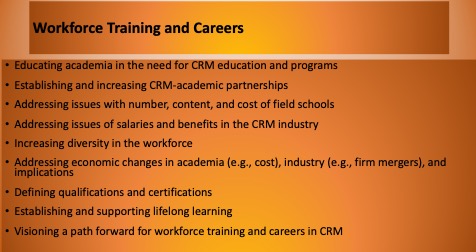
Workforce Training and Careers
It has been my long experience in a career in cultural resources management that everything starts and ends with a trained an motivated workforce, so it is fitting to begin here.
There are a couple of premises that I hold to be true and that drive the discussion with regard to the question, “How do you build an archaeologist?”
The very first thing to know is that archaeology is both a profession and a trade. You cannot build a good archeologist from the classroom only. Remember the term, “armchair archaeologist?” Likewise someone very good in the field, unless a true savant, cannot have the grounding and theory and method gained from a classroom education to be truly useful. It takes both education (the professional side) and experience (the trade side).
The current model of getting an undergraduate education in anthropology and then graduate school with a field school somewhere in there and then starting as a field crew member and working your way up to Principal Investigator is suitable for a small fraction of potential archaeologists.
It takes too long. Eight years, if you include 4 years of undergraduate, 2 years of graduate and then 2 years of practical experience.
It costs too much for the return. College is no longer affordable and even PI salaries aren’t sufficient to cover the up-front costs.
It effectively blocks all but those with resourced families that can support this ascent. And this plays into the racial disparities in familial wealth. It is possible this alone could explain why archaeology is such a “white” profession.
This also disregards the inherent bias against compliance archaeology by the mainline university graduate programs, who continue to train Mesoamerican archeologists or any other cultural region other than the US, who have no useful education or training that would prepare them for a CRM career. More on that later.
There is a lot of talk about alternative pathways to building an archaeologist and I think this discussion is worthwhile. However, it is also treacherous insofar as any who wants to pursue this alternative pathway needs a clear understanding of what are the consequences of veering away from the traditional model, codified in the Secretary of Interior Standards.
SOI standards are at the minimum, a standard. And generally, they can be applied to an individual to determine whether that individual can meet that standard.
Once you agree that there can be an alternative pathway, it is essential that there be national agreement on what is required within that pathway. And the more flexibility you give in that pathway, the more urgent the need to settle on a national standard of competence.
For any student seeking to become that professional archaeologist along this alternative pathway, there has to be a clear plan, i.e., what exactly they need to know and do to get there. Part of the attraction to establishing an alternative pathway is two-fold: less classroom and more OJT meaning less cost and time, and, more ways for entry from a different career. Choices come with costs. It is inexcusable to tempt a potential candidate with an alternative and have them spinning their wheels because the specific requirements weren’t specific enough. They think they are making progress toward that brass ring, but are actually veering off into the weeds.
If there is an alternative pathway, there has to be some adjudicating group that will certify that the candidate has indeed gotten there and meets those standards. The more flexibility you give in getting to professional qualifications, the more important this becomes. For geologists or engineers, there are state boards that certify candidates professionally. Buttressing these boards is an infrastructure of standards, training, and testing, not to mention legal licensing.
Finally, you can’t put dead ends into the mix, meaning you cannot offer a progression from a field-based experience to a Crew Chief and then offer no way to advance to PI other than the traditional approach. There may be individuals that don’t want to become Professional Archaeologists but want to remain as highly skilled technical workers, but for those that want to advance to Professional status, there has to be a non-traditional route to get there, from each stage of accomplishment.
SOI standards have a gaping hole. They do not require any knowledge of historic preservation law or practice, such as Section 106, or NEPA, nor frankly anything to do with consultation with groups that have interests in the projects, such as Native Americans. This needs to be addressed somewhere in the standards we would adopt.
Focusing on the traditional method of getting to professional status, there are several things that can be done to lessen the time required and lessen the economic burden.
If we’ve learned anything since COVID it is that there is a useful role for remote learning. This was experimented through MOOC classes a decade ago, but we now know what we can teach remotely and what we cannot.
I would argue that any class that was traditionally taught as a survey in a large classroom is a prime candidate for remote learning. Introduction to Anthropology, Introduction to Cultural Anthropology, Introduction to Archaeology, frankly any course that beings with the phrase “Introduction to….” I am not saying these courses aren’t important, just that they aren’t necessary to take in person in a university setting.
We are already talking about bringing Community College students into universities as a cost-saving measure and as a pathway to an affordable university education. Many of the courses that a Community College would offer are in the “Introduction to…” realm.
This is the opportunity for SAA and RPA and maybe a consortium of universities to assemble a core curriculum of introductory on-line courses that can be offered at any time and no cost to anyone. If we can establish this curriculum with regards to minimum requirements, we can wipe a half dozen courses off the schedule, at the very least a full semester. For candidates with day jobs, this should be a godsend.
Going this route will also require a test of some type to ensure that the candidate has mastered the material. Use the College Board as a model.
The trade aspect of learning is just as important. To that end, the traditional field school is inefficient, expensive, and non-standardized. It may be time to bury the idea entirely.
Instead, hands-on experience could be gained through a trade union model – apprentice, journeyman, master. This is an opportunity, but there are some caveats:
In most trades, there is a union that takes responsibility for certifying the skill levels of its members. (When I submitted my comments to SAA in 2024, I was unaware of unionization efforts for archaeological technicians. On Thursday afternoon, I heard a presentation from Freeman Stevenson, titled “The Return of Unions to the CRM Industry,” presented in the US Archaeology at the Crossroads Part I Symposium. The long, hard effort toward unionization appears to be underway with the Teamsters. It remains to be seen if it catches fire. I have no illusions that it will be easy. After all, virtually every effort at unionizing any sector of the economy took decades. Still, Stevenson and others give me hope.)
In this model, the unions set up off the job training and oversee it. (I confirmed with Stevenson that his efforts include this model of union training, currently housed in West Virginia.)
Work at any of these levels is paid work, through the terms of the contract. More skill means more pay. Lower level trade members work under the supervision of a higher level. Archaeology has done training in this manner for decades, but we are loathe to call it that, since we are “professionals,” not plumbers. And we either grossly underpay our underlings, or not at all.
Industry is part and parcel of this arrangement. This is how they get trained workers. They offload the training and certification to the union. Collective bargaining agreements manage the relationship.
Archaeology could unionize and set up an arrangement for training along these lines. (See comments above.) If they don’t, then following this trade union model (which I believe to be a good model for training), would require setting up some national or regional system for overseeing the training and certifications.
At the end of the line, there needs to be some certifying organization that would judge candidates, possibly at the levels of crew chief and Principal Investigator/Professional Archaeologist. Standards probably need to be national to allow movement between states. There could be qualifiers for regional expertise built on top of the standards.
I haven’t spoken to some of the education that I consider essential to making a good professional archaeologist. That is coursework in cultural anthropology, especially political anthropology and, yes, anthropology of religion. One of the shortfalls of current archaeological training is the overemphasis on practical field techniques over a strong grounding in anthropology. Especially when working with descendant communities, a good anthropological background is invaluable. In the future archaeological environment, avoiding consultation with descendant communities is a non-starter.
Melding the professional and trade aspects will require some coordination. Schools like Drexel University already incorporate a strong internship practice within their programs. Aggressive merging of on-line classes, OJT, and a trade union model of apprenticeship could reduce the classroom component of professional training to 3-4 years (In my estimation), resulting in a Master’s Degree. Overall, it may take a person the 6-8 years to get there, but they will be fully employed during most of it.
Will the academy go along with this? I doubt it. They haven’t to date and this disrupts their traditional models of education. What I would say for land-grant institutions is this. “Not only have you received your charters from the Federal Government as well as much support, but also have built your institutions on land taken from the Indigenous Peoples that inhabited it earlier. You owe two debts in the telling of the history of this country, one to the public at large, and one to the original inhabitants. Archaeology is one method of telling a history that wasn’t written down or a history only told by the victors. Establishing an archaeology program that doesn’t include the state you are in is simply negligence of duty.” SAA and RPA need to bring the full force of their influence on this point, not just to the university presidents and deans but the state legislatures that fund these institutions.
Is there an impending shortage of archaeologists or not? I keep getting two different answers and I’m not sure everyone is speaking from the same data. Altschul and Klein sounded the alarm 2 years ago in a deep dive of the future for the profession. Yet at the SAA Meetings in NOLA, Chris Dore in Session 293: Transformations in Professional Archaeology, Industry Challenges for Cultural Heritage Consulting Firms in North America, strongly suggested the issue was overblown and there are sufficient archaeologists to meet future demand. Can both views be correct? I have my doubts.
Part of the problem may be on which data each argument rests. Altschul and Klein seem wary of US Bureau of Labor Statistics data as showing the full picture, while Dore seems to rely heavily on that data. Dore also seems to accept that PhD’s generated from the academy will be suited to the CRM world. My own anecdotal surveys show regional unevenness and unevenness in level of archaeologist. Some parts of the country seem to be OK at the moment for supervisory archaeologists but are having trouble getting field crew. Other parts of the county see vice versa or any other combination. So it is hard at the moment to see a national trend, whether there is one or not. Perhaps the biggest difference is that Dore sees work declining in future years, while Altschul and Klein see an explosion shortly. (In any case, the recent wide-spread firings of Federal employees, including archaeologists and the intentional weaking of environmental and historic preservation laws and regulations may resolve the issue simply by eliminating the need for CRM studies, therefore eliminating the jobs.)
My own takeaway from this discussion is that we need to focus on the way we are currently producing archaeologists, which is inefficient, and socio-economically discriminatory. I do believe the issue of field crew will be solved in the market. You have to pay people better to get folks who will work in that environment. Plain and simple. It appears that this is starting to occur, but still there are gaps in matching a “trained” workforce with jobs.
A final thought. Bureau of Labor Statistics grossly underreports archaeology jobs, yet many universities rely on these numbers to gauge future student interest. This is to our detriment. As long as academia has a role in training future archaeologists, and I think they do, putting department after department at risk from dodgy numbers is a bad idea. SAA and RPA need to be united in pushing the Labor Department hard in the direction of producing more accurate counting of the number of working archaeologists in the US. And they need to do this today. Having a certified and licensed category will point BLS in the right direction.
Diversity in the workforce (a good goal, regardless of what the current Administration thinks)
This continues to be a problem, but I do believe the underlying issue is the amount of family wealth needed to “front” a student through the long and expensive process to reach professional status. Otherwise, the student is likely to incur crushing student loan debt. Targeted scholarships and financial aid only goes so far and it probably unsustainable. The only way to create diversity in the workforce is to radically cut the costs in time and money to get to professional status. I have offered some ideas above. People aren’t stupid. You can be welcoming and accommodating ‘til the cows come home, but those economically disadvantaged won’t commit unless they can see a sustainable future in it. And while better pay in the entry level field crew positions can help there, commensurate pay for professionals is also needed, not just in academia but in government and private employment.
Certification and licensing
I have written at some length aboutcertification and licensing. To summarize, we need to keep clear the difference between certification and licensing. Organizations like SAA or RPA or state councils can certify. State or Federal Governments can license. And while I do support certification at a regional level or national level, licensing should be a goal. I think this will help with pay, respect (which translates to pay) especially within the private sector land of engineers, and clarity with regards to the Bureau of Labor Statistics.
I think licensing is much more important in cultural resources management than academia, but it wouldn’t hurt to have a segment within academia that are licensed.
Decolonizing-Engaging Descendent Communities
My first recommendation is that the word “decolonization” should be dropped. It is not useful within the context of Airlie House 2.0 and CRM. To me, it sounds like bumper sticker sloganeering. It is designed to offend all but the true believers. It invites the nativists in our country (an exquisitely choice term which really means the opposite of what it appears to mean) to jump down our woke throats and fight anything we might want to accomplish. Even within our group, we will waste a lot of time trying to define what it means and this is time wasted, when effort needs to be focused on doing. (Everything done since January 21st vindicates this statement.)
Almost all CRM archaeology is conducted under Section 106, which is a Federal law administered by federal agencies, which are part of the United States Government. Let me suggest a test. The next time you are in a project meeting with the design team and engineers, just casually suggest that we need to decolonize archaeology. See what the response is.
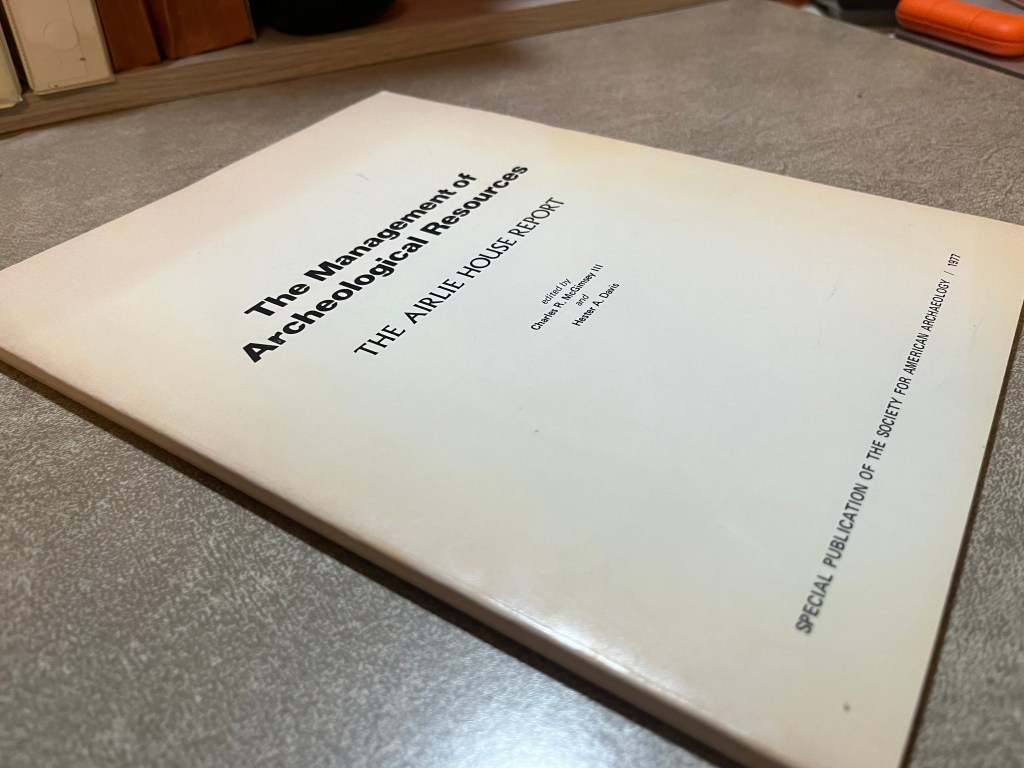
There was a lot of good advice in the original Airlie House Report, produced in 1977, relevant to this topic. I think most of it has been ignored in the subsequent 47 years. While there has been some advances in law and practice since then, it may be a good idea to start with Section 5: Archaeology and Native Americans, and proceed from there.
If 36CFR800 is the basis for most cultural resources management under Section 106, or Section 110 for federal land management, then the core singular point is this. “As anthropologists, should it not be the archaeologists first responsibility to take into consideration living descendants of those cultures they study?” (their emphasis) (p.90)
There is a special role for consultation with Federally recognized Tribes in conducting compliance archaeology. It is specifically defined in 36CFR800.16 Consultation means the process of seeking, discussing, and considering the views of other participants, and, where feasible, seeking agreement with them regarding matters arising in the section 106 process. The Secretary’s “Standards and Guidelines for Federal Agency Preservation Programs pursuant to the National Historic Preservation Act” provide further guidance on consultation.
Most consultation takes place within a specific project and in that sense is limiting. What is ultimately necessary for effective project consultation is building a trust relationship outside of projects. Many state DOT’s and FHWA divisions have taken that extra step to build a working relationship and I think this is the way to move forward. And it takes respect, humility and hard listening to make it work. The outcomes of these extra-project meetings and consultations can find value in program wide programmatic agreements.
If we can take a wider view of consultation, then some of these other issues will be addressed. We can sit down with the Federally recognized Tribes and figure out how to increase the number and presence of native archaeologists. But we would need to dig deeper and sit down with the Federally recognized Tribes and figure out what are the important questions to ask and what stories to tell. Not on a project by project basis, but within the profession. So ultimately, although this is a CRM exercise, the universities have to be willing to bring representatives from Federal Tribes into discussions of how and what to teach in archaeology. Only then will we be taking into consideration the living descendants of those we study. Hiring one or two indigenous archaeologists to the faculty will not solve this problem, although it’s a good starting point. (See also, Bonnie Pitblado’s 2022 article in American Antiquity 87(3):217-235, On Rehumanizing Pleistocene People of the Western Hemisphere.)
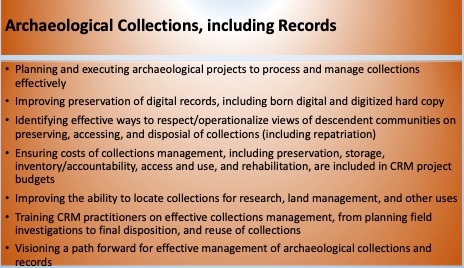
Archaeological Collections, including Records
I don’t have all that much to add to this section, with one exception. There is an inherent problem baked into the CRM process under NEPA. The problem is a contracting and timing problem and is created when project schedules force the conclusions from a study to be produced before the collections are fully processed and designated for accessioning. The NEPA decision depends on the conclusion of Section 106. It is almost always presumed that a draft executive summary serves as the results of Phase I or II investigations. The design consultant and their archaeological team finishes their work, a NEPA decision is made, and then the contracts are closed out as the (obvious) work is completed. However, if there are artifacts, a closed out contract doesn’t allow funds for the archaeological consultant to process or accession them. And there is no obvious hammer to leverage over the consultant since processing the collections is rarely in the punch list of deliverables. How could they, since it might not be completed until after the project is built years later?
Secondly, funding set aside for archaeology in the design stage is finite. It is spent in order – field work, essential lab work, executive summary, final report, artifact processing and curation. Often field work and essential lab work consume the entire budget, so by the time the final report and artifact processing and curation is to be done, there is no funding. Going back to the client and/or prime is out of the question. So the work doesn’t get done.
If there is a data recovery involved in the project, again there can be a contracting problem. First, almost always there is a separate consultant involved due to the conflict of interest provisions related to NEPA. The new consultant often acquires the collections from the Phase I or II and proceeds to Phase III. As before, it may take years for the collections to be fully processed and accessioned and once the project has the ribbon cutting, the contracts are often closed. The total amount needed for curation is a tiny fraction of the total project cost, perhaps $100k versus $100m, so holding the contract open for such a small amount is difficult to sell. Rarely have I seen adequate provisions set in the contract to reserve monies to complete the curation in a Phase III. It’s really hit and miss.
The Federal Agencies are often not much help. Archaeologists are rarely in the room when contracts are drawn up, and few agencies have the archaeological expertise to bring to bear even if someone thought to ask an archaeologist to help in putting the contract together.
Perhaps the only real solution is to set up a bond model for artifact curation, where the contractor puts up a bond solely for the processing of the artifacts and their ultimate curation.
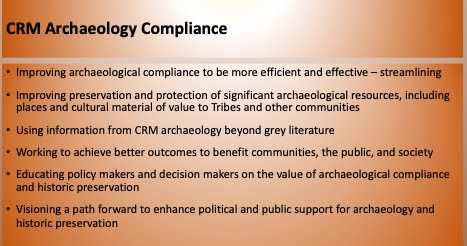
CRM Archaeology Compliance
If we do the necessary work in fuller consultation with Federally recognized Tribes, we should expect to widen the range of questions we would want to ask from the archaeological record and expand and enrich the kind of stories we could tell. If we lay the proper extra-project groundwork, we should also be able to achieve better project outcomes not just for those involved Tribes, but the larger society.
A specific comment regarding reporting and grey literature. The traditional model of creating a standalone report with background (often boilerplate), setting, field methods (standardized), field results (including geospatial mapping and artifact catalog), interpretation, and results was born of the 20th century. Maybe it’s time to leave it there.
A better way to envision a report is as a virtual document that is assembled for the reader, but the bits and bytes reside in different places. Leave aside the background section and results and interpretation for the moment. The setting could be pulled from a multi-layered environmental GIS, requiring only the delimiting of the project area as a polygon. If the GIS is a cultural GIS, the known site information would be embedded automatically. Field methods are generally standardized and usually reference guidelines. All that would need to be added are any exceptions to the methodology. Field results belong in the cultural resources GIS, albeit at a much finer grain. Every testing unit could be plotted in space, and linked to its stratigraphy and contents. The artifact catalog should reside in the state’s larger artifact collections catalog. Photos, drawings, and the like could also be tied to units within the cultural resources GIS and reside there as well. What the reader would see is pulled from these various databases and linked through the common project identifier. Instead of being written as a standalone set of data, each portion would be written once into their respective databases. When needed, they would come together into this “report.” A version of this could be found in the Digging I-95 effort.
The background section would also be pulled from another source. That would be the synthesis of the history of the region, or state. Think of it like a Wiki-page that could include chronology, geography, themes, with regional syntheses (from Western and Indigenous perspectives), and research topics. A model for this does exist in England, aka the East Midland Historic Environment Research Framework.
The point of establishing a Wiki-like environment is that it could be amended and modified one project at a time. And it would replace any of the published state-level synthesis, titled, “The Archaeology of (fill-in-the-blank).” For the background section of a project “report,” the geographic location of the project would direct which section of the synthesis would be pulled.
The conclusions of the project, presumably stating what the important information was gained from the work, would be entered into the synthesis Wiki-site as new information, then pulled out again for the purposes of the “report.” The important (Criterion D) information gathered from a project would always be within a context of what is known and clearly differentiated from it. As much of the information contained within the Wiki-site would be available to the general public as could be done, recognizing that some of the information would remain sensitive.
There are several advantages to this approach. First, it would greatly standardize the collection of archaeological information. It would also ensure the GIS and artifact catalog information would be entered into their respective databases up front, instead of chasing these data sets down after the fact, and either re-entering them, or figuring out how to translate field formats. It would also lay bare what was learned from the project and presumably advance the state of knowledge one project at a time. And it would give the public a clearer view of that state of knowledge.
The current Administration wages war on history and science. Or, maybe this is American Archaeology defending the profession against onslaughts from the current Administration. It’s not entirely clear.
In late April, I had the privilege to attend the Society for American Archaeology Meetings, in Denver. I wondered why I was attending not only this meeting but the Association of American Archaeologists (ATA) meeting on Tuesday and Wednesday prior. I had been retired from PennDOT for 7 years and had recently ended my term as President of the Pennsylvania Archaeological Council. What was I doing there? Fortunately, the answer awaited down in the bowels of the massive convention hotel, in a series of windowless rooms.
The ATA meeting always refreshes my batteries, and it is good to reconnect with professional colleagues, even if you are the only one in the room drawing a pension. The mood in the room was not unlike that of a gathering storm. Federal probationary employees were being terminated right and left, even those that had worked for a year or more and had come to FHWA, or FRA, or FTA service from lengthy service at state DOT’s, or consulting firms. Permanent federal employees were being pushed out, but the DOGE reaper hadn’t pushed in the doors at FHWA, yet. Yes, the mood in the room was like a gathering storm. Typically at ATA meetings, it is larded with crisp, black humor. It’s what archaeologists do, so that the meeting outwardly did not present as anything different from any other ATA meeting: playful abuse of the FHWA Preservation Officer, David Clarke (although David could only participate remotely due to one of many travel bans); preservation success stories, especially from the host state DOT; endless sidebar conversations over seemingly insoluble 106 problems, begging other state professionals for reaction, input, solutions. This time, the conversation included queries over firings and who’s left in the offices, both at USDOT Agencies and at the Advisory Council. The ATA chair had figured out how to hold a hybrid meeting on zoom. This was both good and bad. Good insofar as more archaeologists could attend. Bad insofar as the meeting was recorded and folks were talking on eggshells. The proverbial elephant in the room sat patiently in the corner as we conducted our business.
On Thursday, the SAA Meetings began in earnest. The elephant relocated, but did not leave. Using the SAA Meeting App, I had booked a steady dose of “Whither Archaeology” sessions. The membership was clearly alarmed over goings-on from the Federal Administration. Everyone wanted some providential guidance on what to do, but none was forthcoming. Opinions divided along classic lines. In one camp, members argued for full-on resistance to Administration actions and executive orders, summarized by a t-shirt that appeared during the meetings- red with the image of an arm holding an upraised trowel and the message, “Resist.” Workers of the World Unite meets Orozco. For solutions, specificity seemed lacking. The other camp argued care and caution. Fighting back against the Administration required measured actions, to fight smart- legal action, avoiding DEI-tagged language, talk in code, etc. Again, for solutions, specificity seemed lacking. Thursday was cry-in-your-beer day.
I had hoped the SAA leadership would seize the moment and provide some specific actions that membership could take. Thursday brought several sessions dealing directly with the existential crisis. Discussion, but not action. Thursday turned into Friday, with the main General Membership Meeting that evening. Again, no action. Discussions continued into Saturday with further discussions. When the Meeting ended, we slow-walked our way to the airport and flew home.
In mid-March, I sent the Pennsylvania Archaeological Council my last President’s blog. This one was unusual insofar as I focused on the Administration’s attacks on both history and science. Nothing between mid-March and late April had altered my views, and even in mid-May, I believe the comments stand on their own. Here is an edited version (cleaned up only a little bit):
President’s Report
(My apologies for not talking about all of the different orders and initiatives from the current Administration that give me heartburn, such as climate policy, environmental policy, foreign policy, domestic policy, tax policy, Ukraine, USAID, Israel, DOJ, LGBTQ rights, immigrant rights, human rights, DOGE, general chaos, etc., etc. I need to focus.)
Let me open this post as clearly as I can. There is no Republican science. There is no Democratic science. There is no Republican history. There is no Democratic history. There is science. There is history. Now this may be easily misconstrued. History is after all written by the victors and there is history of Republicans and history of Democrats. Still, one history doesn’t blot out another one. And any single history from a single perspective simply fails to tell the full story.
Science and history have been weighing on my mind lately for two reasons. First, archaeology could be framed as history told through scientific methods and techniques. We rely on both. Secondly, the current Administration appears to be waging war on both science and history. In the national scheme of things, we are a flyspeck, an afterthought, a trifle. But I find it inescapable that the current Administration is waging war on us, whether they know it or not.
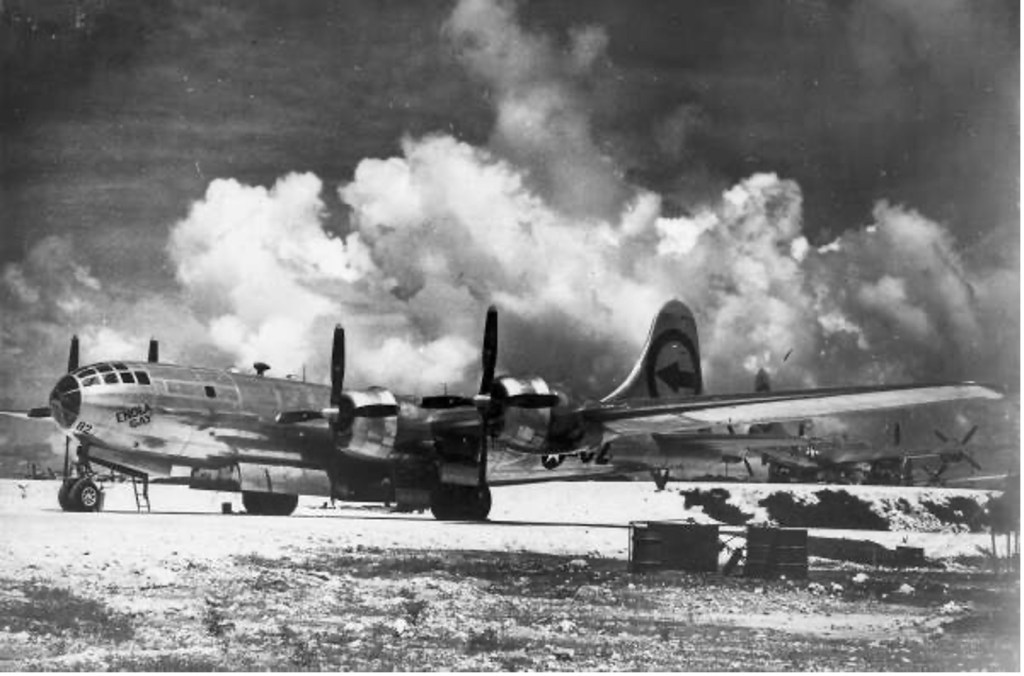
The anti-scientific position of the current Administration is documented in who they are selecting to lead the important national scientific and educational institutions (Kennedy, Jr. for HHS, McMahon for Education, etc.), severe and arbitrary cuts in indirect cost reimbursements for research, staffing cuts at Federal scientific agencies (with a particular vengeance toward climate science), and even word censorship that permeates national policy. The anti-history position is commensurate. And by anti-history, I mean anti- any history other than white (usually male) protestant history, something more in favor a century ago. The Advisory Council on Historic Preservation has been gutted. One anecdote summarizes DOGE’s Ministry of Truth’s approach toward history. In the Pentagon’s purge of DEI-related materials from its memory banks, photos of military firsts for women, Blacks, and Hispanics were scrubbed. And of course, the LGBTQ icon of WWII, the B-29 that dropped the atomic bomb on Hiroshima, the “Enola Gay.”
Under the guise of pushing back on DEI, I believe the current Administration’s goal is to erase the past, at least the past not in synch with its politics. Erase it to be able rewrite it to suit their needs and advance a particular political agenda. This is Authoritarianism 101. Our job is to tell the past and expand on the telling, not erase it.
I could go on, but we don’t have time. Think for a moment on what the archaeological economy is built: the three-legged stool of academia, museums, and CRM. Universities are already under attack for supposedly allowing antisemitic activities and DEI on campus. Columbia is just the first and most prominent. Understand that none of this has to do with actual antisemitism or diversity, equity, or inclusion policies or activities, and everything to with forcing universities to bow to the Administration’s power and Project 2025 goals. What does that have to do with us? Check down some of the terms that are being scrubbed from national databases: anti-racism, cultural competence, cultural differences, cultural heritage, cultural sensitivity, culturally appropriate, historically, identity, indigenous community, intersectionality, multi-cultural, native American, race and ethnicity, sociocultural, socioeconomic, tribal, etc.
Will our professional communication amongst each other be reduced to grunts and hand signals? And as universities feel the pinch from dried-up federal funding and pressure to give fealty to the current Administration, Departments like Anthropology will be even more at risk than they were a year ago. The same holds for Museums.
CRM has proven to be the backstop of archaeological employment for nearly 50 years. Many good archaeologists, some who I know personally, have been fired from Federal government agencies for no cause other than being probationary. At the current pace, many others will be on the chopping block. The bigger threat will be the gutting of NEPA and Section 106, which governmentally can be done in ways other than Federal staffing reductions and changes to the law. CEQ regulations, which used to regulate NEPA are now just guidance. Large parts of 36CFR800 are not spelled out specifically in the National Historic Preservation Act, but have evolved and been adopted over the last 40 years. That and $3.50 will now get you a cup of coffee. Two years ago, Terry Klein and Jeff Altschul declared an impending staffing shortfall in CRM. Two years later, I guess we can thank the President for solving that problem, not by adding trained archaeologists, but by eliminating jobs.
What do we do? In full confession, there have been days in the last 4 months where I just want to doomscroll, or curl up with a good scotch and binge-watch Ken Burns documentaries (Huey Long is still the gold standard and still relevant). That is not very helpful. So let me propose a few things:
Stay informed. As painful as it may be, the political and economic environment is rapidly changing, almost day to day. At the very least, be informed of changes to the Advisory Council, NEPA, Section 106, and any Federal Agency that you may work with. Lately, I have found that Linked-In has more information, especially through Allyson Brooks; Marion Werkheiser, Ellen Chapman and Cultural Heritage Partners PLLC; the SAA newsletters and e-mails. Find reliable news sources that covers science and culture and follow them.
Stay engaged. Whatever level of action you might have undertaken, please continue. If protesting in the streets is your thing, great. If letter writing is more to your tastes, write. But there are two things we all could and should be doing. First, find out who your congressional representatives are in the House. Your Pennsylvania senators are John Fetterman and David McCormick. Let them all know how you feel on specific executive orders that may be illegal under Article I, Section 9 of the Constitution, and proposed legislation. Tell them the importance of both science and history and by extension, archaeology. Secondly, talk to your friends and acquaintances, especially the ones that aren’t archaeologists. Make the case for why what you do is important and then ask them to write their representatives and tell their friends. (In discussions in Denver, it became clear that Job 1 for archaeologists is to explain to the public why what we do is important.)
Stay defiant but stay positive. The current Administration wants you to submit to the new status quo as quickly as possible. You can choose to not submit, but to do so you need hope and a vision for a better future (another definition of hope). Don’t give up. Perhaps Elie Weisel offered the best perspective, “The greatest evil in the world is not anger or hatred, but indifference.”

 I, Beckerman, not Robot