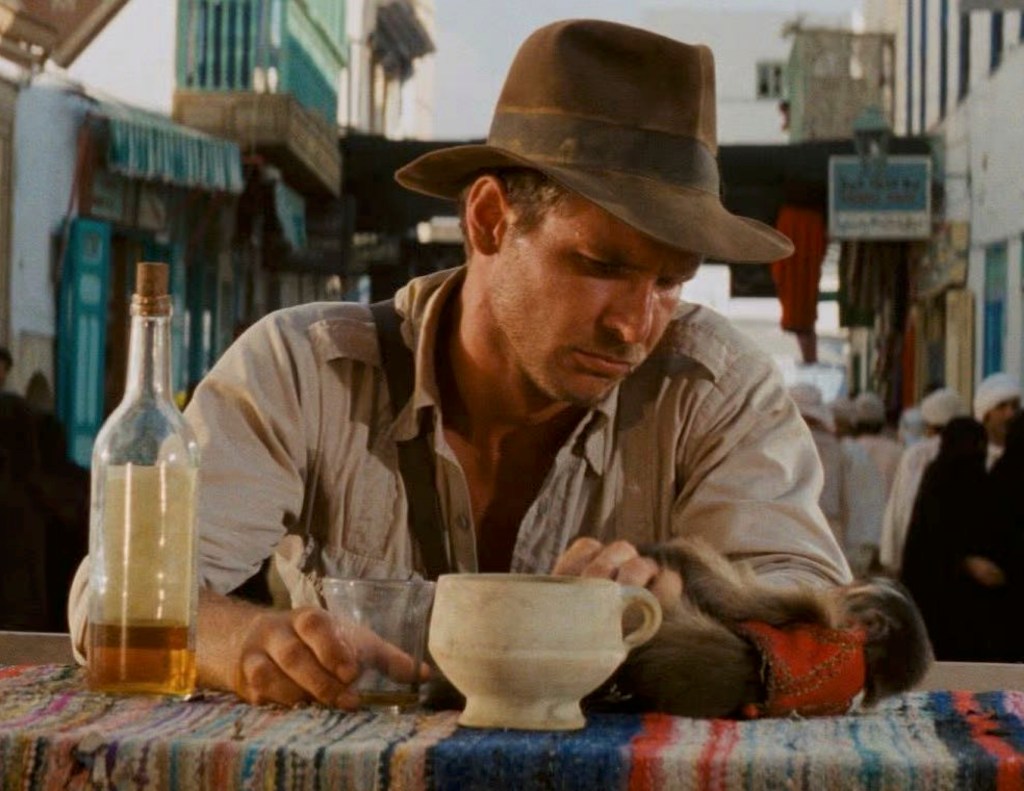
Recently, I was at a banquet. The individual to my left got excited when they asked what I did and I replied I was an archaeologist. The conversation went as I might have expected. They always wanted to be an archaeologist when they were a kid. Check. Then they wanted to know what was my greatest find. Check. Like the coward I am, I mumbled something about the 16th century eyeglasses found on the I-95 dig near Philadelphia. A surprising and very cool artifact. I answered her questions politely but completely avoided the deeper point (not Clovis). Archaeologists and archaeology are not really about finds, or even artifacts. Sorry, Indy.
As a young adult, I also found archaeology and ancient history fascinating. Who didn’t? However, my high school and college sights were set on aerospace engineering. I was a product of the 1960’s, especially the space race, and was reasonably good in science and math. My father was an engineer. The die seemed cast. My encounter with college was humbling, very humbling. Anthropology became my life raft. After a course on Old World Prehistory, archaeology-specifically anthropological archaeology- became my north star.
It wasn’t the artifacts. I had some modest coin and stamp collections as a kid, but they never really ensnared me. I am still not a collector, although I did have a brief fling with old radios. I spent a summer at Monte Alban collecting pot sherds, one sherd at a time, one terrace at a time. Many thousands of sherds, lovingly carried down in rucksacks from the mountainside to the lab. Still, I had no real emotional attachment to these potsherds, these artifacts.
What caught me in the classroom and then in the field in Oaxaca were the big questions. What was the origin of civilization? Where did agriculture come from? Who were the Neanderthals, and more importantly, if they showed up today in modern street clothes, would we be able to tell them apart from us on a crowded street? After 150 years of intellectual scrutiny, we still don’t have definitive answers, but I do think we are getting closer to the Neanderthal question.
When I got to the field, even the smaller more mundane questions grabbed me. How did this site become this way; how did it form, and deform? Although the artifacts and environmental remains like seeds and pollen are the basic 1’s and 0’s of our information, what goes with what and when are critical questions in answering the question of what happened here. At an individual site, we act like a bunch of Sherlock Holmes’s, looking for clues, free associations, datable material – anything to put the puzzle together. And Holmes had it easy. If we are solving a jigsaw puzzle, we are doing so with most of the pieces missing and the remaining pieces damaged to some degree or another. It is easy to find artifacts in a field. Ask any farmer. It is much harder to accurately tell the story of a particular site, and by story I mean who lived there and how did they live, and when.
Archaeologists are largely storytellers, historians without texts in many cases. Science guides our pursuit. More precisely the scientific method. Hypothesis, data, test, analysis. More and more current archaeology relies on very sophisticated laboratory methods, in dating, botanical analysis, microscopic analysis of how stone tools were used, DNA, etc. But these are still only techniques and yield only data.
The real science is piecing this all together to make a credible story, but one that can be challenged by further evidence. Real science is a process of throwing out ideas as hypotheses, gathering data to throw at the hypothesis and prove or usually disprove what is claimed. In much of science, an experiment can be replicated and either supported or disproven. In most cases, when an archaeological hypothesis is proposed, there is no way to replicate it. We don’t have time machines (and even if we did, there would be some serious ethical issues. Just ask any science fiction writer). So we are reduced to arguing by analogy, by finding comparable data, by finding parallels where they exist. We are often solving jigsaw puzzles for which there may be no other known copies nor any similar puzzles.
The individual sites and their stories become the building blocks to go after the bigger questions. How did we evolve from small closely related groups of hunters and gatherers tens of thousands of years ago into complicated and stratified societies only a few thousand years ago? Is the concept of private property innate or something that evolved? Is capitalism our natural state or is it something else? Are we innately competitive, innately cooperative, or both? Even the question of what is a family is fair game? Our popular notion of the nuclear family with father, mother, children represents an eentsy, weentsy fraction of human experience. These stories are hard to tell, and because of that become highly contentious. We share that with science and increasingly with history. It does not stop us from trying.
Last April, I watched a session at the national archaeology meetings in April on Submerged Ancient Sites. In particular, several presenters discussed what may have been happening on a land bridge in the middle of Lake Huron called the Alpena-Amberley Ridge, 100 feet below the modern lake surface around 9,000 years ago. Yes, 9,000 years ago, this Ridge was indeed dry land. Using a multidisciplinary approach of remotely operated vehicle mapping, scuba excavations, artifact analysis, predictive modeling, and virtual world simulations informed by modern caribou hunters, these archaeologists were able to make a compelling argument for caribou hunting in this particular space, including the hunting strategy including specifics on the ground. This is archaeological critical thinking at its best. No other discipline could touch it.
Despite the difficulty in getting to answers, archaeologists ask these and other questions that no other field can answer or even try to answer. We don’t have respondents; we don’t usually have written records; we don’t have all or most of the puzzle pieces. Sociologists and economists don’t see the full range of human behaviors and possibilities. Cultural anthropologists look at the here and now and generally don’t get to see societies changing over many generations.
We do have the two tools in our box other disciplines lack. Journalists note that today’s news is tomorrow’s history. But historians have at most 5,000 years of written history and only in a few select places. Almost all of human history is unwritten, but this is our sandbox. Our time zones are centuries and millennia – deep time. With rare exceptions, like Herculaneum, we won’t be able to say what happened from one day to the next. We will go to the last Ice Age to look at cold weather adaptations. We will go to Cahokia a thousand years ago and ask why? Deep time is a powerful tool.
Secondly, if we are grounded in anthropological thought and the concept of culture, we have at our disposal the variety of human experience across the globe for the last several centuries. It might not tell us how early farmers in the Southeast organized their marriages a thousand years ago, but it tells us what the range of possibilities might be. To the degree that human behavior is patterned and repetitive, this information give us some clues. And like good cultural anthropologists we can be self-aware of our biases and prejudices in the application of science and analysis.
What are our big problems of today? Adapting to a rapidly changing climate? Increasing income inequality in our society and elsewhere that is destabilizing democratic rule? How do we bring back the family in an increasingly fractured and isolating society? What the hell is a family anyway? As a species, how do we adapt to rapidly changing technology, or more specifically, will AI kill us all and what can we do about it? Archaeology won’t solve these or other problems. It’s not designed that way. But archaeology provides critical thinking and a frame for understanding these problems, and can point to many more examples where we as a species have been there before and how we dealt with those problems before. We can help. I even have the conceit that if the US Administration had brought in archaeologists into the room after 9-11, bringing an understanding of the deep history of the Middle East, our approach to Afghanistan and Iraq might have been greatly different and much more successful.
As I was demolishing a pretty good carrot cake for dessert, I looked at the individual on my left at the banquet. I wish I had the foresight and the words to tell them what I am saying here. Archaeologists can write fancy and use big words and explain big concepts, but we are notoriously bad at simple human communication. There is an old joke amongst archaeologists on being anti-social. We are anthropologists, but we like our respondents dead. That’s because we don’t have to talk with them or listen to them. Like all caricatures, there’s an element of truth to it. Today, we need all the critical thinking we can muster. Archaeologists do this and bring stories of people who aren’t around to tell them. We do make the dead speak. Unlocking the past is not some academic exercise. Understanding where we came from provides the grounding for our future. Or as Robert Heinlein put it, “A generation which ignores history has no past – and no future.”
 I, Beckerman, not Robot