I broke into a sweat upon waking up from a fever dream the other night:
Fresh off his victory with the East Wing of the White House, President Trump announces further upcoming improvements:
Gettysburg Battlefield Casino and Resort
Cemetery Ridge will be upgraded with a Resort and Casino, including a 100 foot tower, from which the entire Battlefield can be seen. Slot machines will be added to the Cyclorama, so that Patriots can play with special blue or grey tokens while observing the battlefield enactment.
Statue of Miss America
From New York Harbor, visitors can see a renewed 21st century Statue of Liberty, more becoming of America’s beauty – short dress and heels, bigger boobs, and a smile. Oh, and not copper colored but white, as God intended.
Mount Rushmore Trump Tribute
President Trump’s visage will be the only one to be seen on Mount Rushmore. To paraphrase The Princess Bride: “Have you ever heard of Washington, Jefferson, Lincoln, and Roosevelt? Morons!”
Linked-In Misery
Shortly after the demolition of the East Wing of the White House, I committed a cardinal sin by posting about it on Linked-In. Actually, multiple sins. First, I let my heart rule my head on the post. Never a great idea for social media. Secondly, I usually shy away from topics that are likely to get widely discussed by others. My happy place is that lonely dirt road that no one else travels. Finally, Linked-In is not built for long form discussion. It’s not even built for discussion. Replies get buried down below. Anyone coming in fresh can get lost in the thread. Like it’s click-bait cousin Facebook, Linked-In thrives on controversy, and now apparently AI slop featuring kittens riding dogs and the like. Not to mention the ubiquitous corporate ads.
The post got a lot of clicks, some supportive, and some dismissive. Probably par for the course. The main post and related comments I provided on the East Wing are attached, should you feel an urge to read them. If I were you, I wouldn’t bother. However, it did lead to a brief exchange that forms the subject of this blog. Thanks goes to Allyson Brooks, the Washington State Historic Preservation Officer and an outstanding preservation warrior.
After I noted that nothing is safe after the demolition of the East Wing, she quickly responded (correctly) that “You (Ira) know very well that no historic building or site is safe. It is all consultation.” After the dust had settled on the Linked-In imbroglio, it got me thinking. Given the weakness in the current federal historic preservation laws, just how is it that anything gets preserved?
What the Laws Say
A quick review. The National Historic Preservation Act of 1966 establishes the National Register; Section 106 of the Act requires consideration of the effects Federal Actions have on historic properties through project construction, funding, licensing, etc. Nothing in the National Register requires protection to properties that are listed therein. Nothing in Section 106 guarantees protection of historic properties. As of the Summer of 2025, approximately 2,500 National Register Listed Properties have been removed from the list, the vast majority from loss. These are just from the listed properties and does not include those lost that were determined eligible for listing in the National Register but not listed. This is against a backdrop of over 100,000 listed National Register properties. I am leaving out National Monuments designated under the Antiquities Act of 1906. There are currently 129, most of which are protected. It was the mother of all losses, the 1963 demolition of New York’s Pennsylvania Station, that spurred the passage of the act in the first place.
Section 106 is usually wrapped within the umbrella National Environmental Policy Act (NEPA) and its processes, so when you hear about an Environmental Impact Statement or Environmental Assessment, it almost always embeds a Section 106 review. Categorical Exclusions (the third of the NEPA actions) sometime contains a Section 106 review. And finally, within my world of DOT, there is a parallel law within the USDOT code referred to as Section 4(f). It requires USDOT (in my case FHWA) to demonstrate that there is no prudent and feasible alternative to “using” (the technical term for whacking and similar to an adverse effect) a historic resource in a project. Putting Section 106 and 4(f) side by side is one way we at the DOT drive ourselves crazy as there is a lot of overlap, but significant differences, and both have to be applied generally to historic resources. Leave it suffice to note that 4(f) sets a higher bar than Section 106, but again FHWA is particularly adept at demonstrating that there is no prudent and feasible alternative to use, especially with regard to historic bridges. The bottom line is that protection is not assured.
Many states also have historic preservation legislation, but none that I know of guarantee preservation, especially for properties that are privately owned. There is a 20% tax credit for rehabilitation of historic properties under the Internal Revenue Code, Section 47. Local ordinances in the form of Historic Architectural Review Boards (HARBs) exist within the NHPA, but again, these do not guarantee preservation, although HARBs do exercise a lot more control. Unfortunately, not many municipalities have them.
We live in a country where private property rights are highly valued. This condition permits historic properties that are privately owned to be altered or demolished by the owner using their funds and resources, with very little legal recourse. In fact, there is a whole cottage industry of lawyers whose only purpose is to prevent governments and public institutions from “taking” historic properties, i.e., impinging on the property rights of owners. Privately owned historic properties may be eligible for the National Register, but can only be listed with the permission of the owner. But within this rule lies the seed of historic property protection.
Historic Preservation and Soft Power
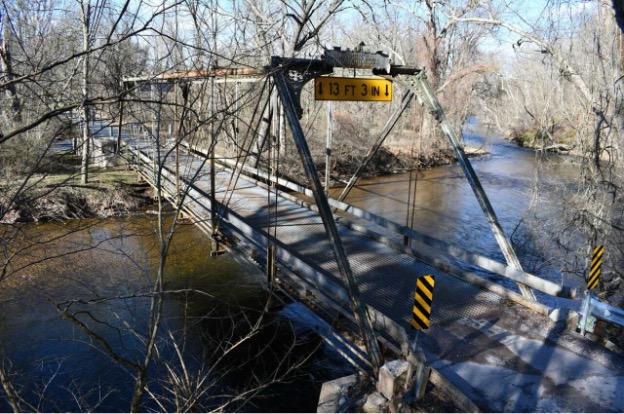
I live in New Cumberland, Pennsylvania, a small town of around 8,000 with a small downtown. I like living there for a number of reasons, but this is no Colonial Williamsburg. There are a handful of historic properties that are eligible for listing in the National Register, but none of these are listed. The three local landmarks are the Iron Bridge (built in 1936), the West Shore Theatre (1940), and the Public Library (founded in 1976 in a building that was built in 1819). For various reasons none of these are on the National Register, although all are older than 50 years. Yet each one is highly valued and treated with respect as the cultural places they are. The Theatre was closed several years ago and nearly abandoned, but community support and funding led to its restoration and re-opening in 2022. It won a Preservation Pennsylvania Award for Public Impact in 2024. The Bridge is a steel truss and nothing particularly special, except it is the namesake for several business around town and an annual music festival. It is in pretty good shape currently. There are no plans to replace it that I’m aware of, but I swear there would be hell-to-pay if that were to occur. The Library’s core is a 19th century farmstead, which has been heavily modified and added to over the years, but again the family associated with the property, the Benjamins, are very much part of the historic fabric of the community, and central to the story of the town. The building is owned by the borough, and it is very much protected and cherished.
All three of these places live in the netherworld of not quite National Register, but small “h” historic. It is possible that someday, they may become Historic. Standards change and comparable properties may become increasingly rare. But for now, they are protected – not by any set of Federal or State or Local laws, but by community interest and support.
A few miles down the road is the 1887 Sheepshead Bridge. Built by the Phoenix Bridge Company, the 114-foot Pratt through truss connects Cumberland and York Counties across the Yellow Breeches Creek. It is National-Register eligible.
In January, 2020, the bridge was closed to traffic and not considered repairable to be reopened for vehicular traffic. Typically, this is the death knell of historic bridges that can no longer meet a transportation need. However, with the active support of the local community and the West Shore Historical Society, prospects for the bridge improved considerably. In 2022, the project was awarded a $1.4m PennDOT Transportation Alternatives Set-Aside Grant, along with an addition $600k in PennDOT funding. With this commitment, the bridge will be rehabilitated for bicycle and pedestrian use and after restoration will be put back on its original location. Upon project completion, estimated for the Spring of 2026, ownership of the bridge will be transferred to the West Shore Historical Society.
Historic Bridges.org rated this bridge 9/10. As noted above, being historic, even being highly historic (not a technical term, as all eligible properties are on an equal footing legally, but not practically) does not offer protection or preservation. Yet, this particular bridge is being preserved, through a combination of public interest and support, and special funding provided by PennDOT. One might suggest that it was only money that made the difference. The reality is more complicated.
PennDOT and Historic Bridges
I am dwelling on historic bridges here because this property type is the one I most frequently encountered while working at PennDOT, and in many ways the most frustrating. Bridges are part of the transportation infrastructure and Pennsylvania is an old state. This means that there are a lot of historic bridge here. At the same time, the transportation infrastructure needs to function for its citizens, and when a bridge is no longer safe to cross because it can’t handle the loads of modern trucks or is too narrow for two lanes or otherwise functionally obsolescent, it is the responsibility of PennDOT to do something. From an engineering perspective, the simplest thing is to replace the bridge with a new one which will meet load requirements, allows at least two lanes of traffic, and is cost effective. The Section 106 consultation requirements (usually the project has Federal Funds) or 4(f) requirements (even with state funds there is an equivalent State 4(f) called Section 2002), would suggest a rehabilitation might be recommended instead of a replacement, which stands in contradiction to the elegant engineering solution.
Any bridge project – historic or not – will greatly affect the local community. Simple bridge replacements can close a crossing for months. Bigger ones can take years. Public involvement and coordination with stakeholders is crucial and necessary, and preserves whatever good will PennDOT has in the local community. By the way, this is the same community that owns cars and trucks and pays licensing fees and buys fuel, all of which funds PennDOT. And they have long memories and they vote for their state representatives and senators that oversee PennDOT. You catch my drift?
Within all that discussion and coordination, if there is a historic bridge involved that’s on the table, too. More often than not, the fate of the historic bridge depends on the degree of local support for that bridge. (This also holds for other historic properties as well.) In some communities and regions, there is much greater interest and support for historic properties than in other areas. If you drew a straight line between Erie and Philadelphia, that would pretty much define a gradient of historic property (and bridge) support with a high in the east and diminishment as you traveled west and north. This is excepting enclaves like State College and Pittsburgh.
What is in play, then? Bridges that are under consideration for replacement have usually been posted for weight. By the time a bridge is being considered for replacement, large trucks including ambulances and fire engines have been prevented from using that bridge. When there are other routes in a redundant system, this presents less of a problem, although response times to fires and other emergencies is a real consideration. When there is no other route to a home that may need, say heating oil, this can make that home unlivable. Never a good thing.
If the bridge can be rehabilitated to lift the load restrictions, rehabilitation can suit the project need. Sometimes this can be done. Sometimes not. If it can, then the question of costs comes into play. I have great respect for civil engineers. Give them enough money and they can do practically anything. But PennDOT is a public agency and has a responsibility to spend prudently. It is then when the question of whether a rehabilitation that may last 30 years and costs as much as a replacement that may last 75-100 years bumps up against the prudent part of prudent and feasible. Which argument prevails?
I do not wish to portray this as some David versus Goliath or good versus evil dynamic. I have seen some spectacular bridges lost and some questionably significant bridges saved. I have seen some PennDOT administrators unwilling to fully embrace Section 106 and 4(f) and some local communities using the bridge project as the tool to achieve local planning, totally disinterested in the actual historicity of the property. Finally, and this is an important point, there is no slide rule plug in a number answer for whether a bridge should be saved or not. Frequently, the decision revolves around a matter of degrees – can the community live with a weight restriction? Is a new bridge a need or a wish? Would a cheaper rehabilitation that lasts 30 years be good enough for now? Could the bridge be closed without significant loss of access? And for local communities that might need to freight the 5% or 10% of the cost of a new bridge- tens or hundreds of thousands of dollars – can they afford to make that decision now? Oh, and for any local community that has more than 2 families, there’s going to be a pro-replacement contingent and an anti-replacement contingent. Unanimity of local opinion only happens in North Korea.
It’s in this soup that community support for a historic bridge, or frankly any historic property, plays out. If the local community is strongly in favor of a historic property, the decision needle moves a few degrees one way. If few people care, the decision needle moves a few degrees the other way. And in those cases where a rehabilitation is feasible and possible prudent, those few degrees can make the difference between save and lost. Earlier, I mentioned the ability for private landowners to block a national register listing on their historic property. A national register listing still means something. It’s not nothing. And although FHWA and PennDOT (receiving federal funds) will treat a listed property the same as a determined property, in the local community a listed property is much more visible, has more cachet, and is woven more tightly into the historic fabric, i.e., the community’s local story and narrative than a mere determination. And let’s remember that PennDOT’s primary mission is to maintain an efficient and modern system to move people and goods. Almost as important is the need to not piss off the local communities in which its projects are done.
The Larger Picture
I’ve been using PennDOT and 4(f) and historic bridges to talk in some detail on how things can be preserved. Even outside of DOT (no 4(f)) and bridges as a property type, I do believe that the principles of community interest and support remain. Local community support for historic properties is what preserves them in the face of progress, modernity, late stage capitalism, what have you. Laws and regulations provide the pathway when there is sufficient time and consideration given to public input as strongly suggested in NEPA and Section 106. Laws and regulations alone do not protect historic properties. As corny and flip as it sounds, people organized in groups, people who learn about and care about the history of their community – these are the ones that protect historic properties. Lyndon Johnson and Congress didn’t wake up one day and pass the National Historic Preservation Act because they felt like it. The law was passed because other people, lots of people, were screaming over the loss of Pennsylvania Station and other important historic places.
Would the loss of the East Wing bring a similar response and result as was done in 1966? I don’t know. It was 59 years ago. Times were different. The political landscape was different. Then, historic preservation was much more of a Republican ideal, with roots in Teddy Roosevelt. The Democratic ideal might have been characterized more by urban renewal and Robert Moses. We are more mobile now than ever. It’s harder to have a sense of place when you don’t put down roots anywhere.
Still, as a species I believe we are rooted in story. It is perhaps the only way we make sense of the world. The sense of place and its associated story is what we crave, whether our family has been there 5 generations or moved in last year. We can adopt places just as we adopt families if we don’t have ready access to a rooted past. Perhaps the East Wing was just my macguffin to get to the larger question of how and why do we protect any historic places at all, given the inherent weakness in current laws and regulations. If we can learn about our history and about our historic places, we can care about them. If we can care about them, we can take the time and energy to protect them. Not just against federal project impacts, but against rampant development, not just against something happening a thousand miles away, but at home in your own community.
 I, Beckerman, not Robot