Response to the Draft TCP Guidance

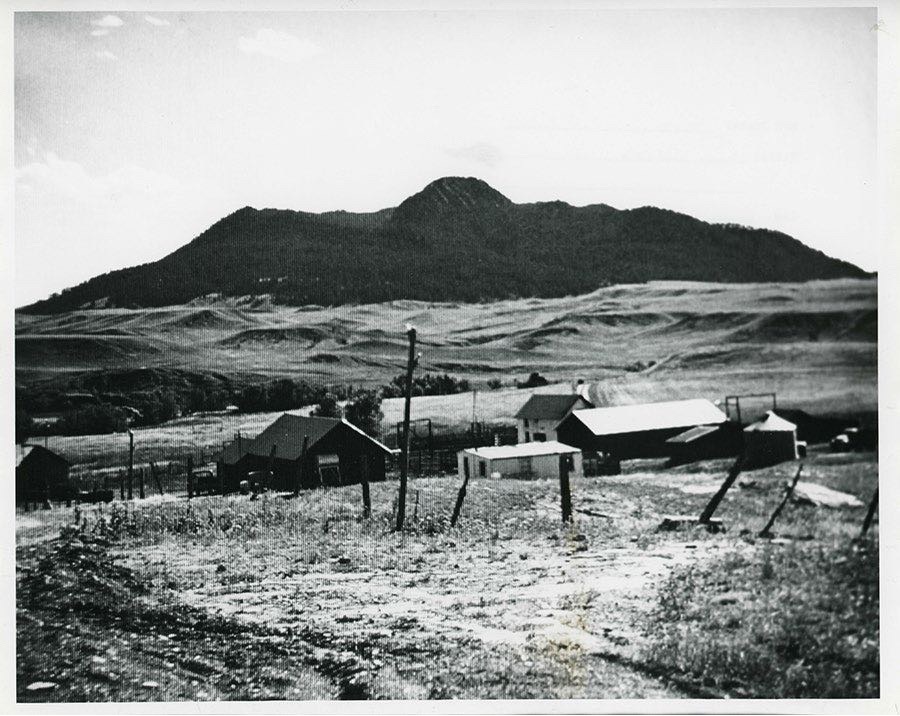
Historic view of Inyan Kara Mountain, Black Hills region, Wyoming (NR Ref. No. 73001929).  (Draft Guidance, Fig 35, page 74)
Fenway Park, from the National Register Nomination (NPS 2012)

Again, I wish to state unequivocally that the comments presented here are my own and not that of any organization of which I may be a member, nor of any past employer.

Summary

The National Park Service has released for comment a revision of Bulletin 38, Identifying, Evaluating, and Documenting Traditional Cultural Places.  While the draft greatly expands the guidance offered to nominating historic places that are important to traditional communities, it is hampered by limits imposed by existing legislation and regulation.  Regardless of how encouraging the guidance is in trying to bring more traditional cultural places (TCPs) into the National Register, nominated places must still fulfill all current existing standards for significance and integrity. In offering this guidance, the authors have also exposed a problem with the entire construct of a traditional cultural place.  In describing what defines a TCP, the guidance fails to show how it should stand separate from other historic places, resulting in a false dichotomy. This dichotomy results in separate guidance, separate terminology, and potentially separate rules for a construct that does not exist in law or regulation.  The immediate answer is to update 36CFR60 to be more in tune with the intent and ever evolving understanding of the National Historic Preservation Act.  Improving the range and diversity of historic places that are recognized by our Nation is a good goal. The proposed guidance does not help.

Background

On November 6, 2023, the National Park Service created a draft, titled: National Register Bulletin: Identifying, Evaluating, and Documenting Traditional Cultural Places, which was issued for public comment on January 25, 2024 (hereafter referred to as the draft Guidance). Comments are due March 25, 2024.  The draft and information for providing comment are located in the Federal Register, Volume 89(17):4988-4989.

This draft is a substantial revision to the current Bulletin 38, which was issued in 1990 and last revised in 1998.  The current guidance is 24 pages. The draft Guidance is 138 pages, which reflects substantial changes, not just document creep.  The draft Guidance represents the best efforts of the NPS team to advise National Register of Historic Places preparers in nominating historic properties that would fall under the aegis of Traditional Cultural Places.

No Regulatory Relief?!

In 1981, the National Park Service developed 36CFR60 to regulate the National Register process. Except for a 1983 tweak, they have been largely unchanged.  In 1992, the National Historic Preservation Act was amended. Most notably, it emphasized the importance of Tribal historic places in the National Register, noting that “Property of traditional religious and cultural importance to an Indian tribe or Native Hawaiian organization may be determined to be eligible for inclusion on the National Register.” (§ 302706[a]).  The 1992 revisions also directed NPS to “establish a program and promulgate regulations to assist Indian tribes in preserving their historic property.” (§ 302701[a]).  This would imply that NPS would need to revisit and probably revise its implementing regulations in effect at the time, including 36CFR60.  Although 36CFR800 has been revised numerous times since 1992, 36CFR60 has not.

NPS issued Bulletin 38 in 1990, prior to these legislative changes, but by 1993 (CRM Vol.16 Special Issue), it was clear that traditional cultural properties as defined in the Bulletin, would do the heavy lifting to implement the 1992 amendments. Ultimately there was no call for the need to revise 36CFR60.  The regs were OK; Bulletin 38 could clean up the discrepancies in culture and world view.

What is the issue?  One should well ask how Tribes are to use regulations that are essentially non-responsive to the kinds of places that are of traditional religious and cultural importance?  For anyone who has read the National Conference of State Historic Preservation Officers (NCSHPO) report, Recommendations for Improving the Recognition of Historic Properties of Importance to All Americans, issued in 2023 (referred hereafter as the NHDAC Report), this should not be a surprise.  Specifically, the Policy Subcommittee, tackling Legal and Regulatory Issues, identified Traditional Cultural Properties* as the third of three key issues, noting “The current existing structure of the NRHP program does not adequately account for Traditional Cultural Properties (TCPs) and other places of significance to tribes and other communities.”  While the report emphasizes the current nature of SHPO and state historic review board involvement in evaluating Traditional Cultural Places, the problem is rooted in the laws and regulations that establish the National Register of Historic Places.

*Please note that the use of the term Traditional Cultural Property is limited to specific citations in previous reports and documents.  Otherwise, the term Traditional Cultural Place is used.

TCP’s versus “Normal” Historic Places

The draft Guidance begins by defining a TCP.

A traditional cultural place (TCP) is a building, structure, object, site, or district that may be listed or eligible for listing in the National Register for its significance to a living community because of its association with cultural beliefs, customs, or practices that are rooted in the community’s history and that are important in maintaining the community’s cultural identity.

OK, what is a living community?

A “living community” in the context of a National Register traditional cultural place is a group that is deeply rooted in American history. It is a group that has contributed to the diversity and richness of the American people and the broad patterns of the nation’s history, and that is differentiated from other types of affiliations by its traditional group identity.

OK, a living community is not a family, nor is it a bowling league. Fine. 

I think the draft Guidance has set up a dichotomy between TCPs and other historic places that may not be real.  Let’s take Fenway Park. Listed in 2012, the nominators took pains to declare it was not a traditional cultural place.  Throughout the nomination are references to exactly the characteristics that are attributed to a TCP.  If you would argue that Red Sox Nation is not a defined ethnic group, I would wholly agree.  But then the draft Guidance also notes that the Green River Drift Trail, Wyoming is a TCP, not associated with an ethnic group. Cowboy culture, perhaps? The differences are starting to blur.

In a fashion, all places on the National Register are traditional cultural properties.  Think about why they are listed, and hold that thought when going through the draft Guidance characteristics of a TCP (p.27):

To be listed or eligible for listing in the National Register, a traditional cultural place will have the following characteristics:

  • The place must be associated with and valued by a living community.

Aren’t all National Register places valued by a living community, whether it be local, state, or national? Going to the NHPA,  it states:

… (b) The Congress finds and declares that—

(1) the spirit and direction of the Nation are founded upon and reflected in its historic heritage;

(2) the historical and cultural foundations of the Nation should be preserved as a living part of our community life and development in order to give a sense of orientation to the American people;…

…(4) the preservation of this irreplaceable heritage is in the public interest so that its vital legacy of cultural, educational, aesthetic, inspirational, economic, and energy benefits will be maintained and enriched for future generations of Americans; (my emphasis)

As reflected in the National Register, the NHPA succinctly lays out the need and value of historic places to the American people, and not just to the old blue haired ladies in the DAR.

Next characteristic:

  • The community that values the place must have existed historically and continue to exist in the present.

How and why does a historic place get nominated to the National Register?  Of course the place has to exist in space and time. But someone somewhere had to take note of it and care about it.  On my worst days, I might concede that the National Register exists only to provide developers with tax credits and they may or may not have any historical connection to the place; however, even when a place is nominated by a developer, it’s success in being listed depends much more on the local community’s feelings and their sense of place.

Next characteristics:

  • The community must share beliefs, customs, or practices that are rooted in its history and held or practiced in the present.
  • These shared beliefs, customs, or practices must be important in continuing the cultural identity and values of the community.
  • The community must have transmitted or passed down the shared beliefs, customs, or practices, including but not limited to through spoken or written word, images, or practice.

These three points are really one point.  A historic place is the physical expression of a community’s history.  And what is the point of history if not to reify the shared beliefs of a community.  History is rooted in story. It’s not simply the recitation of facts and dates. We tell our history to tell our origin stories and to answer the question, “who are we?” It is probably one of the essential ingredients that make us human.  If I say the words, “Plymouth Rock,” how is it that so many of us know exactly what I’m talking about.  Even at the local level, we point to the old school, the mill ruins, or the oldest house in town to remind ourselves of who is our community.  And in the age of hyper-mobility, we take our new neighbors and drag them to the library exhibit, the local fourth grade history project, or to the local bar to regale them about what and who they’ve parachuted into and who they should/will become.

Next characteristics:

  • These shared beliefs, customs, or practices must be associated with a tangible place.
  • The place must meet the criteria for listing in the National Register of Historic Places:
    • A place must have significance: it must be important in a community’s history, architecture, archeology, engineering, or culture.
    • A place must have integrity: it must retain the ability to convey its significance.

This goes without saying and again applies to all historic places.  Finally, the list concludes:

If a place does not have these characteristics, it may not be a TCP as that term is defined by the National Register Program

TCP does not exist in Federal Law or Regulation.  More than anything, it is a construct, a tool, really a thought experiment.  The TCP is intended to create space for historic places not normally or typically seen as eligible for the National Register.  If these are the characteristics that define a TCP, I am hard pressed to see how any NR listed place fails to meet these characteristics.  The guidance, going back to 1990, has created a dichotomy between “normal” historic places and “traditional cultural properties.”  I do not see that dichotomy.  

I think we could all agree that expanding the thinking about the National Register is a good thing.  But does it help to create two kinds of historic places that ultimately can only be one?

Who Gets the Call?

The draft Guidance makes an effort to push consultation with traditional communities, including Tribes, and includes a section on Engaging with Traditional Communities (p.41-45), as well as a later section on Reconciling Sources (p. 49-50), which also provides fairly plain potatoes guidance on how to talk and listen.  This is all well and good, but… when all the talking and listening is concluded, who gets to say what is or is not eligible for listing?  Yes, of course, it is the Keeper of the National Register, but when things are going right, the nomination is teed up for them to give a big yes.  When things are going right, all the work is done down below.

The NHDAC report hits it on the head in the Executive Summary:

Tribal sovereignty is more than slighted in the process – they should not have to depend on the state and local decision-making gauntlet to reach the federal government to conduct Government to Government consultation. At the same time, state, local and private property rights and interests require due process considerations setting up an awkward regulatory conundrum. (p. 3)

In 2016, the NHPA was amended to require SHPO review for nominations submitted by a Federal Agency.  If there is a THPO present to review a nomination on Tribal land, the SHPO does not have to be involved. However, there are many potential nominations off Tribal land that would qualify as a TCP.  If there is no THPO present and authorized, these and other Federally originated nominations must be reviewed by the SHPO.  It becomes sticky when a Tribe wishes to make a nomination and expects government-to-government consultation over that nomination, i.e., specifically with the Keeper of the National Register, but there are non-Federal actors in the way, i.e., the SHPO.

Within the draft Guidance, in the aforementioned sections, there is encouragement to engage, but the Guidance is largely moot on the point of who gets the call.  Within the current 36CFR60, other than through THPO’s when they have the authority to review, it is the State Historic Preservation Boards and the SHPO that are the arbiters of what goes forth and what is held back.  This is despite the NPHA’s language to help Tribes in their preservation efforts, e.g. Sections 302701 and 306131(b).

The draft Guidance becomes especially tricky when advising on Reconciling Sources, where there are discrepancies in sources.  Although it does promote talking and listening from the range of available sources, the draft Guidance is still bound by language of 36CFR60.6(k)

Nominations approved by the State Review Board and comments received are then reviewed by the State Historic Preservation Officer and if he or she finds the nominations to be adequately documented and technically, professionally, and procedurally correct and sufficient and in conformance with National Register criteria for evaluation (my emphasis)

What does “adequately documented and technically, professionally, and procedurally correct and sufficient and in conformance with National Register criteria for evaluation” actually mean?  The draft Guidance is moot.

Different Rules for TCPs?

At times, it seems the draft Guidance is making up a different set of rules for TCPs versus “normal” historic places. If you look closely, it seems that the draft Guidance is running as close to the line as it can without crossing it, so the charge may be more perception than reality.  But the point of guidance is to beat perception into tiny little bits.

Let’s start with boundaries.  The draft Guidance states outright that boundaries may be difficult to define and express in European American terms (p.98).  The draft Guidance suggests that character defining features of setting may extend beyond the boundaries of the place into the surrounding environment (p.101). They refer to NR Bulletin 16a, but that particular Guidance states that

“The area to be registered should be large enough to include all historic features of the property, but should not include “buffer zones” or acreage not directly contributing to the significance of the property.” (p.56)

For large natural landscapes, the draft Guidance suggests that it may be impossible to agree on boundaries, but since boundaries have to be set, the preparer may need to just forge on (p.113), with appropriate disclaimers (p.116).

Moving on to period of significance, in Section V, the draft Guidance notes that “establishing and expressing the place’s period of significance in European American terms may be difficult” (p.97).  Guidance is given by a series of specific examples, which in context for each historic places makes logical sense.  Clearly, for some communities, a historic places has always been significant. There is no meaningful start or end date.

When you get to Bulletin 16A, the story changes.  The Guidance is fairly clearcut. For periods in history, enter one year or a continuous span of years, e.g. 1928, or, 1875-1888.  For periods in prehistory, enter the range of time by millennia, e.g. 8000 – 6000 B.C. Spirit Mountain’s period of significance of creation to the present makes logical sense, but doesn’t conform to Bulletin 16A Guidance.

Is this a problem?  The NHPA orders the Secretary of the Interior to promulgate regulations for establishing criteria for properties to be included on the National Register (§ 302103(1)) and for establishing a uniform process and standards (my emphasis) for documenting historic property by public agencies and private parties for purposes of incorporation into, or complementing, the national historical architectural and engineering records in the Library of Congress (§ 302107(2)). The draft Guidance seems to set up one set of rules for TCPs and another set of rules for the rest.  Whether the draft Guidance crossed the line or came close to crossing the line doesn’t really matter.  Guidance should be clarifying, not leading to further questions.

Boundaries and dates may be an issue of “po-tae-to” “po-tah-to” for the National Register, but these can be huge for applying Section 106 and establishing effects. For better or worse (and too often worse), the National Register exists in a Western legal system, as do all of the land rights.  To the degree that Section 106 has value, it is within that system, and so Federal Agencies and those seeking Federal funds or permits examine their undertakings through that lens and no other. For better and worse, land managing agencies must know what is within their responsibilities and what is not.  And even though there may be interpretation in assessing effect on an eligible or listed place, there is less leeway in assessing use in 4(f).

TCPs and Religion

36CFR60.4 is abundantly clear.  

“Ordinarily…properties owned by religious institutions or used for religious purposes…shall not be considered eligible for the National Register.” “However, such properties will qualify if they are integral parts of districts that do meet the criteria of if they fall within the following categories:.. A religious property deriving primary significance from architectural or artistic distinction or historical importance…”  

This does not leave much wiggle room for historic places such as Inyan Kara Mountain, in Wyoming.  The solution in the draft Guidance is to somehow excise religion from Lakota culture and cosmology. What remains is the  home of spirits in the traditions of the Lakota and Cheyenne (p.72). Likewise with Kootenai Falls in Idaho, now properly cleaned up as a vision questing site.  My question is why or how would you be able to remove religion from a traditional culture?

The draft Guidance states

Criterion Consideration A was included among the National Register Criteria for Evaluation to avoid historic significance being determined on the basis of religious doctrine, not to exclude any place having religious associations. (p. 70)

I think this is only part of the story. Separation of church and state was on everyone’s minds in 1966. Criterion Consideration A was put in to specifically exclude religious places.  (see Cushman 1993:50). Otherwise the first 500 nominations to the NR would have been churches, synagogues, and mosques of various denominations.  A traditional cultural community might have a religion that looks different from monotheistic Christianity, but religion may and often is fully integrated into the culture and no easier to separate out than extracting the ghosts of Ted Williams, Babe Ruth, and Carl Yastrzemski from Fenway Park.  For many TCP’s to be eligible for listing and needing Criterion Consideration A, the entire culture would need to have religious and spiritual values excised.  To paraphrase Richard Henry Pratt, “Kill the religion and save the nomination.” This is yet another reason why 36CFR60 needs revision. 

Where to Go From Here?

I feel bad for the authors of the draft Guidance, as they have been given a bad hand to play, and try to play it the best way they can.  For those of us who write guidance and policy, the frame, the language, the content- all of it has to be tied to both law and regulation.  This is Guidance 101.  We are not allowed to just make stuff up. The problem with the draft Guidance is that is built on a foundation of mud and the pilings don’t reach the bottom.

The highest priority should be to revise 36CFR60 to accommodate historic places that don’t fit in the Western Cultural paradigm.  This was recommended by the NHDAC. Their recommendation is still valid.  I wonder whether the resources spent on drafting this Guidance wouldn’t have been better utilized in updating the regulations.

Pending revisions to the regulations, one must question the utility of the TCP construct.  It doesn’t exist in the NHPA nor in 36CFR60. It doesn’t exist in Bulletin 15, except by pointing to Bulletin 38.  Likewise with Bulletin 16A. It’s not in Form 10-900.  TCP has its genesis in 1990 as a response to the American Indian Religious Freedom Act and the 1983 Cultural Conservation Report submitted to the President and Congress.  The intent of the TCP was to broaden the thinking of the National Register, to nominate and list historic places of value to traditional communities, not just Independence Hall and Plymouth Rock.  The creation of the TCP also created a problem.  TCP’s have to meet the National Register standards, as outlined in 36CFR60 (see above), so although they may be visible as this different thing, legally it is all of single piece.

Without TCP legal and regulatory standing, the preparers of this and earlier Guidance have to navigate what is special and what is the same.  This is not a good place to begin writing guidance.

Compounding the difficulties in this draft (as well as the original 1990 Guidance), the argument starts with the premise of “here is the norm, now let’s talk about what’s different as an exception to the norm.”  I believe that was a mistake, in that it unintentionally elevates the norm to, uh, the norm and the TCP as some to be handled by exception.  My own experience of working with the National Register in one way or another over the last 40 years is the ability for the NR as well as the National Historic Preservation Act to grow and evolve generally within existing law.  Keeping in mind the NHPA begins:

… (b) The Congress finds and declares that—

(1) the spirit and direction of the Nation are founded upon and reflected in its historic heritage;

(2) the historical and cultural foundations of the Nation should be preserved as a living part of our community life and development in order to give a sense of orientation to the American people;

(3) historic properties significant to the Nation’s heritage are being lost or substantially altered, often inadvertently, with increasing frequency;

(4) the preservation of this irreplaceable heritage is in the public interest so that its vital legacy of cultural, educational, aesthetic, inspirational, economic, and energy benefits will be maintained and enriched for future generations of Americans;

Nothing in this limits what the Nation finds as its historic heritage. Instead of beginning with the norm and providing guidance for the TCP, maybe the guidance should begin how so-called normal historic places have their own cultural roots and how their presence on the National Register owes to traditional communities, such as the DAR or the Mount Vernon Ladies Association, and how Red Sox Nation can be considered a religion and Fenway Park a religious property.  The guidance could and should talk more of a continuum of cultural communities within the larger Nation and less about a binary of differences.

The current draft Guidance should be withdrawn. Overdue work should begin on revising 36CFR60, with an eye toward expanding our thinking on what can be eligible for listing in the National Register. Out of that thinking, it may be reasonable and proper to retire the TCP construct and to think of all historic places as tied to their own traditional communities.

Citations

National Conference of State Historic Preservation Officers

2023  Recommendations for Improving the Recognition of Historic Properties of Importance to All Americans. A Report of the National Historic Designation Advisory Committee.

National Park Service

1983    Cultural conservation : the protection of cultural heritage in the United States : a study by the American Folklife Center, Library of Congress, carried out in cooperation with the National Park Service, Department of the Interior ; coordinated by Ormond H. Loomis.

1992    Guidelines for Evaluating and Documenting Traditional Cultural Properties. Bulletin 38

1993    Traditional Cultural PropertiesCRM Volume 16, Special Issue.

1995    How to Apply the National Register Criteria for Evaluation. Bulletin 15

1997    How to Complete the National Register Form. Bulletin 16A

2012    Fenway Park National Register Nomination. NAID 63796726

Recommendations for Improving the Recognition of Historic Properties of Importance to All Americans: A Commentary

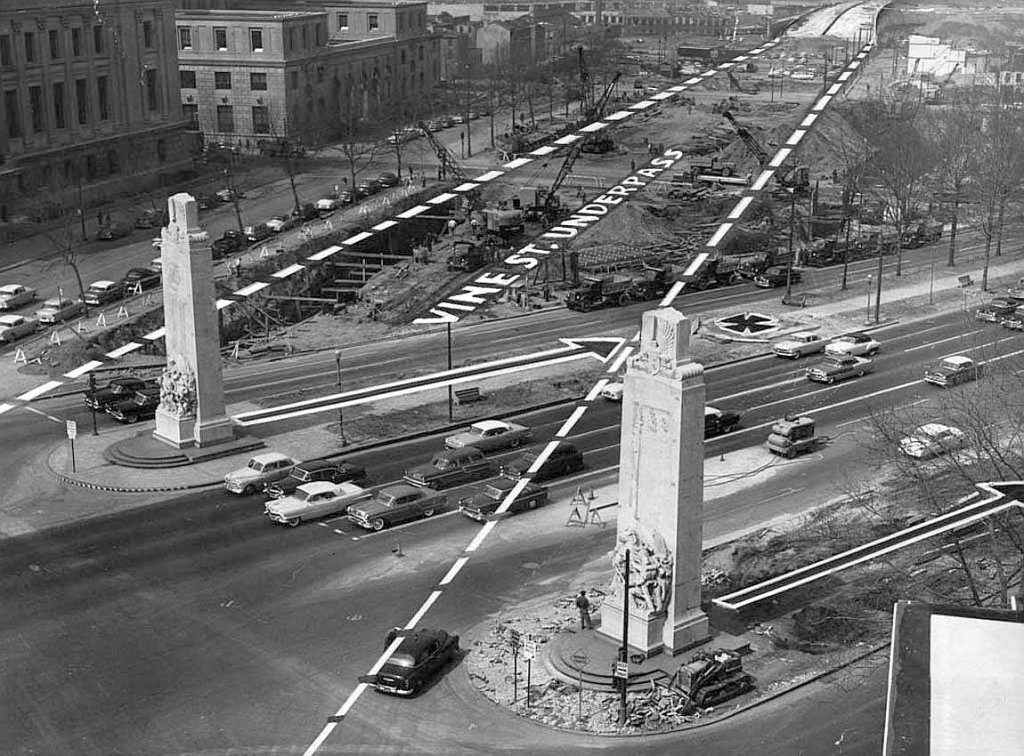
Vine Street Expressway Plans in 1956.

A little more than a month ago, I came across a report prepared by the National Conference of State Historic Preservation Officers (NCSHPO).  NCSHPO formed an Advisory Committee, called the National Historic Designation Advisory Committee (NHDAC), in 2021.  Its stated intent was “to examine the intent, history and implementation of the NHRP with an eye toward fostering greater access and inclusion.  I would recommend that anyone who is involved with the National Register of Historic Places read it.

I have been engaged with the National Register most of my professional career, mainly assisting PennDOT in navigating the Section 106 process. Since retirement, I have served on the State’s Historic Preservation Board, whose primary responsibility is reviewing National Register nominations.  (This gives me one more opportunity to state for the record that the views in this pieces are wholly my own and do not represent the view of the PA SHPO or any other organization.)  So this report is of great interest to me professionally and personally.

For the rest of this commentary, let’s assume that you have read the article and are familiar with its points.  I do wish to recapitulate its main points, since I believe the report appears a bit more disorganized than it needs to be. Perhaps that was due to the number of individuals involved and the number of sub-committees responsible for weighing in.

The report does a good job of identifying the crucial issues.  This is important.  Identifying the wrong problems usually leads to the wrong solutions.

Properties that have a great history but there’s nothing left

Louis Armstrong’s boyhood home.
Louis Armstrong’s neighborhood today.

Properties eligible for listing cannot get there on significance alone.  A property must be able to convey its significance.  How then can a property that has been blitzed (my technical term) be able to have sufficient integrity to convey its significance?  It can’t. And so it can’t be listed.

This eliminates from consideration many places that could be listed otherwise.  I am thinking about Louis Armstrong, probably the most important American musician in the 20th century (not hyperbole, really).  His birthplace was on Jane Alley in Storyville in Nawlins.  All that remains is a historical marker, his childhood home having been razed for a traffic court and police headquarters in 1964.  Over and over again, urban renewal and development of the interstate system have obliterated homes and neighborhoods, many of which contain the history of America.  Closer to home you have the Hill District in Pittsburgh, or the Chinatown neighborhood divided by the Vine Street Expressway in Philadelphia.  Even accumulated neglect of individual homes, exacerbated by lack of capital as a result of redlining and banking, led to their demolitions at a much higher rate than in resourced neighborhoods.

For Black communities especially, what often remains as culturally important places are churches and cemeteries, two property types that have by definition been typically excluded from the National Register.  Taking a step back, one might be tempted to see all of this as piece to erase the history of black and brown people, blocking them from the National Register through multiple means.  But correlation is not causality, and the low percentages of eligible properties requires no more than a casual indifference to any properties not fitting the western European colonial narrative.

THE NCSHPO working groups are clear that the ability for a place to convey significance is a big problem. Their proposed solutions, whether closely embraced or just spit-balled out are not really workable.  If you’re going to have a National Register of Historic Places, you cannot get around the need for the place to have sufficient integrity.  That is as close to immutable as you can get.

The entire NR process is much too complicated

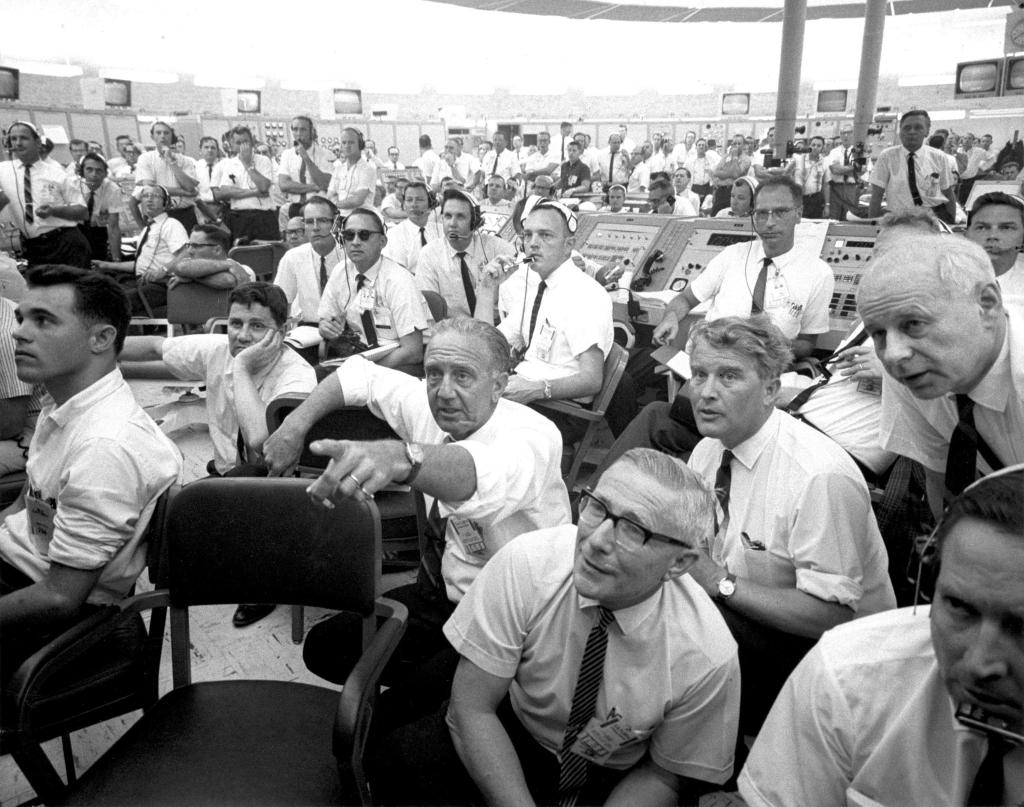
No this is not a consultant internal powerpoint pre-submittal review of a national register nomination. (Saturn blockhouse personnel at Launch Complex 37 during the September 9, 1965 liftoff of the Apollo SA-3 test flight. Image credit: NASA)

I’ve had a front row seat at 14 Historic Preservation Board Meetings to discuss many more National Register nominations.  The average nomination is 100 pages long, more frequently than not with 2 dozen plus photographs, plus maps, diagrams, and other exhibits.  A non-insignificant fraction of those nominations submitted are done for expected tax credits.  Almost all of the nominations have: 1) been prepared externally to the PA SHPO; 2) have been exhaustively reviewed by PA SHPO staff before coming to the Preservation Board.  We read them, discuss them and then (usually) recommend they be sent to the National Register for approval for listing.  The PA SHPO staff has been excellent in making our work easier. I firmly believe the Board looks closely at each nomination.  Most elicit some comments, often minor points, occasionally major points.  I think the success record in Pennsylvania for listing has been pretty good.

Running the gauntlet though, takes many months, is labor intensive, and when prepared professionally, can be expensive.  A professional’s understanding of what goes into the nomination is valuable, but I question whether those professionally prepared nominations have forced the rest to clear a higher bar than is necessary.  It is a phenomenon I’ve seen among many environmental and engineering consultants over the years.  I’m not sure it has a name, but it is a cross between mission creep and kitchen sink. A consultant is largely measured and paid by results delivered.  If the nomination is sent back, that’s a delay.  If the consultant missed something, there’s a client ready to tear them apart.  From the consultant’s point of view, the whole process is a black box. The consultant preparer has a supervisor or reviewer. The reviewer has a quality control check person.  Mix all this with anxiety and the resulting soup demands that any crumb of information, any possible argument for eligibility has to be jammed into the nomination.  These professionally prepared documents, like some stuffed crust pizzas, set the bar for what everyone else needs to do.  Too much is not enough.

And it trickles up to review staff. They want the nomination to get approved by the National Register in DC for all the reasons you can imagine.  And let’s face it. The lack of clarity at the NR, the rotation of review staff there, all keeps the state SHPO staff guessing on what are that day’s rules.  So again, the black box and anxiety pushes the SHPO to make sure the nomination misses nothing, point by point, paragraph by paragraph, section by section.  I don’t think we prepare this carefully for open-heart surgery.

I might at this point bring up the whole issue that the documentation in the nomination is often  the only organized and accessible written history of the property, so there is some need to get the facts right and to tell the full story.  My complaint here is not about telling the full story, it’s about what is necessary to tell any story.

Under NHDAC (Section VIII), specifically with regard to National Register Documentation, Survey and Training, the following is recommended:

The NPS should develop videos and/or webinars that provide more detailed information regarding documentation expectations and requirements—and also specifically addressing what is not required. This webinar would ideally be presented to each state review board individually by its assigned NPS NRHP reviewer, providing an opportunity for Q&A and conversation.

Further on, NHDAC recommends:

Consider developing unified, simplified, and streamlined eligibility determination processes for public use that helps set expectations up front and allows both applicants and SHPOs to identify and prioritize historic resources. The use of “determined eligible” designations can aid in Section 106 and local development projects and foster greater protection and consideration of historic resources across the board, and not as a “showstopper” far down a project timeline.

If it were up to me, I would marry the two and focus on getting documentation expectations and requirements to the lay public, using as many media tools as possible.  The NPS put out a series of short YouTube videos about 8 years ago, called the National Register Toolkit. I found it general and accessible, but not really all that informative.  Many state SHPO’s have made forays into public education and training and a simple Google search shows their efforts.  I suspect some are quite good.  But here’s my question.  The NR has to be aware that state SHPOs are starving for guidance. They are aware their NR guidance is outdated, but it doesn’t seem the National Register is up to the task.  Perhaps it’s simply lack of resources or federal government inertia.  The individual state efforts are admirable, but appear to me to be inefficient.  First, they are doing the work that the NR should be doing. Secondly, although each state has a SHPO office, there is at the end only one National Register, not 50 Registers plus territories and DC.

If this work is truly important and it appears the NR is not capable of completing it, then maybe the NCHSPOs as a group should underwrite a single effort that could serve all of them. It would seem more efficient to have a small sliver of each SHPO appropriation put into a pot to provide the resources to create this training, and have a NCSHPO panel oversee the contracts and product. (This is really no different from the TRB’s NCHRP process, so I am not taking credit for having invented anything.)

Surprise! A Process built for Euro-American architecture and communities doesn’t work as well for anything else

At least 3 Susquehannock Villages are in front of us at Washington Boro, PA.  Together, they contained stockades, up to 80 long houses, and between 1,000 and 3,000 men, women, and children.

Archaeologists know what I’m talking about.  No matter how hard you squint, it’s difficult to see how the corn field in front of you conveys the pre-contact Native American village you have before you.  So, the NR gives you  Criterion D, the dumping ground for properties significant not for important events, nor people, nor architecture.  We comfort ourselves that these sites contain information important in prehistory, and, since it is not frequent that all of the site is excavated, enough of the site remains to likely have the potential to yield important information.  This, of course, reduces all Native heritage, history, and cultural value to data points.

Things tend to break down when all that remains of the site is the collection, sitting on a shelf in some museum.  Here, the NR provides some form of refuge, under Criterion A. The hitch is the data must be important, but what does that mean to an archaeologist, who would tend to think of the totality of all archaeological data from all regional sites is taken together to be important?  This gambit also kind of blows up the notion of centrality of place and ability to convey a site’s significance.

The NR simply wasn’t built for archaeological sites and attempts to fit them into the NR frame sort of works, kind of.  This probably is one of the reasons there are so few archaeological sites listed in the National Register, despite the fact that there are many that have been determined eligible by respective SHPOs.

Sadly, the limits of the NR are precisely at the juncture where tribal concepts of history and space begin.  Property boundaries are an artifact of western land ownership law. Towns, counties, states, all artifacts of western history and development.  History itself is a Greek concept adapted to western philosophical thought.  A critical element of history is the written record.  This leaves peoples without written history at a disadvantage in the history business, which may help explain the reticence to accept orally transmitted story as history, including in NR statements of significance. If you are limiting your story sources to written materials only, how can you effectively tell the full story of properties that don’t fall into a western paradigm?

Although Traditional Cultural Properties are considered within the National Register, the bottom line is that any TCP still must meet the NR standards under one of the Criteria of Eligibility and have the integrity to convey significance.  TCPs don’t have a new or different set of rules, just the shimmering mirage of a more open and expanded NR.

I’ve always thought the NR as extremely flexible.  Only half-heartedly would I say that I would not hire a historic preservation specialist that couldn’t write a convincing nomination for a Dixon Number 2 pencil.  The NR is flexible, but, like a rubber band, is not infinitely flexible.  

Why should a property 51 years old be in play for eligibility but not a property 49 years old?  Although it is appropriate to leave a certain amount of time for a place to be understood as historically important, the choice of 50 years is wholly artificial.  My own theory is that when the National Register was established in 1966, 50 years before was right in the middle of World War I, a cataclysmic event that split everything that happened before it and after it into two different worlds, unrecognizable to each other. In 1966, 50 years made sense, not just in history but architecturally.  

What’s to be done?

The NHDAC threw out a slew of recommendations, but did not favor one over another.  I felt that some were certainly worthwhile.  In particular:

  • Outreach coordinators.  Coordinators in SHPO offices can and should go out to under-resourced communities and work with stakeholders there to solicit properties, assist in preparation, and train, train, train.
  • Diversity staff and boards.  Simply going out into communities is not going to fix the problem, simply putting a band-aid on it.  More effective solutions will be developed only when NR review committees and SHPO staff better reflect the demographics of the country.  As important as this is, it is no simple matter.  Blood, toil, tears, and sweat will be needed over a long period of time to build the necessary working relationships, trust, and pipelines.
  • The National Register of Cultural Places?  This actually makes sense to me.  Opening recognition to culturally significant places, removes some of the straightjacketing that comes with the National Register of Historic Places.  Whether NHRP should be folded into the NRCP is a larger discussion for another day. However, the square pegs of non-western historic properties shouldn’t be continually forced into the round holes of current NR rules.
  • Multiple Property Documentation Forms are highly useful and I’ve seen their value here in Pennsylvania.  They do take a lot of work to set up, but pay back in much simpler Nominations that fall under them.  I do not understand why they aren’t used more.

Needless to say, there were some recommendations I found tepid and some that gave me heartburn.  In particular:

  • There is no magic wand to take a place that has been so altered as to be unrecognizable and declare it somehow eligible to the NR.  Local landmarks, historical markers, giving CLGs more control over “not really eligible” properties won’t address this issue.  Ultimately, we may have to accept that once gone, a property is gone.  However, we do have the ability to tell and teach the story of erasure and work to recover the history of the place.  The National Register is but one tool.
  • Fiddling with integrity standards has unintended consequences.  The standards for listing in the National Register are supposed to be the same as for determinations of eligibility (at least that’s my view). Many agencies grapple with Section 106 reviews of properties determined eligible and assess effects and “consideration” of adverse effects based on eligibility.  Changing the bars on integrity could result in agencies having to consider every property before 1973 (as of today’s writing) a potential adverse effect under Section 106.  I cannot think of any action that would get the National Register legislatively eliminated faster than taking this route.

SHPO staffs are historically and notoriously under-funded and under-resourced.  Some of the better ideas will require substantial increases in funding, which does not appear likely in the current Federal authorization or State authorization models.  Sadly, lack of understanding of what the National Register does in the current climate of erasing history is probably what is saving the NR and SHPO offices from much deeper funding cuts or elimination.  It is a disheartening time to be a historian of any stripe, especially those interested in establishing some kind of equity in recognition of our Nation’s history.

More funding and more targeted funding will help greatly, but in the current climate where some politicians are fighting hard to get rid of the Departments of Education, Energy, and the EPA, where does history get its due?  So, for the short game, all I can recommend is pushing regional inter-state or national partnerships among SHPOs, working to simplify and demystify the nomination process, heavy listening, and sharing best practices of nomination form preparation.  That and maybe training AI to prepare the forms.  The heart of NR nominations is convincing storytelling, but I don’t think even the Writers Guild would object here.

We Need a New Electrical Grid. We also Need NEPA.

Godzilla contemplates how to remake the grid for renewables.

Two documents came across my desktop recently. Together they provide the theme of this piece.  The first was an oblique call from the Society for American Archaeology Leadership to meet with our US Senator, John Fetterman, over the recently passed House Bill, HR 1.

The second was a NYTimes Editorial Board editorial of May 7th: “We desperately need a new electrical gird. Here’s how to make it happen.”  What caught my attention was the centrality of the National Environmental Policy Act in both pieces, to a greater or lesser extent the villain in why energy projects are being held up.

My Spidey sense immediately raised an alarm.  When the right wing in the US House of Representatives and the generally liberal editorial board of the Grey Lady are singing from the same hymnal, something is going on. Further coloring my view is a career in environment in transportation, where every decade or so there is clamor for changes to NEPA as the fix for slow project delivery.  The call always comes from industry and Congress, both generally clueless on the workings of NEPA.  Those of us in the trenches have long known that NEPA is always the scapegoat (sometimes it is Section 106 just to mix it up a bit), but never the core issue.  So this most recent alarm rings hollow, although their convergence rings a greater one.

There’s simply too much here to unpack.  HR1, The Lower Energy Costs Act, is not just “drill, baby, drill,” but also an assault on renewable energy in general and the Inflation Reduction Act in particular.  It is also another try at neutering NEPA.  The Times, on the other hand, is rightfully concerned over how to expedite the crush of power lines and grid infrastructure needed to transition from a fossil-fuel based economy to an electric one.  Despite offering some reasonable approaches, in their pearl-clutching panic they may have also signed on to the NEPA boogeyman.

Nixon signs the Clean Air Act of 1970 as William Ruckelshaus (left), head of the newly formed Environmental Protection Agency, and Russell Train (right), chairman of the Council on Environmental Quality, look on. 50 years ago Republicans were environmentalists?!

Is NEPA a Real Problem?

Is NEPA the real problem, either in speeding up oil and gas drilling, or conversely expediting renewable energy projects?  As stated above, my own experience at the state DOT suggests that NEPA was never the core reason for project delays.  Not surprisingly, the number one cause was simple lack of funding.  Projects went through involved NEPA steps, including numerous EIS-level projects, when not only was there no identified funding for the projects, but no prospects for funding.  Why the projects were carried on the books is anyone’s guess, but certainly some of it was placating local politicians.  NEPA analysis took much less funding than actual construction and as long as NEPA progress could be shown, then the “project” was moving forward.

The national focus has been on EIS-level projects (I presume as you are reading this at this point, you know the differences between an EIS, and EA, or CE).  Over 95% of our DOT’s projects in quantity and in dollars were CE-level projects, not EIS’s.  Over the years, we had gotten expert at moving CE-level projects through environmental review, so that no one within the agency every worried about those schedules.  We had developed tools to expedite the CE process, including a form-based approach, ultimately hosted on a web-based environment. If the project is simple and straightforward, nothing beats a form and forms relieve the need for page limits.  Even if there are attachments, a form focuses the preparer on what’s important and what information is needed.  In addition to forms, our agency worked closely with the FHWA, or federal partner and funder to develop programmatic agreements that included common and predictable projects, making some CE’s by definition, others CE’s by specific tests.  Finally, our programmatic agreements were lined up with other programmatic agreements with other agencies, Federal and State, that had authority over review, approval, or other permits, notably the USACE.  These programmatic agreements set ground rules on who did what, and more importantly ended duplicative reviews.   I’ll come back to these later.

Is there data on this?  Is the NEPA brick wall fact or a folk tale?   Actually, there is some data.  First, most NEPA decisions do not involve an EIS.  In 2014, GAO stated that less than 1 percent of all NEPA decisions were for an EIS.  While most visible and reported environmental studies are EIS’s, in truth (like my DOT) the bulk of the sausage being made is CE-level.  It’s not visible because it’s so common, and it’s not newsworthy because it’s a rare CE that raises a ruckus with the public.  Remember, categorical exclusions are by definition projects that do not have a significant environmental impact.

A 2022 review of NEPA timelines by John C. Ruple, Jamie Pleune & Erik Heiny of the University of Utah and Utah Valley University, showed that within the US Forest Service, an agency that produced 41,000 NEPA decisions between 2004 and 2020, 870 were EIS-level (2 % of the total).  It is true that some EIS-level projects took an inordinate level of time to complete, but these were the outliers.  Looking at the median times, instead of the mean times is a more telling measure. Whereas the mean time to complete the USFS EIS was 3.4 years, the median time was 2.8 years.  For CE’s, mean times were 7 months; median times were 4 months.  The outliers get the press coverage and obscure the overall trends.  Whether a project required an EIS-, EA-, or CE-level review poorly predicted the length of time for that review, accounting for only 25% of the variability.  Some CE’s took longer than some EIS’s.  Other factors that affected review times included low staffing, inadequate project funding, prioritization of the project within the review agency, operator and market priorities in oil and natural gas projects, delays in the applicant providing information, lack of agency planning, and regional differences.

HR 1 attempts to cut NEPA into bits, first by reinstating Trumps 2020 CEQ regulations, then by legislation exempting oil and gas development from anything left.  If these studies are to be believed, we as a nation will have sacrificed environmental protections from oil and gas development, but might gain virtually nothing in return.  Although the focus of HR 1 is almost entirely in oil and gas promotion, there is one provision delicious in irony dealing with offshore wind development (Section 20018).  With the sincerity of Charles Montgomery Burns, it calls for a thorough environmental study of offshore wind, to include:

(1) The impacts of offshore wind projects on

(A) whales, finfish, and other marine 9 mammals;

(B) benthic resources;

(C) commercial and recreational fishing;

(D) air quality;

(E) cultural, historical, and archaeological 14 resources;

(F) invertebrates;

(G) essential fish habitat;

(H) military use and navigation and vessel 18 traffic;

(I) recreation and tourism;

(J) the sustainability of shoreline beaches and inlets.

(2) The impacts of hurricanes and other severe weather on offshore wind projects.

(3) How the agencies described in subsection (a) determine which stakeholders are consulted and if a timely, comprehensive comment period is provided for local representatives and other interested parties.

(4) The estimated cost and who pays for offshore wind projects.

Furthermore, in Section 20119, the GAO is required to publish a report on all potential adverse effects in the North Atlantic offshore wind project Planning Area, to include:

(1) maritime safety, including the operation of 15 radar systems;

(2) economic impacts related to commercial 17 fishing activities;

(3) marine environment and ecology, including 19 species listed as endangered or threatened under the Endangered Species Act.

What’s good for the goose is apparently not good for the gander.

If NEPA is not the Problem, How Do We Expedite Grid Infrastructure?

NEPA is not the main cause for the delay of projects requiring an EIS.  Ruple et al showed this for the USFS.  My own experience at our DOT supports this conclusion.  I suspect any other environmental professional in transportation would support these conclusions. Jiggering NEPA to advance oil and gas projects is unlikely to do anything other than damage the environment.  Applying the same tactics to virtuous renewable energy projects and remaking the electric grid is unlikely to give a different result, particularly if these projects are largely privately funded.  How then to actually speed needed electrical grid projects?

To be fair the NYT Editorial, NEPA reform was only one of a suite of recommendations.  In addition, they were:

Making a single federal agency in charge of major transmission projects.

Endow FERC with the power to approve the routes of major electric transmission lines that pass through more than one state (but only to major projects of national importance)

Identify where power lines should go and begin the approval process before companies apply.

Mandating a minimum transfer capacity for each regional grid.

Putting a single federal agency (FERC) in charge of major transmission projects/give FERC power to approve routes would provide parity with oil and gas pipelines.  However, as the Times noted, “state and local governments would retain oversight of the smaller projects that make up 90 percent of all transmission projects.” *(my emphasis)  This sounds eerily like the issue of EIS-level projects versus CE-level.  This relief may help the largest projects that move high amounts of electricity from South Dakota to the Pacific Coast, but little else.  However, it is reasonable to place FERC at the center of all Federally-funded grid projects, whether national or local.  As 30 years with the DOT showed, even if the funding is Federal and oversight is by FHWA, close programmatic cooperation with the state DOT and other involved agencies, plus healthy public involvement, made the process work well.  At the end, a citizen could care less who signs off on the NEPA document, as long as it gets built and the environment is protected.

Identifying where power lines should go in advance is the essence of planning, but unless that planning includes adequate public involvement, you will get blow back, sometimes extreme and often justified.  Taking a page from FHWA, a process that linked planning and NEPA, PEL, could provide a useful model for planning grid powerlines and facilities. To the degree that the government can find and rank good solar and wind sites and can anticipate their need several years in advance, a concerted up front planning effort with adequate public involvement could smooth the way for permitting and construction.

Going back to what expedited environmental review at the state DOT, some of those ideas are readily applicable to the electric grid buildout.

Push programmatic approaches, both in what qualified as a Categorical Exclusion, and in removing duplicated reviews by other federal agencies or state and local agencies.  Implicit in the programmatic approach is the acceptance of a form-based process for CE review. (This is instead of eliminating all CE documentation and review as proposed in HR 1.)  Have FERC meet with all of the stakeholders and especially those with regulatory authority.  Push hard for agreements to eliminate the need for redundant reviews.

FERC needs to embrace the notion of a vigorous public involvement, early and often.  It may seem counterintuitive that deeper and more sincere public involvement speeds projects but it does.  We certainly know the converse to be true. The faster and harder you push on a project schedule, the longer it will take to complete.  Unless you are willing to repeal NEPA (HR 1 aside), environmental consideration and public involvement will always be central to the process. Doing each of these better is the path to faster approvals.

Alluded to in the Ruple et al article is the notion that adequate staffing of environmental offices (most likely within FERC) will speed the process.  Putting knowledgeable experts at the center of the process worked well at our DOT, and I suspect it is the winning formula for other circumstances. 

The balkanization of electric grids is a hard nut to crack, especially as many are heavily influenced by their privately-owned utility partners, who see it all as a zero-sum game.  This is an area where a carrot and stick approach could work best.  Incentives to promote cooperation and sanctions for going it alone.  Sanctions could include harsher penalties for grid failures during storm or fire events. Incentives could include subsidies or tax breaks for electricity moving from one grid to another.

Building a road or a transmission line is a complex operation, in design, in environmental review, and in construction.  Single silver bullet solutions rarely are effective, and sometimes can be counterproductive.  Even though streamlining environmental review may take more than one approach, there is ample evidence that it is possible and worth doing.  The most effective streamlining does not requiring tinkering with either NEPA or its main regulations.  Things like environmental review page limits are not only ineffective, but just plain dumb.  And we’re going to need better than dumb if we have any hope of adding “47,300 gigawatt-miles of new power lines by 2035.”

Is Archaeology a Legitimate Profession II:

Shortening the Educational Trail

Certification and Licensing

In the last blog, I emphasized the importance of licensing.  What I failed to clarify is that there is a distinction between certification and licensure.  By licensure, I mean governmental sanctioning of a particular set of minimum professional requirements.  Licensed professional archaeologists are legal; non-licensed are not.  By certification, I mean non-governmental sanctioning of a particular set of requirements.  States (or the federal government) license; organizations certify.

No state or federal agency responsible for licensing would create such requirements without the input and support of the professional organization(s) responsible for them.  Therefore, it would follow that creating certifications would precede licensing.  Which brings us to the issue of the RPA, the Register of Professional Archaeologists.  RPA does certify professional archaeologists and has recently created a category for Student and Early Career Archaeologists. Is this sufficient and are we re-inventing the wheel?  I think not.  Critically, RPA membership is voluntary and no one is required to ensure any archaeological work is led by an RPA-certified archaeologist.  If you look to an analogy in a place where there is licensing – Ontario, Canada – you can see that the standards are quite high and quite specific.  And mandatory.  Licensing brings teeth.

Perhaps, SAA, SHA, and other professional organizations could be more assertive on the need for professional archaeologists to belong to RPA, in addition to advocating for licensure.  If SAA, SHA, or other professional organizations are not aligned with the minimum requirements laid out by RPA, then it is incumbent on them to sit down together to work out a common and supportable national standard.  Perhaps membership in RPA could be added to the SAA’s Ethical standards, as it might be argued that belonging to a national certifying organization discourages bad actors, and upholds the other ethical standards.  In the meantime, certifications could more finely slice and dice requirements to create a step-wise pathway for full professional certification, something that RPA is beginning to do with emerging professionals and field schools.

A national focus has the advantage of efficiency.  The last thing the profession needs is somewhat common certifications that vary state by state.  And if anyone is paying attention, time to sort these things out is time we do not have.  The other advantage of national certification is that the state-by-state effort to create licensing can be done with focus.  I’m not a fan of ALEC, but good lord, they know how to get legislation passed.  If we can set up the necessary certifications, one office can write boilerplate legislation that can be presented (and passed) in each state.

How to get to an MA faster

For argument’s sake, let’s assume that we’ve all agreed upon some common national standard for minimum qualifications.  Let’s also assume it will look somewhat like the current landscape, adopting portions of the NPS qualifications and RPA standards.  In any version you might imagine, it’s going to require a boatload of education and a boatload of experience.  If you run the numbers, it’s something like 4 years of undergraduate education plus 2 years of graduate education plus 2 years of experience.  And that’s for the minimum requirements, organized to be maximally efficient.

Having someone commit 6 years of tuition costs toward a profession that doesn’t pay well to begin with is a big ask.  With respect to education, I do believe there are now opportunities to shorten that 6 years of schooling.  I suspect most current graduate programs are trying to play a zero-sum game with education, cramming more applied archaeology into the program at the expense of basic anthropology and archeology method and theory.  If you add LIDAR and GPR requirements, do you have to remove History of Anthropology or Ecological Theory?  There’s only so many credits in an Master’s program and each credit is dear.  To compound matters, fewer students entering Master’s programs have good grounding in anthropology, which they should have gotten as undergraduates, but didn’t.  If we believe that such grounding is important, from where is it going to come?

This can be ameliorated.  For what would typically be survey courses, i.e., those courses taught in a larger lecture hall, we could dispense with the luxury of formal in-person teaching, and emphasize MOOC (Massive Open On-line Courses) or web-based classes.  These classes would be free and available 24/7.  Students entering Master’s programs would be required to attain the knowledge from these classes before beginning Graduate School.  Attainment would be measured through testing.

These on-line classes are not bounded by the structure of a college course: 3 hours a week, 15 weeks in length.  They can take as long as they need- 20 hours, 5 hours, whatever.  They could be bundled into what would be awarded credit as a college course.  I can rattle off several MOOC classes that could be established: basics of stratigraphy; basics of chronology; basics of typology; anthropological archaeology.  You could take what is typically a Methods in Archaeology year-long course and break it down into its component parts and offer them as modules in a MOOC environment.  Assembled in various ways, they could become an equivalent college course with the same college credits.  Voila! One less course that has to be on most every graduate-level program requirement.  And so on.  This would leave precious class hours to dive into the advanced seminar classes that benefit graduate students the most.  National standards would dictate what the MOOC classes would be and what they would cover, and national testing would measure whether students knew the material or not.

I don’t know if universities would balk at outsourcing their foundational coursework, but if it is foundational and basic, why would they not?  Accepting community college credits is becoming much more common and necessary.  How is this different?  The current problem is that such courses do not currently exist in the Internet universe.  A quick survey of available MOOC classes shows a distinct lack of national common course offerings, and there’s virtually nothing relevant to the basics of an archaeological background.  This is a true opportunity for the SAA.  This is the organization that could assemble the needed pedagogues and craft a suite of introductory classes that would begin to prepare students to be professional archaeologists.  Some of the courses would be focused on CRM.  Necessarily, surveys of specific culture area would be needed.  All should be on-line and free to the public, but geared to the pre-professional.  SAA, you can do this. Will you?

No heel clicking here either.  Assuming such courses could be assembled, the harder lift will be to change how graduate schools treat education outside of their direct control.  Perhaps not all graduate programs, but most graduate programs would have to get on board to accept these courses as prerequisites for admission.  Think Advance Placement for the 22-year old.  Ultimately, this will take a serious rethinking of what constitutes professional education within the academy, a notoriously conservative institution.  And this would have to pass muster not only at the department level, but at the university college level, one university at a time.  Oh, and in an environment where archaeology and anthropology are on the chopping block at many schools, again because of the lack of understanding of their value to the society at large.

5-Year Integrated Programs

Some schools, such as Penn State, offer an integrated undergraduate/graduate anthropology degree in 5 years.  Requirements are high and selective and suggest this is not the norm.  If you could normalize this approach, though, you have the chance to frontload the program with MOOC courses and possibly reduce the total educational requirements to 4 years or less.  And this without surrendering any knowledge needs.  Having a national standard (or licensing) for education would make such programs more desirable and there would be a predictable and more affordable pathway to completion.

 Offering integrated degrees is a nudge and a nod toward more efficient education, but does not really address the issues of overall college costs, or, ensuring that the courses offered really are useful for a CRM career as currently practiced (or as anticipated to be practiced in the near future).  The larger problem for university graduate education is the overall indifference to educating students for a CRM career.  Until the academy understands and addresses this key weakness, all 5-year integrated programs will accomplish is pushing unemployable Mesoamericanists out the door faster.

Is Archaeology a Legitimate Profession?

Show Me Your License!

Please note: The views expressed below do not represent the SAA, the RPA, or the PAC. They are my own.

This is not the logo of the Association of Professional Archaeologists, nor on the APA Certificate, which does not exist.

Sitting here on a late February morning, I’ve been reflecting on a February 8th webinar I attended that was sponsored by the Society for American Archaeology.  Titled, the “Future of Cultural Resource Management (CRM) Archaeology in the United States,”  it was intended to be an expansive review of where CRM is going.  Sitting through the webinar, virtually all of the speakers zeroed in on staffing, more specifically the current and anticipated lack of both field crew and directors and principal investigators, exacerbated by the expected demands of the Build Back Better Act and the more recent Inflation Reduction Act.

Most of the discussion outlined the problem in stark terms, but few practical remedies were offered, mostly revolving around better pay and improving the public perceptions of archaeology in general, with the goal of enticing undergraduates to take up the cause.

I think we could agree that improving the pipeline to a new generation of archaeologists is necessary.  I think we also could all see that better pay should improve the attractiveness for archaeology as a living.  But having spent my career in CRM as an agency manager, having spent my career hiring and developing archaeologists, I do have some strong opinions on both the problems, which by the way has taken a few decades to develop, and the potential solutions, all of which require much more than tapping your emerald slippers together and wishing it so.

What Are the Problems?

Beginning on the problem side, there are a few stubborn facts related to the practice of archaeology.  First and probably foremost is that archaeology is a labor-intensive enterprise, and labor is expensive.  Technology has nipped at the corners: GPS replacing transits and alidades; drones and LIDAR replacing aerial photography; tablets replacing paper forms.  Yet, to date, no one has figured out a way to expedite finding artifacts in the ground, so the process of surface survey and shovel test pits, and test units will continue to consume many hours of our attention.  On the back end, there is artifact processing, cleaning, cataloguing, and curating.  And this doesn’t even take into account the end goal of making sense of it all, although a wag could suggest that CRM rarely gets there anyway, so why worry.  We may reach the point where AI can assist in artifact identification, but in 2023 we aren’t there.  And for reasons below, AI might well lag behind.  Labor costs still represent the bulk of expenses for any archaeological undertaking, especially in CRM.  In the United States, even where the pay is poor, archaeology is an expensive proposition.  Pay equity, by which I mean pay commensurate with other fields requiring similar knowledge and skills, won’t make archaeology less expensive.

The second problem, one which we all acknowledge in different ways, is that archaeology is a knowledge discipline. It is like a practice akin to medicine or law.  Experience matters.  More experience usually (although not always) translate into more skill.  We have acknowledged this through making Secretary of Interior Standards more stringent than any other historic preservation field, requiring a Master’s Degree as a minimum for professional qualification.  We have acknowledged this by placing emphasis on field schools and a long apprenticeship.  We have acknowledged this by pushing a trade-like training progression from field crew to crew chief, to project director to principal investigator.  I would argue that there is a deeply psychological reason for the emphasis on practice and experience.  At its core, archaeology is a field of deep curiosity, an n-dimensional chess game with an impossible goal – telling the history of peoples who are no longer there to tell those stories, relying heavily on the unwritten record of scraps of material culture, tumbled in the ground in chaotic and/or predictable ways (thank you, Michael Schiffer).  The hunt for that story is what differentiates us from cultural anthropologists, sociologists, historians, and pot hunters.  I would argue that the quest for those histories is what marks a true archaeologist.  And it is that quest that makes us all compulsive in utilizing any and every technique or discipline out there to achieve our goals.

In the field and in the lab, the question of “what am I seeing” is immediately followed by “why am I seeing it” and “why is it here and not there?” To complicate the training of an archaeologist, more of the same experience is not helpful, but different experiences are.  Digging 10,000 shovel test pits really doesn’t teach you more about stratigraphy than digging 100.  Learning flakes, cores, and tools from one kind of meta-rhyolite is one thing, but differentiating flaked tool types from all the stone used in a region is something else.  Stratigraphy has so many “gotcha” moments that seeing a process the first time is both exhilarating and confusing.  Almost no archaeologists have “seen it all.”  Back to whether AI can help us.  AI appears to be very good at predicting what you already know, regurgitating truths about the mean.  This is largely because AI relies on past experience to predict the future experience.  AI is much less skilled at figuring out surprises.  And archaeology is if anything, a sequence of surprises.  

Licensure – One Solution

What is the point of this long digression into the complexities of our profession?  It’s this.  We are facing a national crisis in workforce numbers. It is coming too quickly.  The entire archaeological community needs to work together to address this now.  We cannot rely on methods of education and training that have served us for a generation.  It’s clearly not working. It’s too slow and too inefficient.  The Academy has largely dragged its feet in adapting its educational focus and methods.  What is needed now is a focused and consistent effort that will necessarily sacrifice exactitude and precision for broadly effective measures.

The general building blocks to create an archaeologist have been there for a long time: graduate education and hands-on experience.  The Register for Professional Archaeologists have established standards for each, but we haven’t done what other professions have done – specific course content requirements, testing, and most importantly, licensure.     Licensure, the same way doctors and dentists are licensed, the same way lawyers are licensed, the same way electricians are licensed.  Fields that require greater skills than archaeology, fields that have greater consequences, all have a minimum agreed upon standard to enter into that profession.  The standard(s) are both national and statewide.  And these standards are written into state laws, along with the infrastructure necessary to implement them, e.g. governing boards.   We have neither the baseline standards nor the state-sanctioned licensing.  I think the root of our problems is our inability to measure our competence in a field as far-ranging, as problem-solving, and as squishy as ours.  And to definitively state who is in and who is out.  Other difficult fields have managed to do so.

What is the impact of not having formal licensure?  In my former life, in the land of engineers at PennDOT, we had a lot of employees who had civil engineering degrees but were not PE’s, i.e., professional engineers.

From the National Society of Professional Engineer’s website (https://www.nspe.org/resources/licensure/what-pe):

What makes a PE different from an engineer?

  • Only a licensed engineer may prepare, sign and seal, and submit engineering plans and drawings to a public authority for approval, or seal engineering work for public and private clients.
  • PEs shoulder the responsibility for not only their work, but also for the lives affected by that work and must hold themselves to high ethical standards of practice.
  • Licensure for a consulting engineer or a private practitioner is not something that is merely desirable; it is a legal requirement for those who are in responsible charge of work, be they principals or employees.
  • Licensure for engineers in government has become increasingly significant. In many federal, state, and municipal agencies, certain governmental engineering positions, particularly those considered higher level and responsible positions, must be filled by licensed professional engineers.
  • Many states require that individuals teaching engineering must also be licensed. Exemptions to state laws are under attack, and in the future, those in education, as well as industry and government, may need to be licensed to practice. Also, licensure helps educators prepare students for their future in engineering.

Speaking about lives affected by civil engineers, all you need to do is look at Turkey and Syria and the disregard for building codes to see what kind of consequences can arise.  At PennDOT, engineers that were not PE’s were limited by job description.  At the highest levels of management, PennDOT could have an administrator who was not a PE. When they did, they necessarily created a second equivalent position whose only responsibility was to be the PE when needed.

An occupation more closely related to archaeology is geology. Professional geologists are also licensed and the National Association of State Boards of Geologists lets us know what’s at stake (https://asbog.org/governance/licensure.html).

Unqualified geologists, who are employed in jobs that affect the public, place an undue risk on the health, safety and welfare of that public. The risks include:

  • The possibility of an error that will cause a loss of life or property
  • The higher costs of supervision
  • The costs of repeating incorrect and incomplete work
  • Lower cost/benefit ratios brought about by an inability to do efficient work

The national organization for professional geologists, the AIPG, was formed in 1963.  In Pennsylvania, their licensure came in 1992.  It still operates effectively.  The Society for American Archaeology was formed in 1932, the American Anthropological Society in 1902, the Archaeological Institute of America in 1879 , and the Society for Historical Archaeology in 1967.  In 1976, SOPA (Society of Professional Archaeologists), the precursor to RPA was formed in response to the challenges of the National Historic Preservation Act of 1966 and the Archaeological and Historic Preservation Act of 1974.  Thirty years after AIPG, licensure for professional geologists was established in Pennsylvania.  Today state licensure for geologists is in place for 40 of the 50 states.  Fifty years after the establishment of SOPA, no states have archaeological licensure. Licensure for archaeologists only exists elsewhere outside the US, such as in several Canadian Provinces.

You may well say that engineering or geology is a hard science and it is unfair to compare it to archaeology.  In Pennsylvania, here are some of the occupations that require a state license:  accountants, auctioneers, barbers, real estate appraisers, crane operators, funeral directors, landscape architects, massage therapists, psychologists, and car sales people, not to mention those in the medical profession.  Tell me honestly, if these occupations require state licensure, why should archaeologists be exempt?

Not having licensure comes with real costs. In Pennsylvania, there is no job title “Professional Archaeologist.”  The archaeologists hired by the Commonwealth are hired under related but non-equivalent job titles, such as historic preservation specialist or museum curator, and which have much lower standards, with pay commensurate with those lower standards.  

Of what worth is archaeology? We don’t save lives in the operating room, or design bridges that won’t collapse, but frankly most professionals in other fields are rarely called to this level of accountability.  Computer programs design most of our bridges, with engineers monitoring the process.  I do believe that archeology has a necessary place in the discussion of our national history, not just in complying with Section 106.  Frankly, archaeologists have done a poor job explaining our value to society.  Hell, we can’t even get our national organization (SAA) to value the one part of archaeology – CRM – that is valuable to society.  Should a bunch of dilettantes playing in the dirt get paid?  Nah!  And then we complain about our pay comparable to other fields, and why students aren’t flocking to us.

Lack of minimum standards is reflected in our work product.  It is uneven at best.  Some practitioners that 10 out of 10 archaeologists would agree are unqualified to conduct archaeology continue to be employed and contracted.  We have no way to police this because we have no ruler to use, either to measure or to smack with.  The flip side of lack of common minimum standards is that anyone and everyone is qualified.  Anyone can claim to be a professional archaeologist (and do).  If you belong to RPA, there is an internal process, but no one is required to belong to RPA.  

Finally, there’s the lack of respect as a legitimate discipline.  A professional engineer can claim a “PE” after their name and it is backed up by state law.  PE’s have great responsibility, but also have earned respect.  The same with geologists, or architects.  We can put an MA or PhD after our names, but speaking from experience, that doesn’t guarantee any level of competence.  We disrespect ourselves by not having a national minimum competency standard.  Then we complain that our profession has no respect with agencies or the public.

Licensure presumes a common standard, and although implemented state by state, is generally established nationally.  Wouldn’t adopting the NPS standards do the trick?  NPS standards are a start, but is probably too loose to be effective.  And there is a glaring omission in the standards for any knowledge of the National Historic Preservation Act or Section 106, under which the vast majority of archaeological work is done.  Finally, what does adopting mean?  The Park Service has talked about revising the standards for several decades with no final outcome.  Without a national infrastructure to enforce the standards, the NPS standards are just some piece of regulation tucked away in a sea of other regulations; the Park Service has demonstrated its inability to be the organization to scaffold that structure.

This is where the SAA, and SHA, and RPA could be effective.  These groups should define the national minimum standards of knowledge and practice required to be a professional archaeologist.  These are the groups with the standing to undertake this national effort.  I keep saying the word national because smaller regional or state efforts will only create confusion.  Yes, I understand that field methods in Arizona are not the same as in Pennsylvania, but if I am in Arizona and talking with an archaeologist there, we both speak archaeology.  We understand each other.

Licensure and national minimum standards would align all of us on a common standard and allow a coordinated effort to establish licensure in each state.  From this we could establish who can and cannot be a professional archaeologist, state by state.  Universities would clearly know what coursework would be needed.  Those interested in offering an education in archaeology that could actually lead to a job would pay attention.  Governmental job descriptions could be aligned with professional needs.  Licensure would be a pathway to pay equity.  The common standard would also facilitate reciprocity between states, enabling an archaeologist licensed in Pennsylvania to work in New York or Ohio, or beyond.  However, until we establish national minimum standards, we are going to be flailing away on small and limited efforts.  

If we are going to develop the workforce needed for the future of CRM, we need better national ground rules and efficiencies in all of our programs.  Frankly, we can’t afford to waste one course or one day in the field for the benefit of training our future archaeologists.  Before students commit to a career in archaeology, they deserve to know precisely what they need to know and do to be considered a professional.

For Part II: Shortening the Educational Trail, click here.

Should Your Next Car Be an Electric?

IRA’s Adventures in Wonderland

A short time ago, a dear friend of mine approached me with a question. They were in the market for a new car and asked me whether they should consider an electric vehicle, an EV?  This is a relatively simple question that pulled me into the rabbit hole of all rabbit holes.  It became so complicated that I ended up preparing not one, but two spreadsheets to navigate the answer.  And because it is so complicated, I thought it might be useful to try to break it down here.

Why Does it Matter?

The planet is rapidly warming due to the human introduction of CO2 into the atmosphere over the last 150 years. Currently, the world average temperature is more than 1 degree Celsius over pre-industrial levels.  If we are to keep the increase to 2 degrees Celsius or less, we have to get to carbon neutral by no later than 2050.  A 2 degree increase in the world average temperature will lead to droughts, floods, storms, and sea level rise that are unprecedented in recent human history.  To not act now will lead to warming much greater than this and multiplied effects.  Available modeling suggests that this future world will be a bad place to live. As UN Secretary Gutierrez recently put it, “We are on a highway to climate hell with our foot still on the accelerator.”

The US has historically been a major contributor to the problem, and as a leading democracy, we have the responsibility to lead in the effort.  Emissions in the US come largely from electricity generation, transportation, and manufacture – about a third each.  In the transportation sector, burning gasoline to power our cars has been the Number 1 problem.   Hence, the need to electrify our cars, trucks, buses, trains, and ships. With planes, we need to fly less and decarbonize, probably through green hydrogen.  Getting my friend into an EV pushes the needle in the right direction, even if that push is miniscule in the grand scheme of things.

The Old Rules

Three years ago, we bought a Nissan LEAF SV Plus.  At the time, the only remotely affordable choices available to us were the Chevy Bolt, the Tesla Model 3, and the LEAF.   For our efforts, we were rewarded with a $7,500 Federal Tax Credit and a State $1,500 rebate.  This brought the cost of the LEAF down to around $30,000.  The only requirements for the Federal Tax Credit were that less than 200,000 vehicles of that model were sold and that we had a federal tax liability of less than $7,500 in our annual income tax filing.  At the time, the Chevy Bolt and Volt and the Tesla had reached that 200,000 sales limit and were no longer eligible for the Federal Tax Credit.

The New Rules

Ah, the good old days.  In August, 2022, everything changed with the passage of the Inflation Reduction Act, known quaintly in our home as “the other IRA.”  The new rules are quite complicated and haven’t really been well explained by either the Federal Government or the press.  The Federal Government has been cautious largely because the specific rules for implementing the portion of the law that takes effect after January 1, 2023 depend on the IRS writing them.  They are still writing ferociously, so the rules probably won’t be released until after January 1st.  The press has done a poor job because it the law is complicated and there is no easy way to simplify it into a single short article.  I am neither the Government nor the press.  So as long as you are willing to take everything I say with a grain of salt, I will attempt such explanation.

Before and After January 1, 2023

January 1, 2023 is a critical date in the implementation of the IRA.  Certain rules apply before then and other rules apply afterwards. There are a few elements of the IRA that transcend the pumpkin date of January 1, 2023.  First, to qualify for the Federal credit, the vehicle has to cost less than $55,000 if it is a car, and less than $80,000 if it is an SUV, truck, or equivalent.  Fortunately, many For EV’s, this is not necessarily a bad thing as the platform in a normal SUV generates a higher center of gravity. Loading batteries on the chassis lowers that center, so an SUV EV is naturally more stable than a non-EV. 

Although the law excludes taxes and delivery charges from that limit, it does not exclude options.  So, if you have an actual car with a MSRP of $53,000 but want the better audio system or trim, it will push the price past the $55k limit.  For cars with a MSRP in the upper $40’s or low $50’, one wonders if this will give buyers some leverage on price as these manufacturers might find those cars sitting on the lot like forever, while less expensive configurations will fly like hotcakes, having their glove compartments stuffed with an extra $7,500.

The second major aspect to the IRA is that to qualify for the tax credit, your income has to be less than $150,000 a year if you’re filing as a single, or $300,000 a year of you are filing jointly.  This will not affect most of the people I know, but it is a nod to the idea expensive EV’s for wealthy people should not be part of the IRA DNA.

Beginning in August 2022 with the passage of the law, the IRA imposes a North America vehicle assembly requirement.  The vehicle has to have final assembly in North America to get the tax credit.  Before January 1st, a vehicle assembled in North America can qualify for the full $7,500 credit. After January 1st, the North American assembly requirement qualifies a vehicle for a portion of the credit: $3,750.  The other half is in battery manufacturing (see below).

Finally, the maximum credits are $7,500 both before and after January 1st.  Credits for used EV’s will take effect after January 1st.

EV Models that are under consideration here, ranked by Range

Before January 1st

Here’s where things get a bit hairy, especially if you need to buy an EV now.  Before January 1st, the 200,000 unit sales cap remains in effect.  So the Bolt and Tesla are off the table for a tax credit if you buy one before then.

Not considering plug-in hybrids, the following models could be eligible for the $,7500 tax credit if purchased before January 1st

Nissan Leaf

*Ford Mustang Mach-e (orders are backlogged, so good luck)

*Ford F-150 Lightning (orders are backlogged, so good luck)

*Rivian R1T

If you are wanting the tax credit, your choices are severely limited.  Otherwise, there are a number of highly rated EV’s that are assembled outside of North America.

After January 1st

After January 1st, it’s a good news/bad news story.  First the good news.  The 200,000 unit sales cap is removed. This brings the Bolt and Tesla back into play.  Secondly, used electric vehicles are now eligible for a $4,000 tax credit.  To simplify this discussion, I am not going to delve into used vehicles.  Another room and door in the rabbit hole.  Another time, another blog.

The bad news, such as it is, is that the $7,500 credit is divided into two halves. The first half is over the final assembly being in North America.  Of the cars and trucks currently on market, all of the ones above except the Hyundai’s and the Toyota are eligible for the $3,750 NA assembly credit.  The other half of the credit is where the battery is manufactured.  At least half of the battery must be assembled or manufactured in North America (for 2023.  In year 2024 and beyond, that percentage increases).  The Chevy Bolt and Bolt EUV, Cadillac Lyric, Nissan Leaf, and Tesla Model 3 and Y all have their batteries manufactured in the US, and therefore would have the other $3,750 tax credit.  As of this writing, it appears the Ford Mustang Mach-e and Ford F-150 Lighting will have their batteries imported and would not have the $3,750 credit.  However, Ford has been suggesting that it will supply some of these vehicles with NA manufactured or assembled batteries in late 2023. Which and when to be determined.

And then there’s the fine print.  The IRS will be writing the rules over what cars, SUV’s, and trucks qualify for which part of the IRA tax credits.  Final assembly in North America seems fairly straightforward, but establishing how to determine what is 50% of manufacture or assembly might be harder to peg. The rules for 2024 and beyond are also different as percentages of battery manufacturing and critical mineral sourcing in North America are increased each year.

EV Choices ranked by Cost after Rebates and Tax Credits

Other Models

If you were licking your chops over the $7,500 Federal Tax Credit, you might be a bit disappointed in the selection of vehicles that qualify in part or in total.  However, these credits will last for 10 years under the current legislation and more models are being introduced in 2023, notably the Nissan Ariya, the North American-assembled Volkswagen ID.4, and the Chevrolet Blazer EV.  The Ariya and Blazer are both SUV’s.  The Ariya is manufactured overseas and won’t qualify for any Federal Credits.  The Blazer is likely to qualify for both final assembly and battery credits, and is expected to be available in the summer of 2023.  Manufacturing is in Mexico, so the assembly part of the tax credit is probably assured.  I do suspect GM will do everything possible to ensure the Blazer EV also meets the battery standards for the other half of the credit.  The Volkswagen ID.4 will be assembled in Chattanooga starting in 2023, so the assembly portion of the credit will be met. Unfortunately, only the smaller 62kWh battery pack, assembled in North America, will be available on NA assembled ID.4’s meaning the tax credit will be for $7,500 but only for a car that has a 208 mile range.  Whether VW fixes this in 2023 or not remains to be seen (see below).

The Pennsylvania Rebate

In Pennsylvania, there is an additional rebate for EV’s, up to a maximum of $3,000.  However, the income requirements and purchase price requirements are more stringent.  Some who could qualify for the Federal Tax Credit will not meet the Pennsylvania income limits, which are set at 4x the Federal Income Poverty Level for a $2,000 rebate and 2x the Level for a $3,000 rebate.  For a family of 3, that is $92,120 and $46,060 respectively.  The vehicle has to cost less than $50,000.  This rebate may be limited to the first 1,000 applicants.  The median household income in Pennsylvania is just under $73,000, so many of our neighbors should qualify. Also, note that the Pennsylvania Rebate includes used EV’s, also set at $2,000.

More Rabbit Holes

The IRA is already affecting EV manufacturing behavior.  Hyundai just announced a new EV and Battery plant in Georgia, with manufacturing to begin in 2025.  GM is signing sourcing agreements for battery raw materials.  As noted earlier, VW is moving some EV production to North America.  What is clear is that the IRA has caught the attention of every car manufacturer that wants to sell EV’s in the US.  The bottom line is going to be: either assemble in North America and build your batteries there, or, go head to head with manufacturers that do, but whose vehicles cost $7,500 less to the consumer.

Short term, I do expect a lot of weirdness in the market.  As was during the chip shortage, car manufacturers may focus their production and delivery on higher end models until battery capacity improves. However, this will only work on the cheaper models.  For models that have MRSP’s near or above the $55,000 or $80,000 pumpkin numbers, dealers may have to offer substantial discounts to bring the sale price below those figures.  Otherwise, those models might sit on the lot for a long time as slightly less expensive substitutes are preferred.

Final Thoughts

What I told my friend, I will tell you.  Unless you are desperate to acquire an EV now, it will behoove you to wait until after January 1st.  If you have the luxury, you might considering waiting until summer, when other models will become available.  The Ford Mustang Mach-e appears to be available for order now with delivery in 6 months, but if you can wait until late 2023, it might be eligible for the full $7,500 as they move battery manufacturing to North America.  Cadillac Lyric orders have been filled for 2023.  Selection and availability in 2024 should be better.  But this is no solace for those looking to buy an EV now or in the near future.

Secondly, I haven’t talked about the LEAF, which we own and enjoy.  Going forward, I cannot recommend it unless you are expecting to never take it on longer trips.  The ChAdeMO standard DC Level 3 high speed charger on the LEAF is simply not going to be supported in the future in the US.  The CCS standard appears to be the one that the Federal Government will support, as telegraphed in its infrastructure grant rules. All of the other vehicles mentioned above use the CCS standard, with the exception of Tesla, who has held to its Supercharger Standard (renamed the North American Charging Standard).  Even Telsa is softening as it is now also offering a CCS adapter.  

And lastly, make sure to see what’s in the final IRS rules and regulations, and possibly what the lame-duck Congress is going to do.  There appears to be some jockeying around whether some companies might be grandfathered in on assembly and battery manufacture.

So, thank you Charles Dodgson for the verbal tools to be able to explain the current EV landscape.  It’s a shame he isn’t around. I’m sure he’d have something wondrous to say.

For whom the bridge tolls. 

A victory for no one,

But an opportunity, if one can seize it.

I-83 Current and Proposed Lane Configurations.

Recently, the Commonwealth Court put to bed the proposal by PennDOT to toll 9 bridges across the state, including the I-83 South Bridge, AKA the John Harris Memorial Bridge.  Politicians rejoiced.  Like they were looking out for our interests.  Senate Transportation Committee Chairman Wayne Langerholc stated, “Today’s decision is a win for all Pennsylvanians, a win for all those who stood with us fighting this oppressive overreach, and a win for Pennsylvania businesses who were arbitrarily shut out of the process.” The total estimated cost of the bridges was around $2.2b.  Tolling would have freed money to be applied to other needed PennDOT projects.  To put this in perspective, it would have been enough money to replace around 1,000 plain vanilla bridges across the state, or about 1 of every 2-1/2 state-owned bridges currently in poor condition.  The new Federal Infrastructure monies allocated $1.6 b over 5 years just for bridges.   That money would just about replace about half of the 1,250 bridges that would be added to the poor condition group during that 5-year time.

Napkin Math  

Every year, PennDOT spends around $4.3b on highways and bridges.  The percentages vary from year to year of highway versus bridge and PennDOT generally does not split out highway from bridge, so assuming 1/3 goes to bridges and 2/3 to highways, in a normal year, PennDOT has about $1.4b for bridge maintenance, repair, and replacement.  Much of this goes to maintenance and repair, but to replace just the bridges that fall in to the poor condition group each year, you would need $500m. Through herculean efforts, PennDOT has managed to beat down the number of poor condition bridges over the last 20 years.  The number of poor condition bridges is now less than half what it was.  That win came at the cost of deteriorated roads.  The headwinds for future revenue are strong, as the recent TFAC report lays out. 

Telling the public that the end of the tolling scheme is somehow a victory for the motorist, or the public is a cruel lie.  The politicians that are saying it know it’s a cruel lie.  In the end, the $2.2b not available from tolling will have to be made up at some point.  Today, there is not nearly enough money to meet all transportation needs, not even if the State Police are pushed away from the trough. (Don’t get me wrong, they should!)  Every dollar spent on a needed project is a dollar taken away from another needed project.  If our politicians were truthful, they would say something along the lines of, “Tolling is not the right way to find the needed revenue to fix our roads and bridges, but unless substantial revenue is raised, through increased taxes or some other fee system that will affect all of you, your roads and bridges will continue to deteriorate.  You will see more congestion. You will see more car repair from bad roads.  You will see more Fern Hollow Bridge collapses, or in lieu of collapses, many more closed and restricted bridges. Instead of a shared public highway system, it will be every man and woman for themselves and all of you will pay far more in the long run.” The truth is sometimes painful.

Reset

PennDOT is looking at the next decade of doing less with less.  Perhaps now is the time to take a step back and take another hard look at PennDOT operations.  I don’t mean the “push the peas around the plate” type of actions, such as halting employee training, out-of-state travel, nor even the $14m frizzen in studies that led to this particular mis-fire.  PennDOT needs to take a cold, hard, look in the mirror and realize that needed funding is not forthcoming, that the Federal Infrastructure boost will only take them so far, and that in the current climate, just keeping the 18 cents a gallon Federal gas tax and 57 cent State gas tax would be the best one could hope for, let alone any necessary increases.

Having worked at state DOT’s for over 30 years, there are periodic waves of funding shortfalls.  Most of the pain is endured by staff and popular but “deemed non-essential” programs.  Engineers were put on this earth to design and to build. Not doing that kills them psychologically and emotionally.   Yet, it is precisely those starvation times that yield the most innovation and change.  And in those moments, the engineers and planners can be forced to rethink their most sacred assumptions.

Refurbish first.  

In PennDOT world, nothing is more exhilarating than a new bridge or road opening.  It’s catnip for the politicians. Its newness dazzles.  It is a benchmark sense of accomplishment for the design team. Everyone is happy.  Much less exhilarating is rehabilitation and repair.  There are no ribbon cuttings.  Its sameness is unimpressive.  In this new funding environment, PennDOT will forego the new bridge for the rehabilitated bridge.  It will need to squeeze life out of the end of use-life.  It will need to be creative in repair and rehabilitation options.  And it will need to accept more risk of the slowly deteriorating system.  Civil engineers hate risk, bridge engineers hate risk even more.  And because of this very strong ethic, you rarely read about a bridge collapse.  Fern Hollow is news, big news, because collapses like this are so rare.  It is in the same league as commercial airplane crashes. To mitigate the risk, PennDOT will need to make more frequent inspections and use new and less proven technologies to detect weaknesses well ahead of time.

Rethink the network.  

In the last 50 years, we have all grown accustomed to being able to get into our car and drive in any direction and get to our destination in the same amount of time.  True convenience.  The highway network has relied on these redundancies for decades.  Going forward, we will have to rethink those redundancies, so that sometimes you have to go in a one specific direction to be able to get to your destination and it might take longer.  Bridges especially may be subject to permanent closings or removal rather than replacement.  This will lead to longer travel times, and in those cases where EMS is needed, there will be health and life consequences.  However, this is the price we as a society will have to pay because we are not paying sufficiently into maintaining a good highway and road system.

Challenge traffic and capacity assumptions.  

This is the hardest lift. Baked into PennDOT thinking is the assumption that congestion can only be relieved by adding capacity.  This is a core assumption with the I-83 South Bridge project.  The current bridge has 7 lanes of traffic. The proposed bridge(s) has 10 lanes of traffic, which is consistent with the I-83 corridor plans near Harrisburg.  The Environmental Assessment suggests that the additional 3 lanes will alleviate traffic across the bridge.  However, time after time, adding capacity induces demand and in a few short years, the congestion is as bad as it was before construction.  Needless to say, even granting that a new I-83 bridge is needed, a 10-lane structure is going to be more expensive than a 7-lane structure. Possibly much more expensive.  It may be time for PennDOT to acknowledge and challenge the core assumptions in adding capacity to address congestion and start looking at ways to reduce demand in the existing system.  Ultimately, it may be less expensive to get cars off the road – in many cases single-occupancy-vehicles (SOV’s) – than building out.  The existing methods for doing this include improving mass transit and creating incentives for carpooling, among other ideas.  Certainly, the $5.00 a gallon gas we are currently experiencing is doing some of that work for PennDOT right now.

It is a truism that engineers are good with things and bad with people.  I have the highest respect for PennDOT engineers in their strong suits- designing and building things.  I have less confidence in those areas of social science and social engineering, that require PennDOT to understand what people do and why and how to change their behaviors.  The funding desert that PennDOT is entering must force its leadership to become more proficient at these arenas, and god forbid to hire or contract more experts in these fields and give them the necessary authority to inform important planning decisions.  In the language of continuous quality improvement, there is never enough money to address all the needs, never.  But there is always enough money to do better.

We are all in this together.  And if we don’t find solutions together, we will all suffer together.  John Donne said it best.

2,013 Miles. Poor Planning. Many Mistakes.

Beaten to the punch?

In recent years, a new type of article has appeared in the popular press – the EV Road trip.  Journalists grab an EV, scope out a longer road trip, and blog about what happens.  Even I have succumbed to the trend, describing our trip to Indiana (PA) last summer.  These articles can be useful.  The biggest fear from the public regarding electric vehicles is the ability to make an EV work on longer trips.  This is critical to solve if a family is to make an EV its only vehicle.  Bundled up in this question are questions about range, and charging on the road.

Most of these articles allow a future EV user a way to envision longer trips.  The more honest of these point out weaknesses in taking these kind of trips, but offer some work arounds.  Then there’s the recent blog by Rachel Wolfe that appeared in the Wall Street Journal (June 4-5,2022), titled, “2,013 Miles. No Gas. Many Hassles.”  A friend of mine shared the print version of it with me.  It can be found at the WSJ.   If you aren’t currently a subscriber or don’t want to buy your way past the pay wall, I’ve scanned and posted the article here. (I usually read my articles on line, but here it was handy to have the actual paper copy to work with.)

Ms. Wolfe made many mistakes on this trip, both in planning and in choices on the road.  The subtitle for the article is, “Our reporter drove from New Orleans to Chicago and back to test the feasibility of taking a road trip in an electric vehicle. She spent more time charging it than she did sleeping.”  I would like to take this blog to deconstruct her trip.  It should have gone better, but I am satisfied that her suffering was deserved.  As a traveler, she made mistakes of commission.  However, as a journalist, she made mistakes of omission.  Her piece could have been instructive and useful to explain how managing an EV on a road trip is different from managing a fossil-fueled vehicle. Instead, it reads like a silly road trip gone bad, a cross between Lucille Ball and Bing Crosby and Bob Hope. (Sorry. My old brain doesn’t work like it used to.)  A cross between Amy Schumer and Bob and Ted.

Mistake #1 – Not knowing what vehicle I am driving.

Early on, Ms. Wolfe proudly announces she snagged a brand-new Kia EV6 that she rented.  The Kia EV6 was to provide a range of 310 miles.  Knowing the range of your EV is critical basic information. All, I repeat all of your trip planning is based on the range of the vehicle.  It sets your stops, your charging, etc.

Later on in the article, Ms. Wolfe demurs that her Kia EV6 model might have had a 250 mile range instead of 310.  The information on Turo might have been unclear. It just lists the vehicle as a Kia EV6.  However, there are 3 different ranges depending on the trim choice.  The basic Kia Light with RWD has a stated range of up to 232 miles.  The All-Wheel Drive Wind has a range of up to 274 miles. The Rear Wheel Drive Wind has a range of up to 310 miles.  All EV owners can state the listed range of their vehicles from memory. They also have it tattooed on their arms.  They can also tell you the actual range of the vehicle under any condition you would name, whether it be winter or summer, dry or raining, highway or local driving, etc.

Given the troubles Ms. Wolfe had with range issues, I find it startling that she, a journalist, never nails down which model she had and why it mattered.  Her only response to Turo and the vehicle’s owner was ”The car is super reliable, efficient and beautiful. (The photos don’t do it justice!) Christian is wonderful and available to answer any questions”

Ms. Wolfe’s Kia Comment

To put this matter in some perspective, Ms. Wolfe currently owns a 2008 Volkswagen Jetta.  Ask her if it would matter to her if she had a 2009 Jetta but didn’t know if it was a Model S, Model GTI, or Model TDI?  The first takes regular gas, the second premium, the third diesel.

Mistake #2 – Not starting my trip with a full charge.

Her first day’s final destination was Nashville, and she had a dinner appointment.  Let’s say 7:00 PM.  She’s going through Meridian, MS.  Google says this is an 8 hour trip with 532 miles on the road.  If you were 100% committed to making tracks, you would likely need to leave NOLA no later than 9 AM.  If you wanted a more leisurely trip, you would need to leave earlier.  Regardless of the fuel source, you would not want to be burdened with a partially filled tank to begin.

If you owned an EV, you would always start any lengthy trip with a full charge if you could.  Meridian MS is 198 miles away.  Even if you had the Light trim Kia, you should be able to make it without recharging.  Instead, Ms. Wolfe adds a wasted 40-minute stop in Slidell.

Mistake #3 – Not knowing how my driving habits affect range.

All EV owners know that the advertised range for any EV is aspirational.  JUST LIKE THE ADVERTISED RANGE FOR GAS-POWERED CARS!  Why would anyone assume that EV manufacturers are more virtuous in their advertising than regular manufacturers?

Driving in April, it is unlikely that Ms. Wolfe needed much in the way of climate control, so the primary determinant of her range would be highway driving.  Yes, driving at 80 mph will hammer range down, compared with driving the speed limit.  This is also true for gasoline powered vehicles.  I’m not saying the Ms. Wolfe drove over the speed limit. It’s just that most of us do.  As a rule of thumb, you should probably presume that your actual range will be 40-50 miles less than the advertised range, especially on highway driving.  This is where the particular model of Kia comes into play.  If she had the base model, she would likely have expended most of her practical range.  If she had the Wind RWD version, she would have about 60 miles range left.

Mistake #4 – Not knowing the implications of the charging locations selected.

All EV owners thoroughly research their charging stops before the trip, making sure the station has the format you need (CHADEMO, CCS, TESLA), how fast the charger operates, and most importantly, is it still in service today?  Because there is no single standard of performance for a high speed (Level 3) charger, you do get situations like Ms. Wolfe’s in Meridian where the High Speed Charger at the Kia Dealership leaves much to be desired.

EV owners also look for a Plan B charger in case the planned charger has issues.  Unfortunately, it looks like Meridian has only one acceptable high speed charger.  Specs on that charger can be found at Plugshare as well as other apps.  It clearly lists the charger as only putting out 19-20 kw which is not really the high speed Level 3 performance you need.

To simplify the discussion, we will presume Ms. Wolfe had the Wind RWD trim level with the 310 rated range.  She has used 198 miles already and would need that remaining buffer.  Her next stop is Birmingham, which is 145 miles away. Multiply by .359, carry the 1.  This translates to needing 49 kWh added to get to Birmingham.  Note: If you cannot or will not do math nor can find someone to do it for you, then taking an EV on trips is not for you.

All of these questions should be answered before getting into the car.  That is why planning is so important for EV trips.  The requirement for good planning is driven by the general lack of suitable charging stations outside of major metropolitan areas.

Back in Meridian, Ms. Wolfe needs enough range to get to Birmingham.  The 49 kWh she needs to get to Birmingham will take 2 hours.  A good time to have lunch.  There are a couple of eateries 10-12 minute walks from the Dealership, all nested in the interchange area.  Functional but not destination quality. If it was important to get to the center of town for lunch, then you would need an Uber or Lyft.

The Kia dealership is logically where almost all dealerships are located, off the interstate in the soulless wasteland of a miracle mile or interstate interchange.  Google maps will tell you this without getting out of your chair.  So, Ms. Wolfe’s 30-minute walk into town would have easily been predicted and known.  Rather than complain about the industrial landscape she had to navigate, maybe she should have taken a slightly deeper dive into why there aren’t more high level charging stations in downtown Meridian?

If she had left at 8 AM, she should have been back on the road at 1 PM.

Meridian to Birmingham is 145 miles away.  Estimated travel is 2 hours 12 minutes.  She could expect to pull into the Birmingham Mercedes Benz dealership around 3:30 PM.  Nashville will be the next stop, which is 200 miles and 3 hours away.  The DC charger at Mercedes Benz is faster, rated at 62.5 kW but demonstrated at 60 kW recently.  The Kia will take up to 1-1/2 hours to charge.  Following Ms. Wolfe’s lead, one would be headed to Nashville by 5:00 PM and arrive in Nashville by 8:00 PM. A bit late for dinner.  Maybe she should have left by 7 AM?  I haven’t made the trip. I am still sitting in my chair, but I know this. Why don’t she?

Mistake #5 – Not taking full advantage of the hotel charger

Long distance EV travel of more than 1 day leans on the availability of an overnight charger.  This way, every morning you can start the trip with a full charge.  Generally, at least for now, there is no additional cost for the Level 2 plug as long as you are a guest.  Ms. Wolfe appears to have defeated her charging regimen by not having the Kia plugged in for enough hours overnight to fully charge.  According to the manual, you need about 8-9 hours. Pulling into Nashville after midnight certainly didn’t help.

Mistake #6 – Not making realistic plans.

Ms. Wolfe noted that she expected to get from Nashville to Chicago in 7.5 hours.  The Google trip planner has the fastest route at 7 hours 8 minutes for the 474 miles.  Google trip times do not account for any stops or for lunch, or for weather or traffic.  Why would Ms. Wolfe expect to get from Nashville to Chicago in 7.5 hours?

On Day 2, she lists 3 stops to charge.  Clarkesville IN is 2 hours 48 minutes away in 179 miles.  Add 25 minutes for charging in Clarkesville, then back on the road.  Clarkesville to Indianapolis is an hour and 41 minutes for 110 miles.  Again, she can charge in 25 minutes at the Walmart, but since it’s after 1 PM she can put the car in the charger and grab a bite.  If she had left at 8 AM, she could have been back on the road at 2 PM, on toward Chicago, 3 hours and 183 miles away.  In principle one should be able to pull in to the Windy City around 5 PM, making the trip in 9 hours.  This is a bit more than filling at a station, but only if you don’t make rest stops.  It would not be 12 hours as stated.

Mistake #7 – Handling contingencies poorly added to poor planning.

There is no logical explanation for why she had only 180 miles range coming out of Chicago on Day 3.  I doubt an explanation is forthcoming, but she surely could have reached the Effingham IL station.  Effingham is 210 miles away.  Well before Effingham, the Kia will spurt out data in real time regarding remaining range, efficiency, etc. It is highly unlikely that blowing through range and being unawares should happen.  Again, every EV owner keeps on eye on those numbers and will use one of several apps to make sure they don’t get stranded or in a jam. When push comes to shove, EV owners will alter their driving habits (drive slower).

The Firefly Grill in Effingham provided the juice and a hot meal.  Noted in the Plugshare report, but not the article.  Ms. Wolfe, at least could have given a shout out to the restaurant.

Effingham to Minor MO is 185 miles.  No explanation why Ms. Wolfe could not make it there.  (Although she actually did.) There is literally nothing in the literature linking tornados with EV range.  Ms. Wolfe’s narrative breaks down here as on one hand, she didn’t have the range to get to Minor, but doesn’t show the alternative charging station on the map.  It seems a bit jumbled.  I presume she got Memphis and then on to NOLA.  A telling comment is near the end of the article.

“I’ve failed to map out the last 400 miles of our route.”

No wonder Mack is upset.

Takeaways

One gets the feeling the tone of the article is that the Gods and electric vehicles are out to get Ms. Wolfe.  Many bad things happen to her.  Some good things, too, but these are underreported.  Much of the bad things that happen to her and her riding companion are due to her bad planning, lack of research and frankly lack of thinking this out in advance. She apparently had a miserable trip, which was deserved.

As a journalist, Ms. Wolfe has an obligation to WSJ, her readers, and even to Mack, to not only lay out what went wrong, but what could be done about it.  I do not wish to diminish the current shortcomings in the charging network as they are numerous.  I do not wish to diminish the shortcomings in the current selection of EV’s on the road, nor the charging standards they use, nor the range, as they are also numerous.  However, driving an EV on trips is not the hell-scape that Ms. Wolfe makes it out to be and as a journalist she should know better.  I would have preferred that she would have shared some teachable moments.

  1. You simply cannot treat an EV exactly like a gasoline powered vehicle.  There are not charging stations at every corner and it still takes 30 minutes to an hour to fully charge an EV if you can find a high speed DC charger.
  2. Knowledge is power.  Owning an EV vehicle for distance driving requires that you are a good trip planner.  You have to take advantage of what is available to you. You might need to adjust your trips, your times, your stops to make it work.  Eight times out of 10, you probably can.
  3. Part of this planning is always having a plan B in case things go wrong, i.e., you have miscalculated range.  This is one of the differences between an EV and a gas powered car.  If you run low on gas, you can find a convenient if pricey service station.  If you run out of gas, AAA will come and put a splash in your tank, enough to get you to a nearby filling station.  This happens many times a day across the USA. AAA reports something like 600,000 instances a year.  With an EV, AAA won’t come by and give you a charge. They’ve discontinued that service some years ago. They will tow your car to the closest EV charger.  Basically, if you run out of charge away from a charging station, you’re on your own.
  4. Things like hotels with chargers become very important and could be the main decider of where you stay overnight, rather than 2 double beds or a king, or a fitness center.  Secondly, it is usually included in the hotel fee.  An overnight charge for a 75 kWh battery is worth $10 at home and $20 on the road.
  5. You rely more on your apps, and not just one.  No single app appears to cover all of the charging stations out there.
  6. Ultimately, more high speed charging stations are needed out on the highways. It is not all that much of a problem to drive 3 hours and take a 30 minute stop during which you charge your vehicle and go to the bathroom and get coffee.  It is a problem when your route has no high speed charging stations that meet your car’s standard within 50 miles of the planned stop. The latter is the norm throughout most of the US.
  7. If you can make an EV work for your trip, take heart in knowing the cost per mile is going to be a third of that of a gas-powered car.  Even if you are paying $0.25 per kWh at a station and discounting any savings from hotel charging, your 2,000 mile trip will cost you $142. Ms. Wolfe’s trip should have cost about $100, with 3 hotel stays.  The same trip in her VW Jetta would cost her about $370 today.

A Lagniappe

Most of the articles mentioned take the perspective of someone who is in the gasoline-powered world trying out the electric-powered world.  What if it were the reverse?  Here is a thought experiment loosely based on Ms. Wolfe’s trip.

Nissan Leaf – 3 Year* Review

*Actually 32 months

Our Leaf charging at our local Giant Grocery Store, while shopping.

Of late, we find ourselves sitting in front of the TV, watching the evening news when the next report on inflation comes on the screen.  Of course, many of these are about gas prices, specifically prices that are skyrocketing, spiking, rising, surging, soaring, nowhere to go but up, pushing pump prices higher, record high, and on the rise.  We are patiently waiting for the newsroom to get to the end of the Thesaurus (it’s “waxing” by the way) and then start over.  Ritually, at the end each piece, we turn to each other and state, “Did you hear something? Gas prices, or something?” Ah, the insufferable smugness of being.  We are just bad people.  We are also EV owners.

In 2019, Linda and I purchased a new Nissan Leaf, Model SV Plus, which I have reported on numerous times.

Driving Experience

For the last 2-1/2 plus years, the Leaf has been our main car, for which we have motored over 23,000 miles. Motored is the right word, as the Leaf doesn’t have an engine; it has a 160 kw motor that still manages to produce 214 hp.  Our driving experience hasn’t changed since my 1-year review.  The efficiency and range hasn’t changed.  If anything, we’ve settled into a normalcy where we generally don’t think about the fact it is an EV.

One of the striking features of the Leaf is how quiet it is when riding.  No engine noise, just wheels turning and the wind outside.  It holds us, our groceries, and any additional passengers.

The heat and A/C works well.  It draws on the battery a bit, but not as much as you might think, perhaps 4%.  The blind spot monitoring safety features work well, but we rarely use the intelligent lane intervention system.  The E-pedal system acts as an internal braking system.  Many times, you don’t apply the brake to come to a full stop.

Cost to Own

Maintenance of the Leaf has been simple. For the 3 years we’ve had it, we’ve put in windshield washer fluid, check the air in the tires, and occasionally run it through the car wash.  This last time, we needed to change the brake fluid.  Like all modern new cars, the tires will be lucky to get to 30,000 miles, so that will be our next big investment.  To date, we have had no repairs, although we did buy a $30 gizmo to disable the automatic door locks when the car is moving.

Inspection has also been simple.  We get our inspection sticker, but do not need or get an emission sticker, which runs about $30.  No oil change either.  Over 3 cycles of inspection and scheduled maintenance, our total cost has been $348.

Fuel costs are low, compared with gasoline-powered vehicles.  Since we bought the Leaf, our overall mpg-e is 128.  Compare that with an average mpg of 24.9 for all new 2019 vehicles.  On paper, that’s over 5x as efficient.  If we modeled a new 2019 gas car, say a Volvo S60, along with the 2019 Leaf, for the same number of miles and the same energy costs – electricity versus gasoline, the total Leaf fuel costs are $926.  The equivalent gasoline costs for the Volvo would be $2,928.  Gas prices have risen dramatically.  If we were to project current gasoline prices ($4.80 a gallon) for the entire year, our estimated 9,000 miles for 2022 would cost over $1,700 in gasoline, and less than $380 for electricity for the Leaf.  This $380 includes the $0.017 per kWh in alternative fuel taxes owed on electrics.

Fuel Costs – the purchase date was September 2019, so the year is 12 months hence, and the prices are noted on the anniversary dates.

Range and Road Trips

We’ve managed a few longer range trips, to BWI, to Indiana, PA, but generally use it locally for errands and shorter trips.  The biggest limiter to more and longer trips is frankly the availability of charging stations, either Level 2 chargers at the hotel we would be staying or a Level 3 charger on the highway.  The Level 3 chargers are critical for road trips as they have the ability to provide 80% charge in 30 minutes.  Level 2 chargers take 5-10 hours to do the same.  That the Pennsylvania Turnpike has so few Level 3 chargers at its rest stops is simply nuts.  Of the 17 service plazas only 5 have non-Tesla chargers and all of these are near Pittsburgh or Philadelphia.  Eleven plazas have dog walk areas, so we know the PTK priorities.  (Imagine if only 5 of the service plazas had gas pumps?)

The 5 charging stations on the Pennsylvania Turnpike.

In Central Pennsylvania, the situation is worse.  In Cumberland County, there are four Level 3 chargers that are not Tesla proprietary, five in York County,  two in Adams County.  None in Perry nor Juniata Counties.  Then again, Cumberland (431), York (588), Adams (120), Perry (35), and Juniata (6) have a grand total of 1,180 registered electric vehicles.  All of Pennsylvania has just under 23,500, which represents 0.2% of all registered vehicles.  

Going west on the Turnpike, the first Level 3 charger is at Bedford, off the Turnpike, 102 miles away.  Going north to State College on US 322, there are none until you get to State College. On US 15 to the New York State line, there are no Level 3 chargers.  Statewide, there are over 550 Level 3 chargers, but 2/3 of these are for Tesla only.  More EV purchases would likely yield more charging stations, but availability of existing charging stations is one of the main reasons people don’t buy EV’s. A true chicken and egg situation.

The Infrastructure Bill is lauded for providing $171 m EV charging funding for Pennsylvania over 5 years, and $5b nationwide.   No one is reporting how many Level 3 chargers will be installed. This does not bode well, as typically it takes $50-100,000 to put up a Level 3 charging station.  Napkin math suggests if 25% of the funding will go to Level 3 chargers, which runs $80k per (the funding requires a 20% match), you would have 53 more Level 3 chargers over the 5 year period.  Barely a dent.  Even if 100% of the $171 million was devoted to Level 3 chargers and all of them were not Tesla proprietary, and the price was reduced to $50,000 each, you would only add 340 more charging stations.

Summary

Our 3-year old Leaf has proven to be a dependable and economic car that serves most of our needs.  Its cost to operate is de-linked from the regular swings in gas prices.  It does not produce emissions.  Note: Transportation is responsible for a third of US CO2 emissions, so making electric transportation a major component of our lives is critical if we are to slow down global temperature rise. 

We find the Leaf limiting insofar as we need a lot of planning to take longer trips, and in some cases, cannot get from Point A to Point B in it.  We also need to pay attention to the range left in the battery so we do not risk being out of juice mid-trip.  But that is a habit we have learned to adopt.  We haven’t been stuck yet.

We are encouraged that our governments seem more committed to building out infrastructure, i.e., charging stations, and that we have noticed that hotels are beginning to install and feature Level 2 chargers that can refuel their EV guests overnight.  Projections of sales of EV’s vary wildly but seem to suggest about half of new cars will be electric by 2035.  That’s only 13 years away.  And there is a lot to do before then.

Mesoamerican Exceptionalism and the Archaeology of the Less Than

A plug for Ken Burkett, the 2022 Winner of the SAA Crabtree Award, given to recognize significant contributions to archaeology in the Americas made by an individual who has had little if any formal training in archaeology and little if any wage or salary as an archaeologist.  Folks like Ken are doing the work research universities should be doing but aren’t.

Archaeology is an anthropology of usually dead peoples using systematic and often scientific processes to explore their material culture and the environment in which they lived.  Archaeology at its best is a thought experiment in trying to tell a history of a peoples without written history or without the benefit of talking to them directly.  It is unique among the humanities and sciences in this pursuit.

Intro

At the end of March, I took an opportunity to attend the Society for American Archaeology Annual Meetings, this year in Chicago, and the first in-person meetings in 3 years.  Like many attendees, I felt that I had been left in a tin can for 2 years and had miraculously been released.  Seeing human beings without the intervening screen was simply wonderful.

Having retired from PennDOT for over 3 years, and barely able to call myself an archaeologist, I still felt it was important to try to take the pulse of the profession. This was in order to better serve the membership of the Pennsylvania Archaeological Council, for which I am current president.  That called for heavy listening.  Although rusty, I think I was able to get an injection of zeitgeist.  Two observations emerged.  The first was hearing over and over again that there was a nationwide shortage of both archaeological field personnel and entry level field directors and principal investigators.  These positions serve the cultural resources management industry, which is the tail that wags the dog for employed archaeologists in the Continental US.  

This labor shortage is concerning because the recently passed Infrastructure bill is going to generate a number of constructible projects that will need to go through NEPA and Section 106.  If Section 106 is held up because the archaeology cannot be completed in a timely manner, the consequences could be dire.  Even when NEPA and Section 106 are not a problem, legislators take great pains to accuse these laws of holding up projects, rather than address the real root causes.  The most likely outcome would be Congress figuring out how to neuter Section 106 so it cannot hold up projects. (No, Congress would not be tempted to try to address the problem, but to bulldoze their way to a solution.)

The second observation was more nuanced and impressionistic.  I tend to look at the program in advance to pick out which of the many sessions would be worth my time during the Meetings.  In previous years, we are talking about 8-10 concurrent sessions, tucked away in various places at the Conference Center.  You can only be at one paper at a time and often only one session at a time because of timing and distance, so it is useful to choose wisely.

So, looking over the program, I notice a distinct lack of symposia related to the archaeology of the Midwest or Upper Midwest.  Historically, the SAA host city has an abundance of sessions and papers on the archaeology of the host city’s catchment.  It is natural and especially useful as it encourages students to attend the meetings and present findings.  Paper presentations are an important piece in the development of an archaeologist as it incorporates synthesis, writing, and most importantly, presenting before peers in an organized manner in an always less than manageable time frame.  Concurrent with the lack of mid-west archaeology was a preponderance of Mesoamerican sessions, as well as the Southwest, the rest of the Americas, Europe, Africa, and Asia.

Now, there’s nothing wrong with the SAA having papers outside of North America, and Mesoamerica and the Southwest are always tasty and interesting culture areas (see below).  Other parts of the world are always somehow interconnected with the US, whether it be someone’s origin story, or socio-cultural behaviors that can instruct us about what is happening here.  But the lack of presentations using the archaeology of the US might be somehow connected to the current problem with a lack of emerging professional archaeologists skilled or interested in working in the US.  

Observation 1 – Disappearing Archaeologists

I heard a lot of explanations for the lack of professionals currently, especially young professionals.  And certainly, the shortages are not geographically everywhere the same.  One colleague suggested that the Department of Labor was grossly underreporting statistics on archaeologists working in the field.  The underreporting appears to be due to many archaeologists being named as historic preservation specialists, or principal investigators, or field investigators, etc., but not actually having the term “archaeology” in their title.  The discrepancy in Department of Labor numbers seem to bear this out.  For 2020, Labor lists 8,500 employed anthropologists and archaeologists total, with 800 openings per year. The job numbers cited don’t seem to match reality of field boots on the ground. The repercussions of this underreporting is to suggest to freshly minted BA’s and to undergraduates that archaeology as a profession is nothing worth pursuing.

Another thesis is that the profession hasn’t caught up with pay what people are worth.  Some years back, you could hire a competent field crew member for $12 an hour and have them do your bidding.  Today, I hear that the starting wage for field crew is around $20 an hour, and that the overall quality of personnel applying is wanting.  For those of you under 40, give me a few minutes to tell you how it was back in the old days.  Just humor me, OK?  Anyway, once upon a time, the beer was cold, the food was hot, wait…let me get back on track. Once upon a time, the costs of education were manageable and tuition for graduate school could either be covered through assistantships or other part-time jobs.  Many of us got our degrees with little or no debt.  Imagine that.  In addition, gaining field experience was more fluid.  I never took a field school, but ended up teaching two.  My experience was OJT, and included everything from full scale excavations on down.  And I was paid, and I could live off that pay, as meager as it seemed.  I consider myself very privileged in that regard, but I don’t think my experience was unique amongst my peers.  Many of us used our field crew experience and pay to gain us entrance into the profession.  

That model hasn’t changed in 50 years.  However, the ease and ability for someone to follow that path has changed.  College costs are no longer manageable.  The (sometimes) benevolent but paternalistic field director has been replaced by a bottom-line company.  Wages didn’t keep up with inflation or even with other fields requiring comparable skills.  The brass ring at the end seems more elusive.  I can fully understand why many people drop out of the pursuit along the way, whether by volition or simply by economic realities.

To recap the model:  to build a good archaeologist, you need both education and relevant experience. At a minimum, an MA/MS is required. That’s 5-6 years of post-high school commitment out of the gate.  And furthermore, you need sufficient coursework to understand basic anthropological concepts and culture history, and a few other skill sets like lab analysis and critical thinking.  The relevant experience is also important.  By Secretary of Interior Standards, you need at least one year of combined experience and another year of supervisory experience. So, at a minimum, that’s another two years.  Do the math.  If you are an 18-year old looking to go into archaeology as a profession, if everything goes perfectly and you have no holes in your resume, you will be at least 25 before you are handed your union card.  And for a starting wage of maybe $48k a year?

Clearly, paying people more may address some of this.  But fulfilling the time commitment is more difficult to solve.  Field schools tend to be too short to provide the repetitive behaviors needed in the field.  In this, archaeology is very much like a trade, rather than a profession.  Field schools also are expensive and takes away earnings from a student who might otherwise be working. (Again, money may address this as well as some programs are beginning to pay field school students.)  CRM fieldwork tends to be more and more one-dimensional as companies are specializing activities.  An entry level field crew member might have a steady diet of shovel test pits and never see anything more than a 50×50 cm square of subsoil at a time for a year or more.  By analogy, this is apprentice-level work, and if you can’t move on to journeyman-level work, you just aren’t going to be that good.  Certainly, agencies are getting smarter about investing in and paying for Phase II investigations and Phase III data recoveries, instead redesigning projects.  Getting emerging professionals adequate and appropriate field time is clearly a problem.

Yes, the model hasn’t changed in 50 years, but maybe it needs to change.

Observation 2 – Disappearing Archaeology of North America

Running an emerging professional through the gauntlet of education and training isn’t the only problem.  The “model” is predicated on this “archaeologist-in-training” having an MA with the necessary coursework and focus.  Implicit in this education is working with the archaeology of a region where you might be working in the future.  Familiarity with the culture area is part of being a professional.  Which is why Secretary of Interior standards require experience in North American Archaeology. Most state standards required experience in the archaeology of the region.  Field experience in Mesoamerica, or South America, or Europe would not suffice. For our CRM archaeologists, experience needs to be in the United States.  

Going back to that second observation over the schedule of sessions at SAA, is there a problem if many of the sessions are in the archaeology of areas not in the US?  Going back over the SAA Program, there were 227 total sessions.  Of these, 116 (51%) had a direct association with a culture area.  This number is difficult to suss out, as the meetings are always a mix of theory, method, and culture history.  My premise for assigning culture area was whether the session papers were built on archaeological data from a particular culture area or not.  Not including Mesoamerica, sessions built on North American data numbered 44 (37%), and included historical archaeology and Southwest Puebloan themes.  A little more than 1/3 of the sessions were relevant to potential CRM archaeology.  The other 74 culture area-based sessions were majority American (Mesoamerica=29; South America=15; Caribbean, and Central America =4).  There were 26 sessions outside the Western Hemisphere.

These numbers seem to hold for earlier meetings, as well.  Going back to the 2018 meetings (2020 and 2021 not included because they weren’t in person), SAA held a total of 986 sessions.  Of these, 483 (49%) had a direct association with a culture area.  Again, sessions built on North American data constituted 39% of the culture area-related sessions.  Mesoamerican sessions covered 24% (n=116), with the rest of the Americas covering another 16%.

Papers at SAA reflect both student and professional archaeological presentations.  These are usually the first drafts of publications and are the best leading indicators of where the profession is with regard to research.  The engines of this research are naturally the research universities that employ the professors and train the students.  Pennsylvania has 4 premier research universities with respect to archaeology: Penn State, Pitt, Temple, and the University of Pennsylvania.  Among them, they employ 23 faculty, plus a few adjunct professors.  Including all anthropology students (not just archaeologists), these four are training 191 graduate students.  I couldn’t assess individual areas of interest, so just assume maybe 1/3 are archaeological.  Research universities have resources not available to smaller private or public universities, such as West Chester, Franklin & Marshall, or IUP.  They include research laboratories, associated museums (such as the University of Pennsylvania Museum), and arrangements with other departments that have nice toys, such the Accelerator Mass Spectrometer at the Institutes of Energy and the Environment on the Penn State Campus.  In some ways, any Department at one of these universities has the full resources of the university at its disposal.  I could not estimate this reach, but do note that the annual budgets for these 4 institutions together exceeds $15b a year.

These four universities were very present at SAA, continuing a tradition going way, way back.  During the 3 years of analysis (2018, 2019, and 2022), the 4 Departments authored or co-authored 149 papers or posters, many of which were by graduate students.  For this, they are to be commended.  However, of the 149 presentations, only 11 used archaeological data from pre-contact North America, and only 5 from the mid-Atlantic region.  The math is stark. Not 37% or 39% of North American themed sessions, but more like 7%.  For American archaeology, SAA papers show the direction of the profession.  And as stated earlier, professionally qualified archaeologists in the US need US experience, which would be evidenced in SAA papers.  Part of the shortage of emerging professionals in CRM could be laid at the feet of limitations on field experience, field school, and costs and time commitment of graduate school.  But part of the shortage, at least here in Pennsylvania, could also be due to disinterest by the major research universities in producing archaeologists interested in Pennsylvania, or at the mid-Atlantic, or even North America outside Mesoamerica.

How we got here, I can only conjecture. I am fairly certain this was decades in the making.  If you look at the engines of research in Pennsylvania archaeology since WWII, you see the Carnegie Museum, the PHMC State Museum, Franklin and Marshall, Temple University for a bit, and the State Schools, such as IUP, Clarion, California, West Chester, Millersville, and Bloomsburg.  Unfortunately, the smaller schools are often relying on 1 professor, lack graduate programs, and a shortage of resources.  At a particular university, often when the professor retires, the work ends.  This is no way to build a sustaining program or build on research.  In Pennsylvania, the major research universities have the means, but not the will. The rest may have the will, but not the means.

Mesoamerican Exceptionalism and the Archaeology of the Less Than

Aztec human sacrifice as shown in the Codex Magliabechiano, Folio 70, page 141.  No, this is not a depiction of an archaeology dissertation defense, although it does feel like one.

In academia, there is an eternal arms race over research, and that includes archaeological research.  It revolves around publishing – articles in refereed journals and published books.  Co-authorship is the norm, not just because of the increased collaboration among professionals but also the need to generate citations.  Graduate students are pulled into this, both by their faculty advisors but also by the system that has them chasing fewer and fewer academic jobs available in the marketplace and the need to shine when applying.

Despite any claims to the contrary, sexy counts. Sexy in this context means archaeology of the high-falutin’ cultures, the pinnacles of social evolution, state-level society.  While American Archaeology has always had a history with social evolution, a work by Elman Service (a sociocultural anthropologist) in 1962, Primitive Social Organization: An Evolutionary Perspective (Random House) set the tone for prehistoric interpretation that lasts to today.  In it, Service defines 4 stages of political evolution – bands, tribes, chiefdoms, and states, with bands at the bottom of the evolutionary hierarchy and states at the top.  On one hand, his development of the theory of how a chiefdom comes into being and how it works has been embraced by archaeologists.  It provided a theoretical underpinning for the evolution of culture.  On the other hand, the evolution from chiefdom to state level of political organization has led to a refocus by archaeologists, almost bordering on a fixation.  As a consequence, early state formation, especially in the Americas, has become a staple of theory, method, and culture area, bringing Mesoamerica, the American Southwest, and Eastern North American Mississippian cultures to the fore.  And the battleground for academic jobs.

For better or worse, these are the time periods – Formative, pre-classic, etc. – and culture areas that have absorbed much of the energy and resources, leaving other time periods and culture areas with what’s left.  Other than the populating of the New World, early state formation has been the premier discussion topic, from the classroom to the bars to the Annual Meetings (in that order!).

As a consequence, for CRM practitioners who study and interpret what comes before them and not what is titillating and exciting to talk about in a bar with other graduate students, their career choice comes with two, not one, marks against.  They are seen as sellouts to the profession, slumming for the government and only one step removed from the taint associated with CIA anthropologists.  Secondly, they are rarely, if ever afforded a seat at the “fun” table hosted by the formative state experts or the peopling of the Americas folks. As such, CRM practitioners are relegated to the “Archaeology of the Less Than.”  If you are a professor of archaeology at a major research university, why on God’s earth would you devote a scintilla of thought or steer your hard-won crop of graduate students to a career in CRM or to study the culture areas in your backyard? Why, indeed.

Until research universities are more engaged, and the model for development of archaeologists is revamped, I think we will continue to see a bifurcation into the academic moiety and the CRM moiety.  This serves the profession not at all.  And the time will come when the Department of Labor will be overreporting archaeological jobs, not underreporting them.  And the remaining practicing archaeologists will be sitting in the bar wanting to tell how it was in the good old days, but there won’t be anyone there listening.