The PennDOT and IUP Partnership: A Personal History – V

The PHAST and the PHURIOUS: The Third IUP Contract (2007-2012)

In the fall of 2005, IUP floated a proposal to begin a Master’s Degree in Applied Archaeology.  In July, 2007, MOU 430647 for collections processing expired; however, the work had not yet been completed, given the vast number of collections still needing processing.  Both PennDOT and IUP felt that the partnership was worth continuing, for the collections processing, the Byways to the Past Conference and associated publication series, and the other possible joint activities.  On August 27, 2007, another 5-year MOU (431034) was executed. This time the collections processing was folded into the main MOU and going forward from 2007, PennDOT and IUP operated under a single MOU.

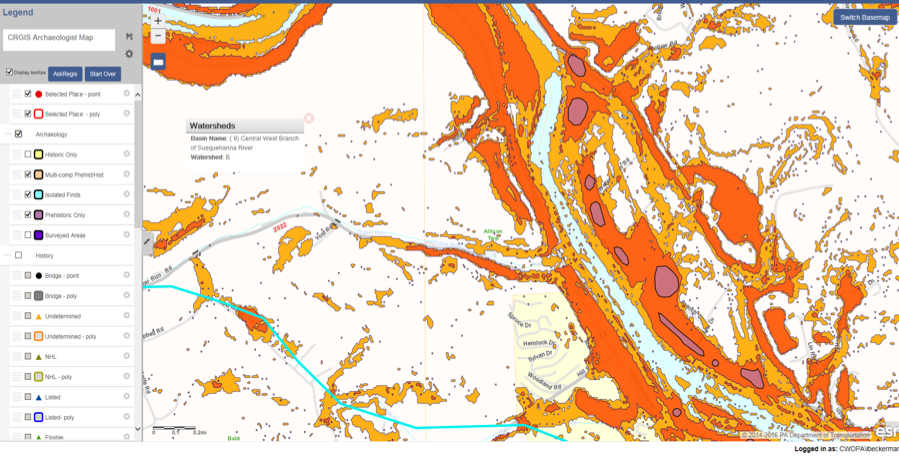
Beginning in early 2007, we began discussing a new way to conduct geomorphological studies.  Geomorphological studies would be conducted prior to an archaeological investigations so that we could confirm that any floodplain was stable and not active during the period of human occupation.  If we could determine that the floodplain was active, then there was no need for further archaeological study as there would have not been a stable land surface for archaeological deposits.

While this was good in theory, the economics weren’t necessarily practical.  Keeping in mind that most applications of this pre-archaeological work would be for bridge replacements in a limited footprint, it still cost upwards of $10,000 to conduct and had maybe a 50-50 chance of eliminating the need for an archaeological investigation that would cost in the neighborhood of $12,000-20,000. The high cost of geomorphology was linked directly to the design consultant bringing in a subconsultant specialist, with the prime’s overhead and profit.  Was there a way to cut the middle man out?

Indeed there was.  At that time, one of the foremost geomorphologists working in Pennsylvania was Frank Vento, who was a professor at Clarion University, also a State-Related University and therefore a state agency.  As an experiment, IUP added Dr. Vento to the IUP agreement, essentially hiring him, for the purposes of conducting geomorphological studies.  That opportunity came at Hunter Station in 2008, and demonstrated proof of concept.  We then turned around and created an MOU with Clarion University and Dr. Vento to conduct geomorphological studies going forward. Our partnership with IUP and the existing MOU permitted this proof of concept to be tested with little effort. At that time, IUP did not have a geomorphologist on staff, so there was no conflict over activities, and the task assignment did not diminish our active list of projects with IUP.  Over time, the Clarion University MOU proved to be enormously cost-effective, providing studies at approximately $2,500 each. Having a cost-effective solution for conducting geomorphology really opened this technique as a tool for our staff archaeologists, making its use much more common.

2008 brought changes to the Byways to the Past Conference. 2007 would be the last year that the Byways Conference would be held on the IUP campus, and as an explicit task assignment through the MOU.  By 2008 it was felt that the remote location of the Conference was a barrier to bringing more people together.  That year the Conference was successfully held in Harrisburg, demonstrating that the Byways Conference could be held outside of IUP.  Attendance from 2007 to 2008 was up 80% and costs were down, as (free) Commonwealth venues were selected.  The story of the Byways Conference after 2008 is worthy of its own story, full of drama, intrigue, treachery, and state government at its most incompetent.  I will leave that story for another day, largely to protect the guilty.

In 2009, IUP conducted a Phase I archaeological survey for a Wetlands Bank in Greene County.  This was unusual as generally we would have archaeological surveys conducted and paid for by the projects through the prime engineering design firm and subconsultants.  In this case, the proposed bank was not yet a programmed project, but there was a need to determine whether the proposed wetland site contained archaeological resources. If it did, the bank would be designed around the resources.  If the resources were large enough, the entire site might be abandoned as a banking location.  This was an opportunity for Central Office to perform a favor for the District by absorbing the costs of the archaeology, and more importantly, by providing the contracting instrument to get the work done.

Coincidentally, in 2009, IUP finally launched its Master’s in Applied Archaeology Program, and in the following Spring PennDOT launched the PHAST program – PennDOT Highway Archeological Survey Team.  The concept, developed by Joe Baker, paired an advanced graduate student from the MA program with 3 IUP summer interns and a cultural resources professional (CRP) archaeologist provided by PennDOT. (Note that by this time, the descriptor QP had been supplanted by CRP so this terminology will be carried forward.)  This IUP team of 4 would be scheduled around the state to conduct quick-hit archaeological surveys, mostly Phase I’s and small Phase II’s, under the direction of the CRP.  The advanced graduate student would serve as field director over the interns and under the CRP, who would oversee the work and sign off as principal investigator. Angela Jaillet-Wentling was the first field director.  Roughly 15 projects were completed in that first year, 2010.  After a fashion, PennDOT finally had its own in-house archaeology program.

I bear the responsibility for this not happening sooner, and I certainly had my reasons.  In my prior job at the Maryland State Highway Administration, I oversaw both the management of archaeological consultants and the conduct of archaeological studies by my staff for SHA. These were often in conflict as projects needed to get done regardless of who did them and there simply wasn’t enough time to both manage the consultants, review their work and reports, and simultaneously conduct archaeological surveys, analyze the results and write the reports.  To make matters worse, there was project creep as the Project Managers thought we could conduct larger and more complex field projects each time.  I vowed that at PennDOT we would not make the same mistake and discouraged any attempt to set up a program for the conduct of archaeology in-house.  Joe Baker, who had come from the Commonwealth Archaeological Program (CAP) within the SHPO, had both the skill and inclination to continue to conduct archaeological studies, as did most of the staff archaeologists, as do most archaeologists in general.  It is the old definition of the profession, “Archaeology is what archaeologists do.” In a catch as catch can manner, some of the CRPs did do archaeology for their Districts, but never officially sanctioned by me or Central Office.  It provided some friction, and until the PHAST program emerged, no real resolution in the conflict.  What finally swayed me was the fact that the proposed program was well-defined and limited in scope.

The mutual benefits of the PHAST program were immediately recognizable.  First, PennDOT got over a dozen projects a year completed at a fraction of the cost from by our regular design consultants and subconsultants.  We were saving $250,000 a year.  Secondly, it benefitted the IUP MA program by giving a student hands-on experience supervising crew, which is not only an important skill set for becoming a professional archaeologist but also is one of the requirements for meeting the Secretary of Interior Standards for a professional archaeologist.  It cannot be taught in the classroom.

IUP gained a useful lab for training its students.  As a state-related institution, IUP is also measured on how well it partners with other state agencies. The partnership with PennDOT clearly helped the Anthropology Department in street cred. And not insignificantly, the paltry (paltry when compared to contracting with private consultants, for sure) sums PennDOT paid IUP in overhead was hard currency in a university that counts its pennies.

PHAST fed and sustained our summer intern program, ESTI (Engineering, Scientific, and Technical Interns) sponsored by PennDOT. In a way, the interns provided to PHAST were free even though they were paid, and paid well I might add. ESTI interns made roughly $4 an hour more than regular students on campus.  The budget to fund ESTI came out of a different budget from ours, so we were literally using other people’s money, even though it was all PennDOT.  The field director’s salary and budget came out of the IUP MOU, so those individuals worked for IUP while the interns and Principal Investigator worked for PennDOT. Field and travel expenses for the field director was picked up by the IUP MOU, but travel expenses for the PennDOT-paid interns was covered by PennDOT.  Administratively, the arrangement was more than complex.  Joe Baker supervised the program, but as he was not classified as a supervisor, he could not technically supervise the interns, which involved matters of signing travel expense vouchers and time sheets. I picked those up during the Summer, as well as officially supervising the other interns working with the PHMC. 

The 3 PHAST student interns gained real on-the-ground field experience for the summer, again another valuable skill that is also captured in the Secretary’s Standards.  In addition, when these students could find their way to Harrisburg on a Friday, Joe Baker would add them into the seminars he gave to the other class of interns during the summer.  It was an enriched cultural resources management education.

The PennDOT ESTI program ostensibly exists as a recruiting tool for future PennDOT engineers.  We in the cultural resources unit would routinely laugh when talking about that aspect of the intern program, but perhaps the laugh was on us. Since cultural resources started working with the intern program, we have hired 3 cultural resources professionals that were former interns, including one who was the PHAST field director. In addition, a number of IUP graduates of the MA program who had worked for us as interns through PHAST are now working for our consultants and sometimes working directly for our office.  So in the end the intern program seems to be doing what it was intended to do.  And to vindicate Joe Baker’s arguments for setting up an internal field program, the Federal Highway Administration saw fit to award the PHAST program an Environmental Excellence Award in 2017.  This prestigious national award is given out every other year to about 12 projects or initiatives. In the history of the program, spanning 20 years, PennDOT has won 5 times, this being the latest.

2010 also brought PennDOT two major changes to its program.  First, the Minor Projects Programmatic Agreement that was signed in 1996 was supplanted by a revised and expanded Programmatic Agreement, which further delegated responsibilities to PennDOT CRPs and District Designees.  Secondly, PennDOT in partnership with Preservation Pennsylvania launched Project PATH, which became our online site for Section 106 consultation. I mention Project PATH because IUP played a key role in its implementation.  A premise of Project PATH was that all supporting documents would be publicly available in close to real time.  This meant the web platform was simpler and transparent.  However, it also meant that archaeological reports couldn’t be housed there.  Archaeological reports often have sensitive information and this information, primarily site locations, is specifically exempted from the Freedom of Information Act. We still needed to be able to share these reports with the SHPO and certain consulting parties and Federally recognized Tribes, and relying on a paper environment betrayed the non-print philosophy behind the Project PATH site.

IUP came to the rescue (again).  The offered up an FTP server for our use, on which we housed our sensitive archaeological reports in a secure password-protected manner. We registered and provided access and passwords to those consulting parties that needed the information.  In that way, we essentially kept two platforms going simultaneously, one fully public, and one (sensitive) that was fully private.  Section 106 work in mysterious ways, and IUP’s assistance was invaluable in getting the full solutions to electronic Section 106 launched.  IUP provided that service until 2017 when PennDOT developed and promoted a Microsoft Sharepoint environment.  At that time, IUP students helped us migrate all of the reports over those 7 years onto that new platform.

Next: Steady, Podner, Steady: The Fourth and Fifth IUP Contracts (2012-)
The PennDOT and IUP Partnership: A Personal History – IV

Legacy Collections without End: The Second IUP Contract (2002-2007)

2002 was going to be a year of change for PennDOT.  In May, the first IUP agreement was going to expire. In August, PennDOT’s commitment to hire on the 5 IUP QPs was coming due.  Although it might seem to the uninitiated that bringing 5 state employees from one agency to another would be a simple matter, that couldn’t be further from the truth.  For one, there was never a commitment from PennDOT to hire the actual individuals from IUP into the PennDOT fold.  The commitment was to give the IUP QPs an opportunity to apply to the PennDOT positions being created.

Given that there was a gap between the expiration of the May IUP agreement and the August PennDOT hiring commitment, we created a bridging agreement (MOU 430636) that covered that time frame.  Basically, the MOU extended the IUP Agreement long enough to complete the PennDOT hiring process, which began that summer.  By the end of August, all but one of the IUP QPs had been brought over to PennDOT as permanent employees, and by September 9th, the last PennDOT committed position had been filled. During this time, moving the agreements through signature was a somewhat harrowing experience as we met deadlines often by a matter of days.

Whither our relationship with IUP?  In theory, it could have ended with the hiring of the IUP QPs into PennDOT.  Instead, as 2002 unfolded, it became apparent that there was value in keeping the IUP partnership going.  For one, the two Byways to the Past Conferences held in 2000 and 2001 were successful and suggested they be continued.  Secondly, we needed an outlet for both popular and technical publication of our advanced studies and archaeological data recoveries.  The first publication on the King of Prussia Inn was successful, but were difficult to produce.  For some reason, PennDOT does not think of itself as a publishing house.  We needed support.  

Finally, it was becoming apparent that many of the archaeological projects completed by PennDOT since the early 1980’s had never been submitted to the State Museum.  There had not been a consistent policy in place at PennDOT to mandate the submittal of collections upon completion of analysis and for various reasons they were abandoned to the contractor.  Prior to 1999, adverse effects to archaeological sites were seen as not adverse in the eyes of Section 106 as long as a data recovery was conducted. This meant that none of these projects had associated MOAs or PA’s, which would have spelled out curation requirements.  Secondly, PennDOT budgets for archaeological work were set prior to the start of excavations.  If more fieldwork was needed, the Project Managers would instruct the archaeological firm to keep digging, but pay it out of artifact processing and report writing. Sometimes, at the end of the final report, there were no funds left to prepare the collections for curation or pay the curation fee.  Sometimes, there wasn’t money left to prepare a final report, but that was “OK” as long as the draft report was accepted by the SHPO and the project proceeded. Inevitably, once the project went to final design and was built, the project line item was closed, meaning there was no funding source to clean up loose ends.  More complicated data recoveries often took years to finish, well beyond the ribbon cutting date.  Most of the time, the consultant was left holding the collections, sometimes for decades. We thought that Archaeological Services at IUP could help us in this regard by cleaning up those old legacy collections.

With these ideas in mind, we worked with IUP to create an MOU to replace MOU 430636.  MOU 430639 was executed July 29, 2002 and while it did not provide PennDOT with QPs, it did provide other services over the next 5 years.  Ironically, one thing the MOU did not provide was training to PennDOT during that period – IUP’s roots are as a teacher’s college.  Due to the silo mentality found in state institutions, the Commonwealth of Pennsylvania had chosen to siphon off anything that might remotely be considered training into its own unit, to be managed by the Office of Administration and the Bureau of Human Resources.  Had we chosen to leave training in the MOU, the agreement would have had to be reviewed by both of those offices, on their own timetable. We could have taken the more traditional approach within PennDOT and have called training “familiarization” but that seemed more of a risk than we were comfortable with and our deadlines in 2002 were fierce indeed.

In December, the first fruits of our efforts began to appear.  Two recent archaeological studies, at Gayman’s Tavernand Mansfield Bridge, were considered worthy for popular publication as we continued the Byways to the Past Series begun with the King of Prussia Inn.  The consultants that conducted the studies and wrote the technical reports prepared the text and images for the popular booklets. Joe Baker would inevitably badger the authors and/or rewrite material himself to get it into popular form.  We both agreed that there is something about archaeologists that precludes writing for the public.  My own theory is that we like to work with dead people because they never talk back.  Communicating with the living is another matter, as we are all just versions of Sheldon Lee Cooper.

That same month, PennDOT issued a task assignment for the production of a compact disc on the results of the Oberly Island Excavations.  Grey literature has been a chronic problem in archaeology going back decades.  Final technical reports might have only one or two copies, which would be kept in either the SHPO’s office, or at Temple or Pitt. Even the existence of these reports was not widely known and at the time electronic versions were completely unknown. The use of compact discs to disseminate important data recovery reports was for us an advance, and was becoming more common across the country. Today, we expect to download this information from web sites or to our phones, but I would like to remind folks that in 2002, the World Wide Web was a teenager, and that iTunes had not yet been launched as a service.   Over the years, IUP produced a number of CDs on our more important projects, which have been distributed to the professional community.  As the capability to download these large technical reports is now with the CRGIS, PennDOT’s CD business is rapidly coming to an end.  The remaining CDs are being distributed at statewide professional meetings, or being used as drink coasters.

Also in December, we executed a task assignment for IUP to begin processing these older abandoned collections.  When collections had been halted in processing, they may have been washed; many had not.  They may have been cataloged, but some had only the catalog sheets from the original inventorying.  Many had not been labeled or re-bagged in clean and durable polyethylene bags for long-term storage.  And certainly, none of the collections had been submitted with the curation fees that would have been owed.  A brief digress here.  Curation fees is a bit of a misnomer.  The State Museum policy was to actually curate the collections without charge; however, the process of accessioning them was costly and those costs needed to be recouped.  Accessioning included checking collections against the submitted catalogs, making sure the materials were properly labelled and bagged, and that they were in suitable acid-free containers.  When the gap between the actual and promised state of the collection was small, the State Museum staff would make up the difference, labelling and bagging as necessary, rather than returning the collection back to the firm to be redone. Accessioning was an extended quality control process and labor intensive.  The fees charged for collections under the flag curation were really accessioning fees.

Having IUP process these collections was a very good fit for us.  IUP already had an operational laboratory that was being used for Archaeological Services work.  Archaeological Services could provide the technical oversight in directing the laboratory.  Finally, there was  a pool of anthropology students who could work on the collections part time.  One of the eternal truisms of life is that student labor is cheap labor, so we were able to process the collections at a fraction of the cost it would have taken the archaeology firms who originally generated them.  Working closely with the State Museum, we were able to establish under which standards collections would be processed, given that some collections were at that time 20 years old and standards had changed.  By processing collections to current (2002) standards, the State Museum was willing to waive the curation fees, which would have amounted to tens of thousands of dollars. In July 2003, after finally acknowledging the full extent of the problem, PennDOT executed a separate 4-year $450,000 MOU (430647) with IUP for processing these collections. The entire legacy collections program was managed by Chris Kula, start to finish, through this and subsequent contracts.

As MOU 430639 progressed through the early 2000’s, PennDOT and IUP took advantage of the flexibility written into the MOU to conduct the following varied tasks:

  • Graphic support for the 2003 Tribal Summit.
  • Supporting Project Archaeology, which was a program to train teachers and professionals on how to develop public outreach materials, especially our Byways publications.
  • Supporting the input of data into the CRGIS.
  • Conducting research on the archaeological aspects of farmsteads, which would complement the above-ground research for the agricultural context study.

Next: The PHAST and the PHURIOUS: The Third IUP Contract (2007-2012)

The PennDOT and IUP Partnership: A Personal History – VI (Conclusion)

Steady, Podner, Steady: The Fourth and Fifth IUP Contracts (2012-)
On February 10, 2012, PennDOT and IUP renewed the partnership with another 5-year MOU (20120112).  In most ways, this MOU mimicked previous ones in terms of scope, but added more formally a geomorphology component and a geophysical testing component.  The geomorphology component was added to provide additional flexibility in choice of geomorphologist, in particular since Dr. Vento was particularly busy with PennDOT and other agency studies.  IUP agreed to add additional geomorphologists to the Agreement with subcontracts.  The geophysical component was new and rather exciting.  As a feature of IUP’s Anthropology program, faculty and staff had acquired both the machinery and skill to conduct magnetic resistivity, ground penetrating radar, and other remote surveying technology.  GPR was particularly useful for identifying cemetery situations and also buried historic archaeological foundations.  We at PennDOT would not have been able to maintain the equipment and skill set on our own.

For the five years of this MOU, the chief focus of activities was on the PHAST program, geomorphological studies, and winding up the collections backlog.  This period of the MOU was one of refinement and adjustment rather than innovation, as we perfected the PHAST program and managed the geomorphological assignments. The curation backlog was largely completed by 2012, but inevitably we kept uncovering old collections that had been missed in the original survey of outstanding collections.  As our goal was to completely bring the older collections up to date and submitted to the State Museum, we continued to make adjustments in task assignments, largely wrapping up activities in 2013.  Later we discovered that the Blue Route Collections, from the 1980s were still not processed. It was a large collection and we have since managed to put our arms around that problem working with Engineering District 6-0.

In 2017, we renewed the MOU again for another 5 years (MOU 201721), largely keeping the same terms and goals as MOU 20120112. This is the current MOU with IUP as of this writing (2019).  As with the previous MOU, the current MOU is also one of adjustment and refinement on the tasks assigned, which are primarily the PHAST program and geomorphological studies.  The Byways to the Past Conference, in its current form as part of the Statewide Heritage Conference, has been taken over by Preservation Pennsylvania, and is no longer a responsibility of IUP.  The collections backlog program – it is worthy of the title “program” given the length of time it lasted and the total number of collections processed – had been concluded.  Byways to the Past booklets are continuing to be published, and IUP remains the publisher of last resort, after first having the consultant be responsible for printing, and then considering PennDOT’s Graphic Services Unit to complete the printing. The CD series is coming to a close, as technological advances now permit these reports to be housed within the CRGIS as downloads.  The IUP Agreement continues to be available for special assignments and is used for such. In addition, PennDOT’s cultural resources unit continues to send a representative to IUP annually to participate in the review of the MA program.

Lessons Learned from this Partnership

I will be participating in a roundtable on university partnerships at the Society for American Archaeology Meetings coming up in April.  It is fair to ask with the distance of time whether there is anything to be learned from this particular partnership over the last 20 years?  I had a front row seat at all of this and often was the individual making key decisions on strategy and direction, so you would think this would be easy.  It is not.  The simple route would be to create a totally revisionist history where each decision and step was brilliantly thought out in advance, with long-term strategic goals, inevitably ending up where we are today, gloriously successful.  

It didn’t happen that way.

Having a front-row seat doesn’t necessarily give you perspective.  Furthermore none of us were hovering over our heads thinking about what we were thinking. We kept trying things until something worked, but didn’t spend time conducting a post-mortem analysis.  With the perspective of 20 years, I may be able to reconstruct what I felt and what I was thinking, but that doesn’t necessarily get you to interpretation and understanding.  I can more or less spell out the emic in this partnership game, but I may or may not be able to get to the etic, where we could more broadly talk about generalizations that might be applied to any partnership. Here goes.

First, just what is a partnership?  We can start with Merriam-Webster:

1the state of being a partner PARTICIPATION//scientists working in partnership with each other

2aa legal relation existing between two or more persons contractually associated as joint principals in a business //began a legal partnership with his uncle

bthe persons joined together in a partnership //the partnership computes its net income … in a manner similar to  that of an individual— J. K. Lasser

3a relationship resembling a legal partnership and usually involving close cooperation between parties having specified and joint rights and responsibilities //The band has maintained a successful partnership for 10 years.

That’s what I love about dictionary definitions. They always throw you deeper into the thicket.  Just what is a partner?

1:    archaic  one that shares PARTAKER

2aone associated with another especially in an action ASSOCIATECOLLEAGUE//our military partners throughout the world

beither of two persons who dance together

cone of two or more persons who play together in a game against an opposing side //partners in card games

da person with whom one shares an intimate relationship one member of a couple //Evan and his partner are going on a Caribbean cruise.

3a member of a partnership especially in a business // partners in a law firm also  such membership

4: one of the heavy timbers that strengthen a ship’s deck to support a mast —usually used in plural

Now, we’re getting somewhere. I actually like all of these definitions and I think all are relevant.  A partnership is a sharing relationship.  Each party needs to feel that it is getting something out of the partnership.  Partnerships are like a dance or a game, which is to say that they are not static relationships.  Partnerships are always in motion because nothing ever stays constant.  Working in state government, I also think of partnerships as playing against an opposing side, trying to make something work against the inertia of governmental mediocrity.  Even definition 4 is relevant. Partnerships need to do things, whether it is to support a mast so the ship can sail, or support a program so it can fulfill its mission.

Partnerships solve problems. Yes, the first rule of seeking a partnership is that one is needed to solve a specific problem.  Not all problems are solved with a partnership, but a partnership in search of a problem is in trouble out of the gate.  Sometimes the problem is concrete, such as how to staff a new program. Sometimes the problem is more abstract, such as building credibility in the larger preservation community.  It can even be the need for constant improvement.  Edward Deming is the founder of the Total Quality Movement, which in the 1950’s brought Japanese manufacturing back into prominence, and has influenced business thinking in the US for decades. His 14 points are worth restating here, and they were on my cubicle wall during my entire career at PennDOT:

  1. Create constancy of purpose toward improvement of product and service, with the aim to become competitive and to stay in business, and to provide jobs.  
  2. Adopt the new philosophy. 
  3. Cease dependence on inspection to achieve quality. Eliminate the need for inspection on a mass basis by building quality into the product in the first place. 
  4. End the practice of awarding business on the basis of price tag. Instead, minimize total cost. Move toward a single supplier for any one item, on a long-term relationship of loyalty and trust. 
  5. Improve constantly and forever the system of production and service, to improve quality and productivity, and thus constantly decrease costs. 
  6. Institute training on the job. 
  7. Institute leadership. The aim of supervision should be to help people and machines and gadgets to do a better job. 
  8. Drive out fear, so that everyone may work effectively for the company. 
  9. Break down barriers between departments.
  10. Eliminate slogans, exhortations, and targets for the work force asking for zero defects and new levels of productivity. Such exhortations only create adversarial relationships, as the bulk of the causes of low quality and low productivity belong to the system and thus lie beyond the power of the work force. 
  11. Remove barriers that rob the hourly worker of his right to pride of workmanship. The responsibility of supervisors must be changed from sheer numbers to quality. 
  12. Remove barriers that rob people in management and in engineering of their right to pride of workmanship. This means, inter alia, abolishment of the annual or merit rating and of management by objective. 
  13. Institute a vigorous program of education and self-improvement. 
  14. Put everybody in the company to work to accomplish the transformation. The transformation is everybody’s job. 

Number 5 is central to developing partnerships:  Improve constantly and forever the system of production and service, to improve quality and productivity, and thus constantly decrease costsThe need for quality improvement cannot be achieved only by relying on internal resources in the work unit.  I would argue that you cannot substantially improve a process or overall quality without engaging in partnerships.  

In government, there is a natural tendency to stay in our lanes, to stay in our silos.  Government is built for inertia.  My first problem was that I couldn’t stand the notion of staying in the work situation outlined in Part I of the series.  The very first partnerships formed in cultural resources were with the SHPO, in the form of a programmatic agreement to move us past the shoveling of dubious documents to another desk for approvals.  In 1997, we had a problem with not having long-term staffing to support our newly minted programmatic agreement.   We thought that IUP had the best ability to create staff, and as a university had the stability to honor a long-term commitment.

Seek best fit through mutual benefit.  As clichéd as it may be, you can’t have a partnership without partners, but some partners are better than others. In approaching potential partners, it was necessary to visualize how the partnership would benefit them and to communicate that vision.  Otherwise, why would the other party give you the time of day?  IUP also had a problem to solve.  They are a state agency and have a mission to provide assistance to other state agencies.  They need to be relevant in today’s world, not just the Academy.  Evidence of that need was the existence of Archaeological Services.

Partnerships take time to build.  Our first meeting with IUP was in the Fall of 1997. The first MOU was executed May, 1999, almost 2 years later.  Actually that was rather fast.  Other partnerships we had usually took 3 years.  Never expect to be able to enter into a partnership (at least not a meaningful one) quickly.  Think about it.  You have two different institutions, each with its own management and administration, rules, lawyers, etc.  Each institution has to move outside of its comfort zone, and regardless of how often or how loud management says it is 100% behind innovation or whatever the current best new thing is, they usually don’t mean it.   After going through Graduate School and working with IUP and other universities for nearly 40 years, I can safely say that universities are every bit as bureaucratic and administratively difficult as PennDOT.  The only difference seems to be in the mission.  At any number of occasions, I could have legitimately given up on the partnership as being simply too hard to execute.  So could Bev Chiarulli, Phil Neusius, and the Anthropology Department.  Commitment, constancy of purpose, and useful streaks of stubbornness brought us through.

Real partnerships add value. In building a partnership, we had to find a way to make 1 + 1 = 3, to create value out of the partnership that transcended the simple transactional nature of the MOU.  At first, the added value was quite abstract, and the transactional nature of the MOU was right in front of us.  Find and rent us QPs and we will pay you.  As we crafted the MOU though, we made sure that the terms would allow us to engage in other mutually beneficial activities.  One of the first was the joint Byways to the Past Conference held in 2000 on the IUP campus in the newly built Eberly Business School facilities. Benefits accrued to PennDOT for hosting a transportation conference, but also to IUP for same. In addition, IUP’s Anthropology Department could show to the Dean and Administration that it was working to serve another state agency, bringing in a little money as well, and furthering IUP’s educational mission.

The Second MOU, sans QPs, also created value, especially in the conduct of the legacy archeological collections project.  This employed IUP students giving them hands on experience working with collections. It kept IUP’s lab busy, and Archaeological Services billable and important.  PennDOT got necessary work completed at a fraction of the cost we would have incurred had we gone the private consultant route.  Again, 1 + 1 = 3.  This was repeated with the Third MOU that brought geomorphological services and PHAST to the table, and which was continued into the Fourth and current MOUs.

Partnerships transcend a business relationship. In building a partnership, it was important to find a way to let both partners feel that they were coming out ahead in the arrangement.   In building and maintaining any relationship, whether it be a marriage or a partnership between two agencies, the same key ingredients appear over and over again: honesty, trust, communication, commitment.  This is not surprising nor should it be.  With IUP, we met early and often, exchanged a lot of phone calls and e-mails. We wrote out drafts of terms for the MOU and other supporting documents.  Each of us had to work our management to sell the concept and get them on board.  

Once the partnership was in place, it required care and maintenance.  When IUP established a Master’s of Applied Archaeology Program, they invited us to sit on an advisory board to guide the program.  We jumped at the chance and never missed a meeting.  When I retired I made sure that there was someone in PennDOT who could continue.  When we did task assignments, sometimes there was advance coordination to check to see what IUP could manage within their schedule.  We wanted the assignments to be realistic and not onerous, a constraint we never applied to our engineering consultants.  When we were holding Byways Conferences, there was also intense coordination on the program, on logistics.  When the PHAST program was initiated, we reserved internships for IUP students, and we made sure that IUP students were considered for other internships in Harrisburg.  We cowrote press releases when good things happened and made sure to give IUP as much credit on any success as we could manage.

Partnerships require adaptation.  Over time, the partnership has evolved and should continue to do so.  The types of ventures we undertook changed over time as our mutual needs and abilities changed.  Our first MOU was for staff, plus some extras. Without the need for staff, the MOU evolved into other mutually beneficial initiatives, such as the legacy archaeological collection project.  As geomorphology became are more important tool in our project studies, we managed to work that into the MOUs.  Thankfully, we had the time to process changing circumstances and make necessary adjustments.

Timing and opportunity matters.  Guy Raz has a podcast on public radio called “How I Built This, with various entrepreneurs being interviewed on how they built their businesses.  One of the best questions comes at the end, when Guy Raz asks each one how much of their success was based on skill and work and how much on luck. The answers are fascinating.  I think the same question can be asked here.  

I know for a fact that my staff and I and Bev Chiarulli, Phil Neusius, and folks at the Anthropology Department worked very hard over the years to build this partnership and to sustain it.  But I also know that a lot of people in PennDOT and in other cultural resources units also work equally hard or harder.  And I consider myself a good salesman, but there are also many who communicate as well or better.  Hard work alone doesn’t result in a partnership.  You could say that luck also played a part, but what I would call luck is having the door open at times.  When I came to PennDOT, my supervisors and managers, including Wayne Kober and Dan Accurti, were receptive to change and new ideas.  It was most visible with the EMS re-engineering, where management, especially M.G. Patel, the Chief Engineer, actually sought out useful change.  Our timing was excellent, as we had just executed the new programmatic agreement and were looking for ways to implement it.  

You don’t get a chance to pick your managers or the timing of these agency-wide initiatives, but you also have to recognize when the opportunity exists and that the door is open.  As stated earlier, working in government means that there is always a Department-wide initiative to increase productivity.  Some are serious, but most are flavor-of-the month management speak. In an advanced seminar, we could teach you tools on how to tell the difference, but let it suffice that it is critical to know the difference before investing the work that would be required to actually produce a partnership.

Lefty Gomez once said, “I’d rather be lucky than good.” He also said his success was due to clean living and a fast outfield.  So to my fast outfield of Kula, Russell, and Baker, I close with a sincere thank you.

The PennDOT and IUP Partnership: A Personal History – III

Part III – And Away We Go: The First IUP Contract (1999-2002)

In the summer and fall of 1997, we began a series of outreach efforts with various Pennsylvania universities.  Other than IUP, none (and I include our land grant university Penn State in that none) were interested in partnering with us on this initiative.  On October 29, 1997, we met with a contingent from IUP which included Dr. Beverly (Mitchum) Chiarulli from Archaeological Services and Dr. Phil Neusius from the Department of Anthropology, Dr. Ginger Brown, the Associate Dean for Research for the Graduate School, and Evelyn Landon from the Institute for Research and Community Service.  Of particular interest was the 10-year track record of Archaeological Services that had provided archaeological studies and research to other Federal and State agencies. Archaeological Services was not an academic department but under Research and Community Services. Clearly, IUP knew how to work with other agencies. One final fact favored IUP. As state agencies, IUP and PennDOT could enter into memorandums of understanding without competitive bidding and with a relatively simple signature and legal review process, taking between 6-10 weeks from start to finish.  A sole-source or bid contract of comparable size and complexity would take anywhere from 1-2 years.

In this and other meetings through the winter of 1997-1998, we hammered out the framework for an interagency agreement, in which IUP would provide 8 archaeologists and architectural historians to implement our PA for a period of 5 years, renewable.  Concurrently, in the fall of 1997, we were also meeting with selected Engineering Districts to float the idea of regionalizing the positions, putting them in the Engineering Districts instead of Central Office BEQ.  Based on our experience with District 4-0 and Jamie McIntyre, it appeared that better use of the QPs could be made in the Engineering Districts, working side-by-side with the environmental team and design team. This was one of the other recommendations coming out of the EMS Re-engineering and went hand-in-hand with provisioning staff. As they say in Texas, “Go big or go home.”

By February, 1998, we had developed a Memorandum of Understanding between PennDOT and IUP which would add 9 staff to the program, augmenting the existing complement of 6 (Beckerman, Kula, McIntyre, Spohn, Anthony, and an architectural historian vacancy ultimately filled by Kara Russell). These 15 staff would be spread over 5 service regions and Central Office, but all field staff would be hosted by an Engineering District.  BEQ shifted its role from the fount of all things cultural to the main support unit, providing quality assurance, technology transfer, training, and outreach to the public.  You will notice the discussions over the winter of 1997-1998 were for 8 additional staff, but that the MOU presented to upper management was for 9.  One of the better ideas from Wayne Kober was to add one more staff member to the Agreement. This one position was not designated for direct project delivery, but for public outreach and other duties as assigned.

This MOU was presented in February to our upper management for funding and we received the go ahead to proceed. However, in March we were challenged by the Union representing cultural resources staff at PennDOT and at PHMC, the Federal of State Cultural and Educational Professionals (FOSCEP).  The grounds of the objection were twofold:

  1.  The agreement was not cost effective, as compared with hiring state employees within the Department.
  2. The work to be performed is traditional FOSCEP bargaining unit work, and should not be performed by another bargaining unit

Despite the fact that we were going to be utilizing state employees, and replacing consultants with state employees, apparently they were the wrong state employees, i.e., represented by a rival bargaining unit. Go figure.

By December, the issues with FOSCEP had been worked out. The MOU calling for 9 IUP positions was scaled back to 5 positions. Concurrently, the Department made a commitment to hire 4 positions initially, and then at the end of 3 years, absorb the 5 IUP hires into the Department, i.e., into FOSCEP.  On May 27, 1999, the 3-year MOU was executed.  The first year’s estimated cost (July 1, 1999- June 30, 2000) was $362,000 with an approximately equivalent budget for each of the next two years.  The MOU would expire on May 27, 2002 and the commitment to FOSCEP would expire on August 13thof the same year.  The initial hires by IUP were Scott Shaffer, Bruce Manzano, Jonathan Daily, Matt Hamel, and Joe Baker.  The first PennDOT hires under this arrangement were Monica Harrower, Kevin Simons, Zephreny Parmenter, and Joe Verbka.  The hiring process by IUP was much smoother than our PennDOT Bureau of State Employment procedures and they were on-board much more quickly.

In addition to the 5 hires, and associated technical and computer support, IUP also agreed to provide training on archaeology and historic preservation to all cultural resources staff in PennDOT, and to sponsor lectures, conferences, symposia, and other educational outreach activities related to cultural resources.  The first Byways to the PastConference was held at IUP at Eberly Hall on March 8-9, 2000 and co-sponsored by IUP, PennDOT, and also FHWA and the Turnpike Commission.  It focused on the intersection between transportation and historic preservation. Topics were wide-ranging as noted in the programs for the Byways Conference in Years 1 and 2:

First Byways to the Past – 2000

Archaeology

Varna Boyd (Greenhorne & O’Mara, Inc.) – The U.S. 219 Meyersdale Bypass Project: Contributions to the study of Monongahela Culture 

Gary Coppock (Heberling Associates, Inc.) – The Case of the Missing Hamlet: An inquiry into settlement, subsistence, and sociopolitical organization in the Upper Casselman Valley ca. AD 500-900 

Thomas C. East (Skelly and Loy, Inc.) – The Wiser Site: A Late Archaic stone bead manufacturing site in Central Pennsylvania 

Peter E. Siegel (John Milner Associates, Inc.) – The Oberly Island Site: Prehistoric Late Archaic/Late Woodland adaptations in the Lower Lehigh Valley 

Albert T. Vish (Skelly and Loy, Inc.) – The Tunkhannock Bypass: Recreating prehistory at the Harding Flat site 

Robert Wall and Hope Luhman (The Louis Berger Group, Inc). – Four Thousand Years of Tioga County Prehistory: The Mansfield Bridge site excavations 

Historic/Industrial Archaeology

Richard Affleck (URS Greiner Woodward Clyde) – At the Sign of the King of Prussia: Archaeology at the King of Prussia Inn, Montgomery County 

Ken Basalik and Jamie McIntyre (CHRS, PennDOT District 4-0) – The Lackawanna Valley Industrial Highway: A view from the anthracite fields Melissa Diamanti (Archaeological and Historical Consultants, Inc.) 

Melissa Diamanti (Archaeological and Historical Consultants, Inc.) – Weighing in on the Union Canal 

Vickie Kunkle (Gibson Thomas) – A Covered Bridge in Indiana County 

Richard Meyer (John Milner Associates, Inc.) – App’s Mill and the Replacement of Camelback Bridge, Penn’s Creek, Snyder County, PA 

Tom Riester (Mackin Engineering Company) – Rehabilitation of the Historic Smithfield Bridge 

Historic Preservation Projects and the Public 

Christine Davis (Christine Davis Consultants) – ISTEA & the Herr’s Island Bridge: Connecting an award-winning brownfield 

Eric Deloney (National Park Service) – HAER’s Historic Roads and Bridges Program 

Kevin Patrick (Indiana University of Pennsylvania) – Safe Highways to History: Interagency cooperation in the Lincoln Highway Heritage Corridor 

Ben Resnick and Diane B Landers (GAI Consultants, Inc.) – Erie Coastal Predictive Model 

Second Byways to the Past – 2001

Archaeology

Richard B. Duncan (Skelly and Loy, Inc) – Sites Are Where You Find Them: The Central Susquehanna Valley Archaeological Site Predictive Model 

Thomas R. Lewis (CHRS, Inc.) – The History of a Floodplain: The Pennsylvania Turnpike Bridge over Yellow Breeches Creek 

Patricia Miller (KCI Technologies, Inc) – A Report on the First Pennsylvanians: A stratified Paleo-Indian site in Liverpool, Perry County 

Paul Raber (Heberling Associates) – Looking Under a Rock: The excavation of Mykut Rockshelter 

Historical/ Industrial Archaeology

Amy Fanz (A.D. Marble & Company) – Industrial Archaeology on Moshannon Creek: The Phillipsburg Tannery site 

Barbara J. Shaffer (McCormick, Taylor & Associates, Inc.) – Food, Drink and Rest Next to the Pennsylvania Canal: Archaeological investigations at Gayman’s Tavern 

Historic Preservation

Thomas E. Boothby (Pennsylvania State University) – The State of the Art of Stone Bridges 

J. Dain Davis (PennDOT Engineering District 9-0) – Caring for Covered Bridges: District 9-0’s Covered Bridge Management Program 

Rick Ortega (Ortega Consulting) – Moving the King of Prussia Inn

Patricia Remy and David Anthony (PennDOT District 11-0) – A Delicate Balance: The story of St. Nicholas Church

Public Outreach and Heritage Tourism 

Brenda Barrett (National Park Service) – Byways to the Past: Heritage tourism and transportation networks 

Matt Hamel (PennDOT District 3-0) – The Bridges of Lycoming County: Rehabilitation of a Lattice Truss Bridge in the Pine Creek Valley

Robert H. Hosking Jr. (McCormick, Taylor & Associates, Inc.) – Floating into the Past: A transportation enhancement project at Hugh Moore Park 

David H. Miller (Society for the Preservation of the Duquesne Heights Incline) – Going Up: The transportation enhancement project at the Duquesne Incline 

Randy Cooley (Westsylvania Heritage Corporation) – Westsylvania and the Path of Progress: Regional heritage tourism development 

Hope Luhman (Louis BergerGroup, Inc) – Scouting for Lessons: The Merit Badge Program at Site 36TI116 

Kevin Patrick (Indiana University of Pennsylvania) – The National Lincoln Highway Study Act: What to do with a heritage corridor the size of a nation? 

Ben Resnick and Douglas H. MacDonald (GAI Consultants, Inc.) – The Coverts Crossing Project: A public outreach model 

Deborah Scherkoske (Skelly and Loy, Inc.) – Spanning the Yards: A bridge replacement and public history program at the Enola Yards 

Transportation Projects and Historic Preservation – Roundtable

Michael Ryan (PennDOT) – An Introduction 

Dean Schreiber (PennDOT, Bureau of Design) – Part One 

Earl Neiderhiser (PennDOT District 9-0) – Part Two

Elizabeth Merritt (National Trust for Historic Preservation) – The Big Picture

Planning and Implementing Historic Preservation Projects 

Ira Beckerman (PennDOT Bureau of Environmental Quality) – Historic Preservation at Transportation Agencies: The CRM Program at PennDOT 

M. Lynn Bortel (Federal Highway Administration) – Some Pennsylvania Issues: The FHWA and historic preservation 

Dan Deibler (Pennsylvania Historical and Museum Commission) – The SHPO’s Perspective 

Pat Foltz (Preservation Pennsylvania) – Byways to the Future: Some suggestions for preservation-sensitive transportation projects in Pennsylvania 

William Hunter (Heberling Associates) – Reforming the Place of Historic Preservation in Ohio’s Transportation Development Program 

Thomas A. Kotay (PennDOT, Center for Program Development and Management) – Getting Preservation Issues on the Drawing Board: The 12-year plan 

Perhaps the highlight of the 2ndYear’s Conference was witnessing lunch between Mike Ryan, our Deputy Secretary in charge of Highway Administration, and Betsy Merritt, who was a lead attorney for the National Trust for Historic Preservation, a group that had been known to sue us in the past.  They were engaged in a congenial conversation over things other than a particular project. If for no other reason that getting two sides to break bread in a neutral setting, the Conference was a success.

For the first eight years of this and subsequent MOUs, IUP hosted the Byways to the Past Conference at IUP.

Next: Legacy Collections without End: The Second IUP Contract (2002-2007)

The PennDOT and IUP Partnership: A Personal History -II

Part II – Business Process Re-Engineering and the District-Based Teams

By the spring of 1997, some of the weaknesses of the BEQ-based QP teams were beginning to show.  As noted above, there was difficulty in scheduling for scoping field views. The lack of communication with Project Managers and Environmental Managers limited trust.  The QPs ability to have input into the creation of design scopes of work was also constrained, as was the review of consultants doing the work prior to their being selected for a consulting contract.  Furthermore, the Adverse Interest Act put constraints on the types of projects our consultants could oversee.  By contrast Jamie McIntyre could cut through those problems and work much more closely with the Environmental Unit and Project Managers.  She was in the District, and as a creature of the District, was de facto part of the team.  The archaeology portion of Section 106 worked better in District 4-0 than elsewhere.

That spring, the Department rolled out a large initiative under the initials EMS (Engineering Management System), which suggested that each work unit re-engineer itself to improve productivity and to try to work the golden triangle of Faster, Betters, and Cheaper.  Our kick-off meeting was held April 11, 1997. The goals of our group were to:

  • Save the Districts time for smaller projects
  • Better value for our money
  • Take the guess work out
  • Preserve PA historic resources
  • Streamline the process
  • Cut design time researching historic resources
  • Improve predictability

Our cultural resources team had some advantages coming into this effort, as we had a newly minted PA, and established a team-based approach to Section 106, pairing above-ground specialists with below-ground specialists.  The re-engineering effort became a lab for additional ideas and suggested process improvements.

Although the final EMS recommendations were far-ranging and ambitious, the most important recommendation was to solidify staffing for the QPs.  Five options were developed, each with its own advantages and disadvantages.

Hire Qualified Professionals– In this scenario, all needed QPs would be hired by PennDOT.  This was clearly the cheapest option from a salary perspective. All QPs could perform all needed duties, including preparing and review proposals, and had the highest potential for the long-term.  The disadvantages were that the existing civil service classifications were not a good fit (see museum curators, above), the salary range might not attract the best candidates, and most importantly, it would require shifting complement within PennDOT.  Shifting complement is a kind restatement of stealing vacancies from other units. It doesn’t make you popular, either.

Use consultants– We had been using consultants and in this option, we would continue to do so, filling all needed positions.  We would be able to specify the skill levels we needed, and presumably we could get them on task faster. Also, as our needs changed, we could flexibly add or subtract consultants.  On the downside, it was the most expensive option (overhead and profit could multiply salaries by 2.5x), did not address the issue with the Adverse Interest Act, and consultants could not perform all of the needed duties, such as reviewing contract proposals.  In addition, there was a concern that consultants generally like to please their clients (us) and might make findings that unduly favor PennDOT, rather than making cold objective decisions.

Hire PHMC staff– In this option, we would enter into an interagency agreement with the SHPO to have them hire and dedicate staff to PennDOT projects.  Some states already used this model.  The SHPO could use their own PHMC classifications; it would not burden PennDOT complement; and, there was the potential for an instant sign-off from the field.  Unfortunately, this option would not address a key Programmatic Agreement goal of increasing delegation of responsibility to the Department, instead regressing back to the old methods of pressing the SHPO for sign-off.

Hire University CRM Staff– Several DOTs had already established partnerships with universities, although in each case it was to provide field archaeological studies.  Using a university in a slightly different way to provide QPs was conceivable, although we were more likely to find archaeologists than architectural historians on staff. This also had the potential to be a long-standing arrangement with the further advantage that being independent of both PennDOT and the SHPO, QPs could make independent judgments.  The question was whether there were any universities in Pennsylvania that would be in a position to enter into such an arrangement.

Retrain PennDOT Staff– This final option would have existing PennDOT staff trained as QPs.  While it would support the central EMS concept of doing our own work, and did not require additional complement, it would have required those individuals to undertake a 3-5 year program of education and training to meet the Secretary of Interior Standards for professional archaeologist and architectural historian that the PA called for.  Furthermore, it was suspected if we did retrain and delegate staff (probably not engineers) as QPs, they would most likely leave the Department for better paying jobs elsewhere, plying their newly acquired specialies.

At a July 23, 1997 presentation of our EMS Re-engineering to upper management at PennDOT, we received approval to move forward with the option to hire university CRM Staff.

Next:Part III – And Away We Go: The First IUP Contract (1999-2002)

The PennDOT and IUP Partnership: A Personal History – In Six Parts

Part I

This year marks the 20th anniversary of the cultural resources partnership between the Pennsylvania Department of Transportation (PennDOT) and Indiana University of Pennsylvania (IUP).  The partnership has served both agencies and over the years have provided staffing to PennDOT, helped move legacy archaeological collections toward curation, hosted conferences, launched and sustained a publication series, trained a generation of students in cultural resources management, and otherwise served as an exemplar to all state agencies in how they can play well together for mutual benefit.  This is that story, as I see it.  Please join me over the next several weeks.

The Bad Old Days

In 1993, I joined PennDOT after a brief career managing the archaeology program at the Maryland State Highway Administration.  I joined a small cultural resources unit in the newly formed Bureau of Environmental Quality, my coworkers being Deborah Suciu Smith, Chris Kula, and Dick Weeden.  The Bureau was led by Wayne Kober, who had formed it only a few years earlier.  In 1993, District 4-0 (based out of Dunmore, near Wilkes-Barre) also hired an archaeologist, Jamie McIntyre.  Chris, Jamie, and I were hired as Museum Curators, Archaeologist II, under the State Civil Service Classification.  In my 26 years at PennDOT, I never did see a PennDOT museum, nor did I every curate any collection other than pencils and compact discs. Go figure.  For a brief period, from 1993 until June, 1994, we worked in the old Transportation and Safety Building on the site where the current Keystone Building resides.  After the 1994 fire, we were temporarily housed then returned to the T&S building, until it was found unfit for habitation. We then operated out of a converted parking garage at Forum Place for about 4 years until in 2000 we moved into the Keystone facility.

When I joined BEQ, the National Historic Preservation Act was 27 years old and PennDOT had been conducting archaeological studies for about half as long.  The Bureau for Historic Preservation, i.e., the State Historic Preservation Office (SHPO), was housed in the Pennsylvania Historical and Museum Commission and was led by Brenda Barrett.  We were aware of the Federal Highway Administration, but in those days, FHWA was relatively disengaged with the day to day activities of the environmental unit.  Our day to day activities were of one of two flavors.  For smaller projects, PennDOT submitted a Preliminary Cultural Resource Review Form (PCRRF) to the SHPO for their sign-off.  Usually, the PCRRF was stapled to a 10 to 30-page report describing the project and potential non-effects the project would have on historic resources.  Our job was to conduct a quality control check on the package and shepherd it across the plaza to the State Museum, in which the SHPO offices were housed.  The second task we had was to manage report reviews of historic resource studies.  PennDOT project managers whose projects were likely to affect historic resources had the design consultant and their subconsultants prepare any necessary studies, i.e., historic resource surveys, criteria of effect reports, Phase I and II archaeological surveys, etc.  As these studies came into BEQ, they were assigned to one of a pool of management consultants who actually reviewed the reports and determined whether they were sufficient to hand off to the SHPO for their approval and sign-off.  Our job was to manage the management consultants and act as intermediaries between the management consultants and the engineers in the Highway Quality Assurance Division, who would draft and send the cover letters to the SHPO.  Given the pace of activities and the rate at which reports came into BEQ, it was a rare event when one of us would actually read the reports being sent over.  Most of the time we conducted the quality control on the comments prepared by the management consultants.  Even as I remember this process and write about it here, I must assure the reader that what I have presented was an oversimplification of the process, having left several intermediate steps out.

By mutual agreement between BEQ and SHPO, the deadline for approval or comment on the submitted reports was 60 days, so a third task we had was to track review times religiously.  PCRRFs was an expedited process, whereby a submission would return a response in 10 days.  On average, the review times were around or just under 60 days, but as much as a third of the reports were reviewed in more than 60 days.  Large reports such as data recovery reports might take up to 6 months for a review, although that generally wasn’t a problem as we had usually received a conditional letter of approval based on an executive summary and a field visit, so the project could proceed into final design.  This being before 1999, archaeological impacts were treated as not adverse if there was a data recovery, so no agreement documents were required to finish NEPA and get to final design.  PCRRFs were usually returned in 10 days; however, a more than insignificant proportion of them required resubmission due to incomplete information, so the Section 106 review for even minor projects could take several months.

In some ways, tracking reports was simple.  It came into BEQ and was stamped in with a  date.  When it was taken over to SHPO, it was stamped in with a  date.  And when it was returned to BEQ with approval or comment, it was stamped with a date. Each document was tracked on a Lotus 1-2-3 spreadsheet and we had a management consultant whose only responsibility was to track the coming and going of reports.  The only problems with the system as designed was that reports were lost being mailed or shipped from the District offices to BEQ, reports were lost at SHPO, and there were frequent arguments over reports that were stamped in on a Friday afternoon or a day before a holiday.  This being the land of engineers, every day was counted and tracked.

Jamie was hired by the Engineering District and did not report to BEQ.  Her duties were largely archaeological, conducting studies and managing the archaeological contracts carried out under the Prime consultants for various PennDOT projects.  Although we coordinated on issues and policy, she and the District operated largely independently from Central Office, which was the general rule in PennDOT.  PennDOT was and remains a largely decentralized organization.

Pivoting

While our routine in the early 1990’s more resembled paper pushers than archaeologists or cultural resources managers, two initiatives were afoot that would change that.  First was the development in Pennsylvania for a Programmatic Agreement (PA) to cover Section 106 activities for FHWA/PennDOT.  Program-wide programmatic agreements had become popular in the late 1980’s as a tool to gain efficiencies on coordination with the SHPO and to provide predictability to agency programs.  At the time the gold standard was the Vermont VTRANS Programmatic Agreement that delegated a lot of responsibility to professionals working for the Vermont Agency of Transportation.  This was a far-ranging agreement that carried a lot of weight and was the envy of the transportation profession.  Every DOT wanted one, but the problem was that Vermont was and is considered a “toy state” with a minuscule program and a very strong preservation ethic amongst it citizens.  PennDOT was the 5th largest transportation program in the country, and it was unclear whether a Vermont-flavored PA could be executed here.

Apparently, it could.  On December 11, 1996 a statewide programmatic agreement covering “minor” transportation projects was executed between FHWA, PennDOT, and the SHPO.  It was limited insofar as it did not cover projects with adverse effects and was limited to categorical exclusion level projects under NEPA.  Still, it represented a leap forward and covered a large share of the program.  The key features in this PA were:

  1. It established a class of activities that could be excluded from further Section 106 consultation by the nature of the activity.  They were small enough to be exempted.
  2. It created a class of PennDOT staff who could make exemptions under the PA, but who weren’t historic preservation specialists.  The class required training and oversight, but were delegated to make exemptions, as District Designees.
  3. It put the responsibility for making findings of eligibility and effect squarely back on to the agency, with PennDOT acting as surrogate for FHWA.  This is what the law intended and now it was going to be the responsibility of PennDOT to own the program and not shrug its shoulders, hand the decision to the SHPO, and then get angry.
  4. Finally, it created a class of historic preservation professional that were delegated to make findings of eligibility and effect on behalf of PennDOT and FHWA.  These Qualified Professionals (QP’s, or kewpies, as sometimes noted) were not SHPO staff, but PennDOT staff and its consultants.

Concurrent with the development of the PA (which actually took three years between proposal and execution) was the evolution of thinking regarding how and where these QPs would be used once a PA was in place.  Ultimately, the line of thinking resulted in a district-based team concept, with an archaeologist and architectural historian being placed in neighboring Engineering Districts and working together as a team closely with the design team and the environmental unit in the District. 

Getting from status quo to District-based teams was not a straight line by any means, but I would like to try to recreate path we followed.  As noted above, a central premise of the PA was that PennDOT would be providing qualified professionals to implement the Agreement, making findings of eligibility and effect.  First question: should these QPs be Department hires, consultants, or something else?  Second question: where should they be based?  Third question: to whom should they report?

As the PA was moving forward and toward signature and execution, PennDOT had to make decisions on how to implement, i.e., staff the Agreement.  In 1996, available Department staff included myself, Chris Kula, and Jamie McIntyre.  We were used to working with management consultants for the previous three years and knew their capabilities, and there was no way that the three of us could cover the Department, not including the fact that none of us were architectural historians.  As a matter of practicality, we would be relying heavily on consultants to augment Department staff.

The initial iteration on implementation paired an archaeologist and an architectural historian with each District.  Archeologists Jamie McIntyre, Chris Kula, Barb (Gudel) Shaffer, and Rod Brown were matched up with Jerry Clouse and Sue Peters on the above-ground side. Our management consultants were tasked with finding a third architectural historian, but through 1996, had been unable to do so.  By November 1996, three teams had been established to cover 11 engineering Districts, with an expectation that the third architectural historian would be provided by our management consultants.  At this point, other than Jamie McIntyre working out of District 4-0, there was no expectation that any of the teams would be District-based, as all of the QPs other than Jamie were coming out of Harrisburg.  Later on, District 6-0 (King of Prussia, near Philadelphia) hired Catherine Spohn in 1997 to serve as their archaeologist for projects in District 6-0.  In 1998, BEQ hired David Anthony to be based in Pittsburgh and be a staff architectural historian that would service the western Engineering Districts.  However, in 1996 and 1997, the PA was implemented largely with Harrisburg staff. 

Operationally, it wasn’t elegant.  PennDOT was a decentralized agency, with environmental review, design, and project delivery coming from each Engineering District.  Although BEQ was its own Bureau and reported directly to the Chief Engineer, each Engineering District was autonomous and also reported to the Chief Engineer, so that BEQ had no direct authority over the Environmental Managers or Project Managers in any District.  Our teams did review technical reports produced by consultants and submitted by the Districts to Central Office for coordination with the SHPO.  So at the beginning, the teams were intermediary between the project managers and the SHPO.  One implicit premise of the PA was that cultural resources expertise would be provided at the start of the project, which was the scoping field view.  To the degree possible, the teams travelled to each Engineering District to participate in these scoping field views and to provide input on what types of studies were needed going forward in design.  Initially this did not work well, as Project Managers were accustomed to establishing the scopes of work and handing the cultural resources off to the prime or sub consultant for completion.  More often than not, that meant cultural resources consultants were handed a soup-to-nuts list of studies to complete, with the assumption that a scattershot approach would not bog down the process.  It also meant that the cultural resources teams often were handed completed reports for work that in their opinions were not needed.  This created more than a little conflict.

As a consequence of the creation of the cultural resources teams, gradually Environmental Managers and Project Managers began to rely on their expertise, particularly when they were able to expedite the project by getting to an effect finding more quickly.  Gradually, the quality of reports submitted to the SHPO for comment improved as well, reducing the number of resubmissions due to extensive comments.  Clearly, BEQ professional staff were beginning to gain hold of the process and to actually fulfill the terms of the PA, moving from paper pushers to adding value.  Given that most of the QPs were based in BEQ and worked closely together, it was also possible to effect training and changes in policy or procedure very quickly, which is a distinct advantage of having a closely working unit.  And in addition to the QPs, the ability for trained District Designees to exempt projects based on the types of activities, also reduced the overall workload.  Those Stipulation C exemptions (made under the PA) largely took over the role that PCRRFs had accomplished only a year before, but with much less paperwork and much more accuracy.

Next: Part II – Business Process Re-Engineering and the District-Based Teams

Moving PennDOT Forward

Rummaging through my files as I was researching a panel presentation on university partnerships, I stumbled across this missive from the last century, 1997 to be exact. Although it is an artifact from the time, I did find it interesting that some of the concepts presented are still relevant today, in particular the need to put creative mitigation under an overall strategic plan.  And although it has PennDOT firmly in the cross-hairs, I think it can apply to any agency that has Section 106 responsibilities. In that spirit, I am offering it for your amusement.  

Archaeology and Historic Resources – Creative Mitigation and Integrated Program Management

Under NEPA and Section 106 of the National Historic Preservation Act, the Department of Transportation must ensure that its Federal-Aid projects consider their effects on historic sites and properties eligible for the National Register of Historic Places.  Similar requirements are found under the counterpart State History Code and Act 120. In the 30 years that these laws have been in effect, PennDOT has aggressively fulfilled its responsibilities and can take credit for much of what is known archaeologically in Pennsylvania, as well as numerous examples of sympathetic design with the historic built environment.

The Challenge Ahead

Despite a strong effort in compliance – reflected in the approximately 250 cultural resource studies conducted each year, dozens of archaeological and historical mitigation efforts, and expenditures of $6-12 million a year – there are some notable deficiencies.  Most archaeological sites are eligible for the National Register for the important information they contain, yet most archaeological mitigation projects, i.e. data recovery excavations, do not yield knowledge and understanding commensurate with the efforts made to gain that information. Second, valuable information that is gleaned from individual sites and individual projects is not being fully communicated to either the technical community or to the public at large. Third, a site-specific or project-specific focus on archaeological or historical resources generally fails to support a regional perspective or context, so that all of the history becomes local and does not inform the broader pattern.  Fourth, avoidance and mitigation have substituted for preservation, with the frequent result that extraordinary measures to avoid harm to important historic properties are negated by later non-PennDOT development activities.

The problems enumerated above are not PennDOT’s alone, but are reflective of National trends and concerns.  To a greater or lesser degree, all Federal agencies and their State Counterparts are being faced with the same challenges.  Most of these agencies have evolved responses to these challenges in the same incremental, methodical, and unreflective way.  Environmental compliance is the cost of doing business, in our case maintaining and improving the transportation system.  All costs above the minimum are excessive.  Because the project is the irreducible unit of measure and the only fiscal unit, cultural resource activities must be confined to the project.  Finally, all non-construction costs – design and environmental studies – are a potential embarrassment to be hidden from nosy legislators and constituents.

The Cultural Resource Management (CRM) field has not escaped criticism either. The 25 year-old promise of an enlightened public-private partnership to enrich our cultural heritage has gone unfulfilled.  Instead, the entire arena of Cultural Resources has become one of fragmented and competing interests: academic researchers, preservationists, CRM firms, Native American Groups, local historical societies, State Historic Preservation Offices, the Agency, and the Agency’s own technical specialists and managers.  Academic archaeologists still ignore the reality that CRM funds virtually all archaeological work in the United States, instead training their students to become university professors for a shrinking teaching job market.  For-profit CRM firms complete synthetic archaeological or historical research as a non-profit activity, if at all, since compliance not research is the product paid for by clients.   Agency and SHPO staffs are usually locked into a zero-sum game of how much fieldwork is enough.   In this mix, the general public has been left out to sit on the sidelines, and, even if aware of the ensuing debates, left to ponder the relevance and value of CRM to society.

Climbing Out of the Box

PennDOT has an unprecedented opportunity to reflect on and rethink the status of CRM as it is currently implemented.  The upcoming re-engineering of cultural resources in May will necessarily lead to re-evaluations of processes, both internal and external. Efficiencies most certainly will be found, both in time saved and costs.  However, if the battle cry is “Better, faster, cheaper!” then there is a risk that only two parts will be addressed, unless there is a clear effort to make CRM betterwithin the Department.  In this context, better is not merely the outcome of faster and cheaper. “Better” can and must be an effort to address all of the above-listed  deficiencies.  Ironically, a single-minded focus just on a better CRM within PennDOT may be the surest and quickest path to a more cost effective program.

The Department must shift its thinking in two ways to accomplishing this re-engineering successfully.  First, PennDOT must embrace a new ethic of preservation, increased historical knowledge, and outreach, and abandon its current ethic of compliance, avoidance, and mitigation.  Second, PennDOT must embrace a program-wide perspective and abandon its project-by-project myopia.  The second shift in thinking is the tool to accomplish the first.

Deming astutely observed that you cannot improve what you do not measure.  In the current climate, PennDOT does measure compliance, avoidance, and mitigation, and success in a project is judged by how well these three are done.  However, these are short-sighted goals that are purely process focused.  Section 106 is a process, but to focus only on the process is to box ourselves into narrow thinking and miss the larger points.   We comply and consult.  We redesign to avoid historically important sites, only to lose these sites to fast-food restaurants and housing projects.  We mitigate by recordation, but the bridge is taken down and no one other than the preparer, the reviewer, and the SHPO will ever read the report or use the information.  We conduct a data recovery excavation, analyze the artifacts, write up the report, but the site is destroyed and few people other than a handful of experts understands what was learned or why.

It is time to start measuring what is important, instead of measuring process. Can we preserve historic resources, so that they will be there for our children and our children’s children to enjoy? Can our bottom line be increased understanding of our past, measurable as scientific knowledge?  And can we communicate this newly gained understanding, both to the research community and to the public at large, measured in heightened public awareness and interest in our past?  As a public agency, funded with public monies, dare we do otherwise?

Creative Mitigation: The Magic Bullet

In the current climate of thought, these goals are difficult if not impossible to reach.  PennDOT’s activities are inherently destructive and only rarely offer an opportunity for actual preservation within a particular project.  And, as described above, only the largest EISs offer any opportunity to broaden interpretation, and provide something back for the community, as a brochure, poster, or lecture.  However, if we can liberate our thinking from a project-specific basis to a program perspective, then much more is possible.   If mitigation need not be directly linked to the project impacts, then indeed it would be possible to incorporate off-site preservation actions into a project.  A mitigation to one historic property being destroyed might be the purchase of an easement on another that could be preserved.  A bridge removal on one location might be mitigated by rehabilitation of second bridge on a different location.  If we can break out of the box of project action/project mitigation, and can be flexible and creative in our interpretation of mitigation, then we can reach the goals of preservation, increased knowledge, and public outreach.

Can creative mitigation be done?  Specifically, is it permissible under Section 106 and will it be supported by the SHPO and the Advisory Council on Historic Preservation, both of whom would need to sanction this approach?  In the current National dialogue, there is every indication that they would.  In Pennsylvania, the US Army Corps of Engineers recently signed a Memorandum of Agreement with both the SHPO and the Advisory Council to mitigate impacts to archaeological sites on a Wyoming Valley Flood Control project by contributing to a Geographic Information System Database initiative.  The Advisory Council recently executed an Agreement with a Federal Agency that mitigated impacts by funding university student scholarships.  The door is clearly open for creative approaches to mitigation.

Integrated Program Management

Once we accept the premise of a creative and possibly off-site mitigation strategy, then CRM within PennDOT can no longer be managed at the project level. It must be managed at a program level.  This is simultaneously liberating and challenging.  It is liberating because the goal now is to find the mitigation appropriate to the effect, whether it be on-site, in-kind elsewhere, or something entirely creative and new.  It is challenging because without the constraint of project location on each mitigation activity, mitigation themes and locations can get redundant, duplicated, or established without consideration of their cumulative positive effects.  If creative mitigations are integrated and managed as a program, addressing the new ethics of preservation, knowledge, and outreach as the driving goals of the program, then the challenge can be met.

Integrated Program Management(IPM) is the key to successfully folding mitigation activities into CRM in an efficient manner.  Potential adverse effects to historic properties would be mitigated by actions falling under one or more of the goals of preservation, knowledge, or outreach.  In consultation with the SHPO, FHWA, and others, and appropriate strategy could be developed and implemented.  Traditional mitigation actions could be considered and may be appropriate; however, the options can be greatly expanded.  Instead of a data recovery excavation on a site that is only being partially impacted, perhaps the appropriate mitigation would be a synthesis and publication on the prehistory of the region.  An eligible bridge that is closed and structurally unsound might be replaced to AASHTO standards, but another bridge of the same type on the State system might be rehabilitated instead.  In lieu of routine consultation and evaluation of 3R and 4R projects in a District, the Department might fund a middle school teaching module on the history of transportation of the area.  This flexible approach does not preclude standard treatments, developed through a series of Programmatic Agreements. 

IPM offers three extremely valuable additional benefits.  Small mitigations can be grouped and leveraged to a greater benefit, be it for preservation, knowledge, or outreach.  IPM can be used to fill gaps.  Finally, and possibly of greatest interest to any re-engineering, IPM can be used to fuel the kind of applied research that can result in more efficient identification and evaluation efforts.  This last point was not lost on the Corps of Engineers in their Wyoming Valley mitigation commitment, insofar as they fully expect to reap the benefits of the GIS in years to come when determining the need for future surveys in their jurisdictional area.

Although IPM would be the management tool for PennDOT, it would be guided by a preservation plan.  Such a plan would define preservation, increased knowledge, and outreach goals, and set guidelines and measurement for them.  It might become a biennial planning document that would set forth more specific objectives that IPM would implement.   The statutory authority for a Federal Agency to establish such a plan is clearly set forth in Section 110 of the National Historic Preservation Act; however, few agencies other than the National Park Service and the US Army have utilized its full provisions.

Developing the Public and University Partners

In order for PennDOT to fully embrace a Creative Mitigation IPM Program, the Department must extend its partnerships beyond the traditional SHPO and FHWA ring. Pennsylvania’s Universities are uniquely positioned to synthesize the history and prehistory of the State, and to undertake the kinds of special analyses that bring greater understanding. The university is also the appropriate training ground for cultural resource professionals.  It may be possible to sustain existing programs or kick-start new programs at institutions that can break away from ivory tower thinking.  Were several universities to partner with PennDOT, they could expect a steady stream of data, student support (as internships or scholarships), and funding for applied research.  For public universities, an association with a State Agency makes these institutions relevant to the larger public, which can be translated into public support. In return, PennDOT could expect this data to be digested into historical knowledge at low cost, as well as a ready laboratory for methodological and technical experimentation.

The other partnership is with the public, both in the historical and preservation community and with the public at large.  PennDOT is not in the public history business, but can find partners who are.  The syntheses that are developed from CRM studies can and must be translated into plain English and presented to a public that is truly eager for its heritage. This outreach can take many forms, as readable summaries, exhibits, lectures, symposia, re-enactments, site reconstructions, Internet Web sites, radio and television programs, books, magazines, or CD ROM.  Preservation activities that include purchase of historic properties or easements will need to be assisted by local historical groups who have the infrastructure to manage, maintain, and interpret these properties.  In return, PennDOT can look beyond the legal and regulatory requirements of CRM, and point with pride to the intrinsic value of its activities.

Pennsylvania’s Archaeological Predictive Model: Unfinished Business

January 2019

Back in 2015, a statewide archaeological predictive model was created that estimated high, moderate, and low probability areas for pre-contact archaeological sites (Harris et al 2015).  At the time of publication, Pennsylvania became the second state in the US to have such a statewide model, the other being Minnesota. Prior to introduction of the model and its ultimate disposition as layers within the Cultural Resources GIS system, project-specific predictive models had been developed, but nothing on this scale had been attempted.  But, building a model and trusting a model are quite different things.  Since 2015, both the Pennsylvania State Historic Preservation Office and the Pennsylvania Department of Transportation have made forays into testing the model against site data collected after the model was created.  These well intentioned peeks under the hood offer some insights regarding the utility of the model, but do not address the key question, “Can archaeologists use it?”

A Bit of History

In 2013, FHWA, PennDOT and its consultant URS Corporation (now AECOM) partnered with the PHMC and FHWA to produce a statewide archaeological predictive model for sites related to Native Peoples in Pennsylvania prior to European contact.  The resulting model creates two GIS (geographic information system) sensitivity layers that show where there is a high probability for these sites and where there is a moderate probability for these sites.  The remaining space is interpreted as low probability.  The model results are currently being used by metropolitan and rural planning organizations (MPO/RPO) in planning transportation projects.  The model provides inputs for PennDOT Connect Level 2 screening forms, and is an improvement over previous inputs that were based only on proximity to known archaeological sites.  In addition, the predictive model will be used to choose alternatives in larger EIS-level projects, rather than independently developing a predictive model for each project.

Pennsylvania was divided into 10 geographic regions for the purposes of developing models that responded to local conditions. Within each region, study areas based on watershed and topographic position were created totaling 132 study areas statewide.  For each study area, a customized predictive model was created.  As with most inductive predictive model development, known archaeological site data was used to build the models. Known archaeological site data was also used to test and further refine the models.  Environmental variables were used in the analysis, including distance to 3rdand 4thorder streams, distance to drainage head, nearness to wetlands, slope and average soil water capacity, amongst others. In this instance, the algorithms used were: backwards stepwise logistic regression, multivariate adaptive regression splines (MARS), and random forest (RF).

Geographic Regions used in the Model

The set of 132 archaeological predictive models created for this project (hereafter known as the Model) is one of the largest and most detailed ever published. The only other statewide model of this type is for Minnesota.  While Pennsylvania is half the size of Minnesota, the Model is at a finer grain (10m cells versus 30 m cells) resulting in roughly twice the number of cells in Pennsylvania than in Minnesota.   The Model is among the first published using both the MARS and RF algorithms in archaeology, and certainly the first on this scale.  The reports of how the Model was developed can be found in 7 volumes on PennDOT’s cultural resources page, the last volume (Number 7) being the synopsis of the study.

https://www.paprojectpath.org/docs/default-source/penndot-crm—general-documents/statewide-archaeological-predictive-model.pdf?sfvrsn=10

Example. Model Results.

Many Caveats

There are myriad issues associated with archaeological predictive models that I don’t want to get into now.  Some of these include:

  1. Inductive versus deductive-derived models. Deductive models have the greatest chance of having explanatory power, but the entire field is underdeveloped. Most predictive models in the US over the last 30 years have been inductive-derived.  Throw a passel of environmental variables into a regression blender and see what comes out.  PennDOT and PA SHPO went with inductive-derived models, sacrificing explanatory power for a better chance at finishing the project.
  2. Uneven survey across the state, both by setting and by region. Some locations are well surveyed (along rivers); some not so much (upper thirds of mountains and hills).  Clearly, regions with better data yield better results.
  3. Variable methods to identify archaeological sites, e.g. surface survey, shovel tests, reporting by avocationals, etc.  Of course you want apples to apples.  In the case of this study, the hope was that quantity (25,000 known sites) made up for variable quality.
  4. Lack of clarity as to what was actually surveyed, i.e., what patches of ground constituted surveyed versus non surveyed. The data set used to build the Model came from over 60 years of work.  This is not a trivial issue, as even site boundaries can be squishy, but this lack of precision was accepted into the study.

Again, each is worthy of its own discussion, but not today.  Instead, I would like to confront the issues of model testing and model validation. By model testing, I mean statistical testing.  By model validation, I mean acceptance and use in the archaeological community, i.e., a belief that the model is worth something.

Statistical Testing

Statistical model testing is predicated on the estimation of error in the model.  Often inductive models make it difficult to estimate error since there isn’t an independent data set available for testing purposes (Verhagen 2008).  A way to approach estimating error is through resampling and cross-validation techniques, such as bootstrapping techniques.  These were used in the development of the Pennsylvania Model.

For inductive models, we would want the model to be both accurate and precise, since the door to explanatory power is closed. A highly accurate model would identify all locations where there are archaeological sites.  A highly precise model would identify archaeological sites in the smallest area possible.  There are really no models that are perfectly accurate and precise.  The Kvamme gain measure combines accuracy and precision concepts into a single number.  In the case of the Pennsylvania Model, the overall Kvamme gain was 0.701. Comparable peer models analyzed by Harris et al had Kvamme gain values averaging 0.432.  So far, so good.

The Pennsylvania Model was operationalized into mapped sensitivity zones of high and moderate probabilities, and by inference low probabilities.  There is nothing inherent in the Model or in the Kvamme gain that specifies high, moderate, or low probabilities.  Nor, frankly are there any quantified definitions within their current use in Pennsylvania archaeology. Yet, this distinction has meaning in practice for compliance archaeology, and any model that would be used in compliance would necessarily need to make these distinctions.  In order to be able to map high, moderate, and low zones PennDOT and the PA SHPO had to make some subjective decisions.  Ultimately, the project team settled on a definition of Low probability of having less than 1/3 of predicted sites being located in more than 2/3 of the geographic area.  High probability was defined as having a prevalence of 0.1, or that predicted sites would be contained within 10% of the geographic area.  What was in between was classified as Moderate probability.

 “Testing” Work to Date

By setting metric standards for High, Moderate, and Low probabilities and by having a reasonable estimate of error, it became possible to compare two models, side-by-side and test whether one is significantly better than the other.  Given that inductive models are not explanatory, the only progress in model building would be this kind of side-by-side test.  Between 2014 and 2017, PennDOT interns worked closely with PA SHPO Staff to see how well the model was performing.  Results from compliance surveys reported after the completion of the model, i.e., independent data, were fair game (Conway et al 2018).  The preliminary results from this analysis supported the efficacy of the Model. It seemed to work.  A second focus of the study was in comparison of the different site discovery methods employed by archaeologists, basically the 3rdcaveat above. Unfortunately, no firm conclusions could be made due to the highly variable nature of testing methods and other idiosyncratic events that affected results.

Coming back to the premise of statistical testing, the question always comes back to tested against what?  The intern work was interesting and useful, but did not presume to be statistically rigorous.  For both the MnModel and the Pennsylvania Model, during model development, statistical comparisons were made against random calls, as a baseline.  Hopefully, any model would work better than coin flips, and in both cases, the models were statistically proven to do that with honors. For the next generation of models to be developed using fresh data, the new model can be measured side-by-side against the old model to see if it is better, not just by feel, but statistically better.  For now that test will need to wait.  To summarize, we have a Model that appears to be performing and works better than random calls, despite numerous caveats.

If You Build It, Will They Come?

The two questions of testing and validation: tested against what; and, will archaeologists use it? could potentially be resolved at the same time.  That the Model was tested against random calls is certainly a start, but the acid test would be against the pool of archaeologists currently making decisions on high, moderate, and low probabilities on their own. Essentially this would be comparing machine decisions against human decisions.  I believe the true test of any archaeological predictive model is whether it is significantly better than what we are doing today in the field on our own with our own puny little homo sapiens brains. Certainly, Alan Turing thought that this was the true test of machine intelligence, vis a vis the Imitation Game. Could an independent observer tell the difference between answers given by a human versus machine?

The utility of this approach is that it does not require the current Model to be perfect, only better than the current standard, which is best professional judgement.  If it can be demonstrated that the Model, or any of its 132 separate individual models is finding archaeological sites at a higher rate in a smaller survey footprint, then validation by the archaeological community will follow.

For us to get to the point where we could answer the Imitation Game question, two changes need to occur in the recording of archaeological surveys. First, all survey archaeologists would be required to state up front what precisely is their survey area, ideally tied into GPS coordinates. Within those survey areas, they would be required to divide the survey area into high, moderate, and low probabilities prior to survey and to report this information with the survey results. To the degree that survey methodologies would change within the survey area, they would also need to report this information also with polygons.  For example, if there is a plowed field within the survey area and it is covered by foot survey but the remainder of the survey area is shovel tested at 15m intervals, that would need to be reported.  Albeit this is a very fine grained reporting; however, we are at the point with technology that tablets in the field could record each and every shovel test pit or every minor polygon accurately and quickly.

Secondly, each survey archaeologist would be required to honestly assess probabilities prior to viewing the Model results, in order to make it a fair blind test.  Cheating is verboten.  This could be managed at the PA SHPO end by requiring each survey to submit its human generated predictions before gaining access to the Model generated predictions. Obviously, this would require some additional programming into the CRGIS and some additional permission steps, but it is doable.

Because the probability models are now artificially sliced up into 10m or 30m squares, but originally were continuous surfaces, it could be possible to customize the model expectations for each independent survey, using an algorithm similar to what was used to create the 10m or 30m probability squares in the first place.  All that is required is that the boundaries of the survey area be captured accurately and that a consistent algorithm be applied to slice that polygon into the high, moderate, and low probability polygons contained within the larger project area polygon.

One last intriguing possibility in organizing data in this way is to make the test less reliant on identifying archaeological sites and boundaries and instead looking at point specific (i.e., shovel test pit) results.  When considering shovel test pits, or 1×1 m units, the whole exercise becomes one of point sampling.  That location has a high, moderate, or low probability from the Model and from the archaeologist.  The result is either negative or positive (nominal data), or artifact counts (ratio), each with its own suite of statistical tools.  This test might do away with the concept of site entirely and focus on intensity of presence on the landscape, i.e., some spots are more intensively utilized than others.

Unfinished Business

Since the Model was introduced to the archaeological community in 2015, survey work has proceeded apace.  If the approach outlined above is to be pursued, then reporting methodologies and consistent human predictions of high, moderate, and low need to start yesterday.  It may be possible to data mine previous surveys through interview and reconstruction of notes, but that would be a labor intensive operation.

Changes to the CRGIS to produce customized probability zones based on revised algorithms would require some programming changes to the system that are not currently anticipated. In addition, survey data capture would also require programming changes in order to acquire that fine-grained data for analysis, and changes to permission rules to withhold Model predictions until human generated expectations are submitted.  As with any government-run system, a long lead time would be needed to effect those changes.

In the meantime, it would be prudent for either PennDOT or the PA SHPO to obtain the services of a statistician to help with research design for testing the model.  This would ensure that the data collection and analyses would pass scientific muster.

This is no small proposal, and would require adjustments in thinking and behavior within the archaeological community, not just adding some programming code.  I do believe that until these changes or something like them are instituted, we will not make progress on the original Model, and would risk the waste of all the good work to date that it has engendered.

Note:Because of my close involvement with the development and launch of the Model, I feel it is important to state that these comments are my own and do not reflect the views of FHWA, PennDOT, or the PA SHPO.

References

Conway, Jessica, Clare Farrow, and Haley Hoffman

2018       Testing the Pennsylvania Precontact Predictive Model.  Paper presented at the 83rdAnnual Society for American Archaeology Meetings, Washington, DC.

Harris, Matthew D., Robert G. Kinsley, and Andrew R. Sewell

2015       Archaeological Predictive Model Set. Final Report.Pennsylvania Department of Transportation, Contract 355101, Project 120205. Harrisburg.

Verhagen, Phillip

2008       Testing archaeological predictive models: a rough guide. In A. Poslunschny, K. Lambers, and I. Herzog (eds), Layers of Perception. Proceedings of the 35thInternational Conference on Computer Applications and Quantitative Methods in Archaeology (CAA), Berlin, Germany, April 2-6, 2007. Kolloquien zur Vorund Frhugeschichte,Vol. 10:285-291. Bonn.

Pennsylvania’s Commonwealth Archeologists Get the Short End of the Shovel

January 2019

Pay equity is a term that is bandied about in numerous discussions, often involving issues of race and gender.  However, you don’t have to go very far to find an example of pay inequity in the profession of archaeology.  Those archaeologists who are working as Historic Preservation Specialists are clearly not being compensated properly for the work they do, and it is well beyond time that the Commonwealth correct this.

What do Archaeologists Acting as Historic Preservation Specialists Do?

Archaeologists who work as Historic Preservation Specialists are employed in two Agencies, the Pennsylvania Historical and Museum Commission (PHMC) and the Pennsylvania Department of Transportation (PennDOT).  All told, there are about a dozen or so employees who fill these positions as archaeologists and another dozen who work as architectural historians.  The PennDOT archaeologists operate under a Programmatic Agreement with the Federal Highway Administration (FHWA) and the PHMC, which delegates a great deal of decision-making authority from FHWA regarding the implementation of Section 106 of the National Historic Preservation Act.  If this all sounds like federal regulatory language, it is. In plain English, these archaeologists determine what kind of archaeology is done on PennDOT projects, review reports, decide which archaeological sites are important, and coordinates with all stakeholders interested in the archaeology on a project. They have a lot of latitude on those decisions and operate largely independently from Central Office Management, as they are also based in District Engineering Offices scattered around the Commonwealth.  (Despite this autonomy, there are numerous and effective safeguards to prevent the archaeological equivalent of Dr. Strangelove.)

The PHMC archaeologists are on the other side of the table in the conduct of this archaeology, as well as the conduct of all archaeology done in the State under Section 106. They also advise state agencies on the need to conduct studies under the State History Code.  Although the PHMC archaeologists operate in the same office under the same roof, they also have a lot of latitude on those decisions.  Both the PHMC and PennDOT Historic Preservation Specialist positions are highly technical and highly specialized, and for which expertise is the reward for extensive experience and knowledge. These men and women don’t learn their craft in a day, a month, or even in several years.

What Does it Take to Make a Professional Archaeologist?

There is some difference of opinion within the profession as to what makes a good archaeologist, and some difference even as to whether archaeology is a profession, a trade, a practice, or something else entirely.  What everyone does agree upon is that archaeologists are not made quickly and that years of experience are worth something in the form of expertise. There is no national licensing of archaeologists and no licensing within Pennsylvania. The closest anyone has to a national Standard is either the Registry of Professional Archaeologists (RPA), or the National Park Service’s Secretary of Interior (SOI) Standards. RPA registry is more of a good practice instrument than a qualifications instrument, and doesn’t align 100% with the SOI Standards. 

The Secretary of Interior Standards for a Professional Archaeologist is below:

The following requirements are those used by the National Park Service, and have been previously published in the Code of Federal Regulations, 36 CFR Part 61. The qualifications define minimum education and experience required to perform identification, evaluation, registration, and treatment activities. In some cases, additional areas or levels of expertise may be needed, depending on the complexity of the task and the nature of the historic properties involved. In the following definitions, a year of full-time professional experience need not consist of a continuous year of full-time work but may be made up of discontinuous periods of full-time or part-time work adding up to the equivalent of a year of full-time experience. 

The minimum professional qualifications in archeology are a graduate degree in archeology, anthropology, or closely related field plus:

1. At least one year of full-time professional experience or equivalent specialized training in archeological research, administration or management; 

2. At least four months of supervised field and analytic experience in general North American archeology, and 

3. Demonstrated ability to carry research to completion. 

In addition to these minimum qualifications, a professional in prehistoric archeology shall have at least one year of full-time professional experience at a supervisory level in the study of archeological resources of the prehistoric period. A professional in historic archeology shall have at least one year of full-time professional experience at a supervisory level in the study of archeological resources of the historic period.

It’s a lot, isn’t it? If you sit down with a calculator, even by doubling up on item 1 and 2, you still end up with the requirements of a graduate degree, plus an absolute minimum of 2 years of specialized experience. Coming out of college, a prospective professional archaeologists is looking at a 4 year commitment till they get their credentials.  This is longer than it takes to become a lawyer, the same amount of time to become a veterinarian or professional engineer.

Why is the Secretary of Interior Standard Important?

The SOI Standard is what the National Park Service uses to establish what is qualified staff at the State Historic Preservation Office.  By regulation (36 CFR 61.4.e), every SHPO staff must include at least one member who meets SOI Standards for Professional Archaeologist.  Failure to do so can lead to action by NPS against the SHPO.  At PennDOT, each archaeologist acting as a Historic Preservation Specialist under their Programmatic Agreement must also meet these same SOI Standards.  By meeting SOI Standards, PennDOT demonstrates that its staff has the knowledge and expertise to make findings of eligibility and effect on behalf of FHWA and can properly work with the SHPO and other parties to resolve issues related to archaeological resources found on PennDOT projects.  The Standards are so important that it would be safe to say not only would the current Programmatic Agreement be terminated, but there would be no other Programmatic Agreement without PennDOT staff meeting the Standards.

The State Employment Classification System

All state employees are classified according to a predetermined system.  Each classification sets a pay range; a definition of the position; examples of work; required knowledge, skills, and abilities; and, minimum experience and training.  Historic Preservation is in a progressive classification series, containing Historic Preservation Specialist (Pay Range 7), Historic Preservation Supervisor (Pay Range 8), and Historic Preservation Manager (Pay Range 9).  Each bump in pay range amounts to about an 8% increment.  Understanding that at least one archaeologist at the SHPO must meet the SOI Standards and that all of the PennDOT archaeologists must meet the same Standards, how does the minimum experience and training for the Series stack up against the Standards?

RequirementSOI StandardsHistoric Preservation Specialist Job Classification
Is any knowledge of archaeology required?YesNo
Is an advanced degree required?YesNo
Professional experience or equivalent specialized training in archeological research, administration or management1 yearNone
Supervised field and analytic experience in general North American archeology4 monthsNone
Is there a demonstrated ability to carry research to completion?YesNo
Professional experience at a supervisory level in the study of archeological resources1 year (full-time)None

Particularly troubling is the fact that the Historic Preservation Specialist Classification was designed for an architectural historian or historian and makes no reference to archaeology at all.  The Historic Preservation Supervisor Job Classification also has none of the SOI Standards in its requirements. The Historic Preservation Manager is the lowest classification that requires an advanced degree.

PennDOT Historic Preservation Specialists necessarily work with a great deal of independence and have authority to sign off on findings of eligibility and effect on behalf of the FHWA. As part of the definition of work for the Historic Preservation Specialist:

Work is performed under the directionof the Historic Preservation Supervisor. Work is reviewed while in progress and upon completionfor compliance with procedures, regulations, policies and results. (my emphasis)

To summarize:

  • Neither the Specialist nor Supervisor Classification require the advance degree that the SOI Standard requires.
  • None of the Classifications in the Historic Preservation Specialist Series have the experience requirements of the Programmatic Agreement or Federal Regulation to employ a professional archaeologist.
  • On paper, the SOI Standards require two more years of education and/or experience beyond that which is required for the Historic Preservation Specialist.
  • Historic Preservation Specialists employed by PennDOT exercise a qualitatively greater degree of independence than what is defined in the Classification.

Oh, by the way.  The Historic Preservation Specialist Classification was created in 1986, over 30 years ago.  It is certainly due for a review, regardless of the number of state employees it covers. 

Is there a better series under which to hire professional archaeologists? The Museum Curator, Archaeology 2 Classification does reference archaeology and does require an advanced degree:

One year of curatorial work in the field of archeology, and a master’s degree in Archeology or Anthropology, including or supplemented by either a museum studies course at the graduate level recognized by the American Association of Museums or a museum internship

However, the job experience must be in the field of museum work, and the description of work is entirely curatorial.  Neither the SHPO nor PennDOT have museums nor the need for curators.

Conclusions

Archaeologists employed as Historic Preservation Specialists at PennDOT require significantly more education and experience than the Classification requires, have greater responsibilities and act with greater independence than the Classification describes, and require specialized knowledge in archaeology that the Classification ignores. The archaeologists employed at the SHPO could be exercising the same degree of independence and follow the regulatory requirements on staff qualifications. This would allow SHPO archaeologists to be free of confinement to a central office, and be located in different parts of the state, closer to their projects. The only reasonable conclusion that can be drawn is that all of the archaeologists employed in the Commonwealth as Historic Preservation Specialists are mis-classified with no suitable substitute and are also underpaid for the work that they do.  And they are long overdue for redress.

Solutions

One could simply say that we are in a free market and that people take jobs voluntarily, including jobs that pay less.  I think this misses the point.  The Commonwealth Classification system is after all, a system and that it should maintain some internal logic.  One aspect of that logic is to expect that jobs with comparable educational and training requirements at comparable responsibilities should command comparable wages.  Isn’t that what pay equity is about?

FHWA and PennDOT might assume that regardless of the wages being paid and benefits being slashed in an open market, there will be an endless supply of qualified candidates to fill vacancies.  That is a shaky assumption.  As having had the privilege of hiring about a dozen archaeologists over the years, I do believe that PennDOT and the Commonwealth is reaching the point where the pipeline of highly qualified archaeologists will dry up.  This may not happen overnight, but inevitably the managers at PennDOT will be faced with longer vacancies, a more poorly qualified candidate pool, and some risk that the Programmatic Agreement that confers so much efficiency on Department projects will be terminated, if not by lack of staff then by implementation of the Agreement by inept and unqualified employees.  Prospects for the SHPO are to have less qualified staff making more rigid and formulaic recommendations at an ever slowing pace.  The Section 106 process will slow down.

The short term solution could be to give every Historic Preservation Specialist a 3-step bump, which is equivalent to the 8% differential between classification, and to start all future staff at Step 4 instead of Base salary.  This is suggested only as a band-aid until the root cause of the pay inequity can be addressed – the substantial revision of the Historic Preservation Series.  One important revision that should be considered is the creation of a new Classification, being the Historic Preservation Professional Archaeologist which would align minimum education and training requirements with the SOI Standards, and would update the Definition and examples of work to conform to the cultural resource management duties undertaken by most staff.  It would be reasonable to peg the Historic Preservation Professional classification at a Pay Range 8, bringing it in line with other specialized jobs that require extensive education and training.

This is my blog and my space and my rules, but you may well ask to whom is this particular blog addressed?  I don’t count any employees at the Office of Administration as followers of this site, and these are the people that need to read this, especially the upper management. I am aiming my words at the archaeological community in hopes they will contact the Governor and the Office of Administration to push for this change.  Having Commonwealth archaeologists who know what they’re doing and operating with some level of job satisfaction and presumably job stability can only benefit the entire archaeological practice in the Commonwealth.

The Economics of Solar Panels (in Central PA)

December 2018

Going with a solar installation is no minor investment. If you are considering solar, look at your annual consumption of electricity, in kilowatt hours (kWh). The generic prices for installation is around $3 per kWh.  That will put you in the ball park.  Our annual electric usage is 7,500 kWh.  Making a decision on whether to go solar or not takes in a lot of factors and it is no simple calculation.  And this disregards any important considerations of saving the planet.

First, a word about scalability.  Our system is on the smaller side, at 7,500 kWh/yr.  There is a bit of an economy of scale, so larger systems would be less expensive per kWh.  This is intuitive as the increase in the system will be through the addition of solar panels only.  For an average homeowner, the wiring into the electrical box, permits, inverter all would be the same regardless of the size of the system.  So the installation of 27 panels would not be half again as much as the installation of 18 panels.

Federal Tax Credit

The gross installation price is usually not the actual cost of installation.  Our Federal government provides a 30% tax credit for solar installations.  If you pay Federal taxes, this is a straight deduction against your tax bill, so if your taxes owed is $100, and your installation is $50, you would get a $15 deduction against your taxes, so now you would only owe $85.  Effectively, those $15 goes into your pocket, or if you wish, you can treat this as a 30% discount against the gross installation cost.  This tax credit is available whether you itemize or not.  Using our $3 per kWh figure from above as your gross installation price, the net installation price is reduced to $2.10 per kWh.  The tax credit is found through Residential Energy Credits at Form and Instructions for 5695.

SRECs

There is something called a Solar Renewable Energy Certificate (SREC).  These exist because of a federal regulation that establishes a renewable portfolio standard (RPS), which requires the increased production of renewable energy sources, such as wind, solar, biomass, and geothermal.  Energy providers in different states have different RPSs.  Power companies can build renewable power plants. but they can also buy credits from individuals or companies that generate renewable energy.  They are traded on an open commodity-like market. One credit is created from each 1,000 kWh of electricity produced. Our system should generate 7 credits each year. Because the mandate differs from state to state, the credits are worth more in some states than others.  For states that have a high mandate, the credits are worth a lot and genuinely subsidize the cost of the system.  In other states, such as Pennsylvania, where the RPS is lower, the value of the SRECs on the Pennsylvania market is correspondingly lower, currently in the $10-15 per credit range.  While there was a recent law (Act 40) to ban the sale of credits into Pennsylvania from out-of-state, this is still a squishy area.  For purposes of our calculations, we see only a $80-100 per year additional benefit from SRECs here.

            Solar as Investment

During our lives, we all make some major purchases: a car, a college education, a house, a wedding, a new roof, etc.  How we see these purchases differs, depending on not just the cost but on whether it is treated as an investment or not.  An investments can be thought of as deferred return for the money spent.  Perhaps the ultimate investment might be a retirement plan, where we don’t expect to see a payoff for 30 years.

How then to see a solar installation?  Leaving aside any warm and fuzzies about the planet, how does it make sense financially?  In our case, we plunked down a chunk of cash. What do we have for our purchase, even if subsidized by the Federal government?  For starters, we are talking about electricity generation. Each year, we normally consume around 7,500 kWh of electricity.  We are averaging about $90 a month for our electric bills (for charges above the basic customer charge by PPL), or $1,100 a year.  We anticipate using electricity for the rest of our lives, so this is going to be an annual cost for the rest of our lives. Our return on investment of the installation of a solar panel system would be $1,100 per year.  So the question now becomes how many years of electricity production does it take to amortize the cost of installation, also known as the Solar Panel Payback Period.  If you go on the internet, you will see numbers ranging from 4 to 15 years. This is due to different reasons.  In different parts of the country, the effective hours of sunlight will differ, figured in kWh/m2per day. Some parts of the country generate twice as much electricity per panel per day than others.  Pennsylvania is on the lower end of that spectrum. Secondly, some states offer additional incentives to go solar.  Pennsylvania does not.  In some states, the RPS is more stringent. In Pennsylvania it is not, calling for only 9% renewable energy by 2038, so the SRECs are worth less.  

To summarize, going solar here is like fighting with one arm tied behind your back – less sunny, lower RPS and consequent lower SRECs.  This would push us to the longer end of the Payback Period Spectrum.  Still, we think for us this Payback Period will be 13 years.  What this means is after 13 years, the system is paid for and will be generating electricity for free, electricity we would still be paying for.  The warranty on the system is for 25 years, but there’s an expectation that it should last longer.  Realistically, we think we could be here for another 20 years, so let’s use that for the time frame.  If electric prices do not rise (and they will), this means we will have made around $10,000 during that period. Comparing investments, if we had put the entire payment into a CD paying 3%, after taxes it would have been a wash. Now, 3% is not spectacular, but I have been conservative on all of the estimates so far, assuming current SREC and electric rates that do not increase.

House Resale

Does the installation of a solar system increase the resale value of the house? Definitely.  The rule of thumb is $3 per kWh, meaning the added resale value to the house would be around $22,000.  Clearly, the new owners would have the generating value of the system for their electric needs. How long a solar system could last is unclear. Data shows that the panels do slowly degrade over time, generating less electricity.  The 25 year warranty is generally for 80% of the original capacity, meaning that after 25 years, the panels are warranted to generate at least 80% of the original production.  Well-made panels should last longer, so that the 80% threshold should not be reached for 30+ years. 

Financing

We also chose to finance the system by writing a check, a luxury we had due to a sick leave payout when I retired.  A lot of folks simply don’t have the necessary Simoleans handy, so other means of financing would be considered.  For starters, this project would qualify for a home equity loan.  Currently, if you are itemizing (big if), you can still deduct the interest paid on a home equity loan to install a solar system.  There are other cost-free schemes out there, such as Solar Purchase Power Agreements.  A PPA means your solar company owns the panels on your roof, and you pay for the electricity they produce, at a discount. Anything that would not call for you to pay out of pocket also would not be as remunerative.   Whether you would buy outright, finance, or enter into an agreement, I believe that even here in suburban Pennsyltucky, the economics can work.

Fiscal Bottom Line

If the only consideration we had was fiscal, then installation of solar panels at our home made sense.  Not only does it give a return of 3% over 20 years, but adds to the resale value of the house.  The installation also functions in the same way that a fixed mortgage works. We have a known and fixed cost of electricity for pretty much as long as we live here.